Opinion: On the clock, off the grid—the hidden health crisis of India’s gig workers
India’s gig economy is not just a story of flexibility and opportunity, but also one of workers paying the price of that flexibility through skipped meals, poor nutrition, and declining health


By Amit Kumar and Isha Sharma
On July 3, the Karnataka High Court declined to stay a law that promises the State’s app-based workers something no employer ever has: a welfare fund. Yet, in the same order, the court directed platforms like Zomato, Swiggy, Blinkit and Zepto to deposit the disputed welfare fee because, months after the Karnataka Platform-Based Gig Workers (Social Security and Welfare) Act came into force, not a single scheme funded by that fee has been rolled out. While platforms and States argue over the paise per ride that needs to be collected, the workers whom the law is supposed to protect continue riding through city traffic across the country.
Also Read
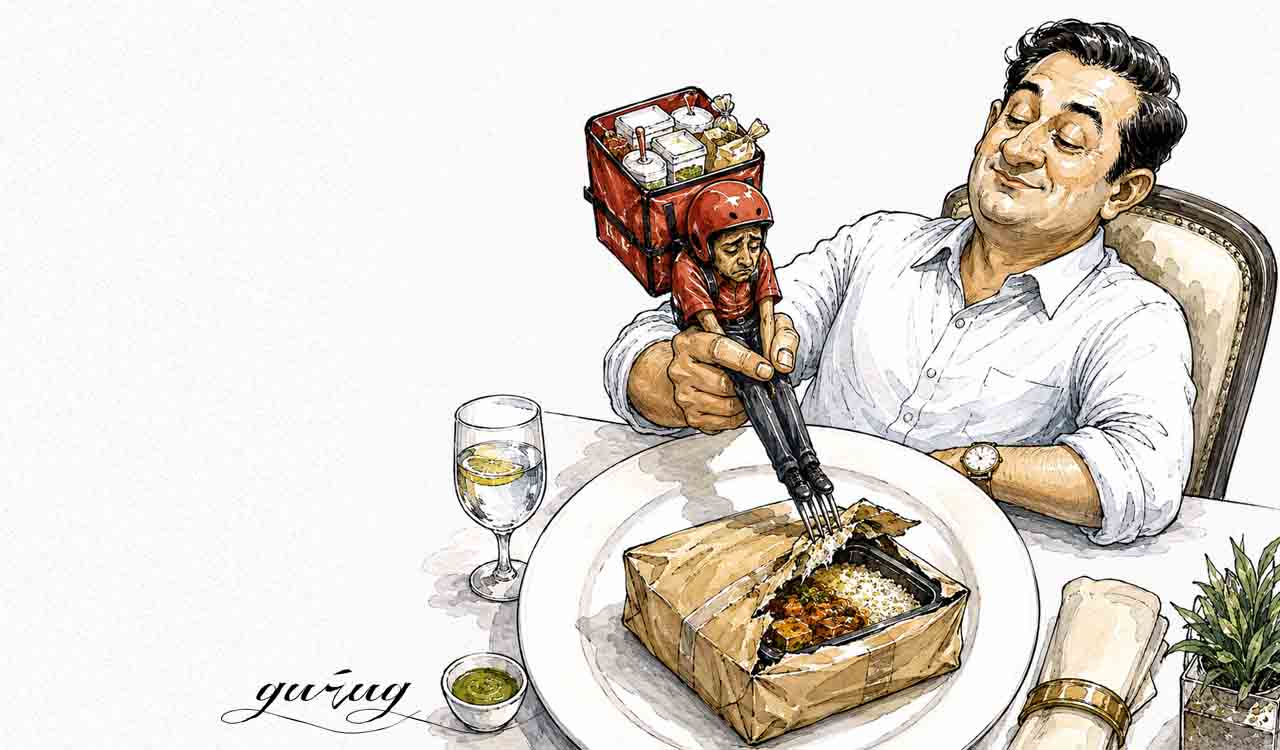
Millions of workers leave their homes every day to work as platform workers without proper, nutritious meals because of how the work is organised. Some skip meals to save time, while others fill up on the same ultra-processed food they spend all day delivering to customers. Skipping lunch to complete one more order is a nutritional deficiency in the making.
Workers and Malnutrition
The same worker can be underweight and micronutrient-deficient one year, and overweight with early signs of hypertension the next. This makes malnutrition a double-edged sword as it inflicts contradictory health consequences. According to the World Health Organisation, malnutrition is broadly defined as deficiencies, excesses, or imbalances in energy and nutrient intake, encompassing overweight and obesity as well as hunger.
The link between gig workers and malnutrition lies in how these platforms pay and organise labour. Delivery and ride-hailing apps largely pay workers per completed trip or order, not by the hour, while offering incentive slabs that reward finishing a set number of tasks within a shift. This structure turns every non-earning minute, including the few it takes to eat a proper meal, into a cost the worker absorbs personally. There are no canteens, no mandated lunch breaks, and no HR policy nudging anyone to stay hydrated; there is only the next order pinging on the screen.
Under that pressure, workers reach for whatever food is the quickest and cheapest—a packet of biscuits, a sugary drink, a plate from a roadside stall—rather than what their bodies need for hours of physical exertion in the heat. The same economics that keep fares low and deliveries fast also keep a rider’s stomach empty or filled with unhealthy food.
No Marginal Problem
This is not a marginal problem, because the workforce living through it is no longer small. According to NITI Aayog, there were 7.7 million gig workers in 2020-21. This number is projected to increase to 23.5 million by 2029-30, and 6.16 crore by 2047 (VV Giri National Labour Institute). Still, India’s labour statistics (the latest being PLFS 2025-26) fail to capture these workers as a distinct category, leaving a growing segment of the workforce statistically invisible even as it becomes economically indispensable.
A workforce that will soon number in the tens of millions cannot be left to meet its nutritional needs on the margins of a punishing work schedule—feeding the people who feed the rest of us should not be this difficult
Since gig and platform workers remain statistically invisible, the clearest evidence of what piece-rate pressure does to the body comes from smaller field studies rather than official surveys. A 2024 survey of gig workers by the non-profit Janpahal found that a large majority worked more than eight hours a day, often stretching across mealtimes with no fixed break. This clearly shows that gig work is no longer merely a ‘gig’ for these workers. Research has also documented high levels of anxiety, depression and burnout among food delivery workers due to long working hours.
A separate survey of over 5,000 gig workers found that 99% of the respondents cited health or mental health concerns linked to the job. A proper meal is the first casualty when pay depends on beating an app’s countdown clock. Water comes next, as bathroom breaks cost valuable minutes that the algorithm rarely forgives.
Extreme weather, particularly heat and rain, makes it even worse. A 2024 survey by the Telangana Gig and Platform Workers Union and Heat Watch found that 52% of workers had experienced heat exhaustion and 30% had shown symptoms of heatstroke during a single summer, with women reporting worsening menstrual health and infections linked to dehydration and the lack of clean toilets along their routes.
The very industry that has normalised instant, on-demand, calorie-dense food for India’s urban middle class runs on workers who themselves eat poorly, and often not at all, to deliver it. Public health researchers have already begun flagging the broader link between the explosive growth of food-delivery apps and rising obesity, diabetes, hypertension and other health concerns among customers.
The workers who make that convenience possible face the same risks, compounded by irregular incomes, exhausting hours and no employer to notice, let alone intervene. These risks cannot be offset by the nature of the job itself. Workers often do not earn enough to meet their household needs, have no minimum wage or meal breaks, are controlled by algorithms, are driven by incentive structures, and work overtime without any grievance redressal.
Policy on Paper
Policy has begun to catch up, but it has yet to address the root of the problem. Although the Code on Social Security, 2025, came into force in November 2025, it has not yet become operational because no central scheme has been notified for them. States such as Karnataka, Rajasthan, and Telangana have moved faster but are not receiving support from platform companies, as seen in the case of Karnataka.
The e-Shram portal and extension of Ayushman Bharat for gig workers are welcome initiatives. But none of them addresses the root causes, such as workers’ employment status, algorithmic scheduling, and per-task pay, an incentive-driven structure that makes a rushed, unhealthy meal the rational choice. The welfare boards under this legislation largely remain on paper.
Deliberate attempts are therefore needed to close this gap rather than leaving it to broader labour reforms. Aggregator platforms should be required to build genuine, paid meal breaks into algorithmic scheduling, rather than treating every idle minute as lost efficiency. The welfare boards being rolled out under State gig-worker Acts should incorporate basic nutritional counselling and subsidised, healthy meals.
Further, welfare funding should not be directed solely towards social security measures such as pensions and accident insurance. A portion should also support workers’ daily needs, such as shaded rest points with clean drinking water and toilets at delivery hubs, subsidised meal counters offering an actual balanced plate, and periodic health check-ups that detect anaemia, dehydration and metabolic diseases before they turn into emergencies.
National surveys must also recognise gig and platform work as a distinct category so that policies are backed by evidence, not merely projections. Otherwise, we will continue to fix a crisis which has yet to be measured.
India’s gig economy has been sold to workers and consumers alike as a story of flexibility and opportunity. Less visibly, however, it is also a story of workers paying the price of that flexibility through skipped meals and poor nutrition. A workforce that will soon number in the tens of millions cannot be left to solve its nutritional needs on the margins of a punishing schedule. Feeding the people who feed the rest of us should not be this hard.
(Amit Kumar is Assistant Professor of Economics and Fellow at Centre for Social and Policy Research. Isha Sharma is Assistant Professor of Economics and Fellow at Centre for Studies in Population and Development, Christ University Delhi NCR)

Related News