Opinion: Poverty has no caste—the unspoken story of India’s Brahmins
India’s social-justice debate should be less obsessed with deciding which community is permanently “privileged” and which is permanently “backward”


By Venkat Parthasarathy
There is a question about social justice in India that we seem increasingly reluctant to ask. Can someone be disadvantaged even when he or she belongs to a community that is traditionally seen as “privileged”? Surely, the answer has to be yes.
Also Read
A recent call from a respected seer to acknowledge the economic struggles faced by sections of the Brahmin community has brought an uncomfortable reality into sharper focus. It is a conversation that deserves to be had without either denying historical privilege or ignoring present-day hardship.
When Truth Gets Lost
Yet when the subject is Brahmins, that truth often gets lost somewhere between history, politics and perception. For generations, the Brahmin has occupied a particular place in India’s social imagination: educated, influential and culturally privileged. There are historical reasons for that perception. But history, by itself, tells us very little about what is happening around the dinner table in an individual family today.
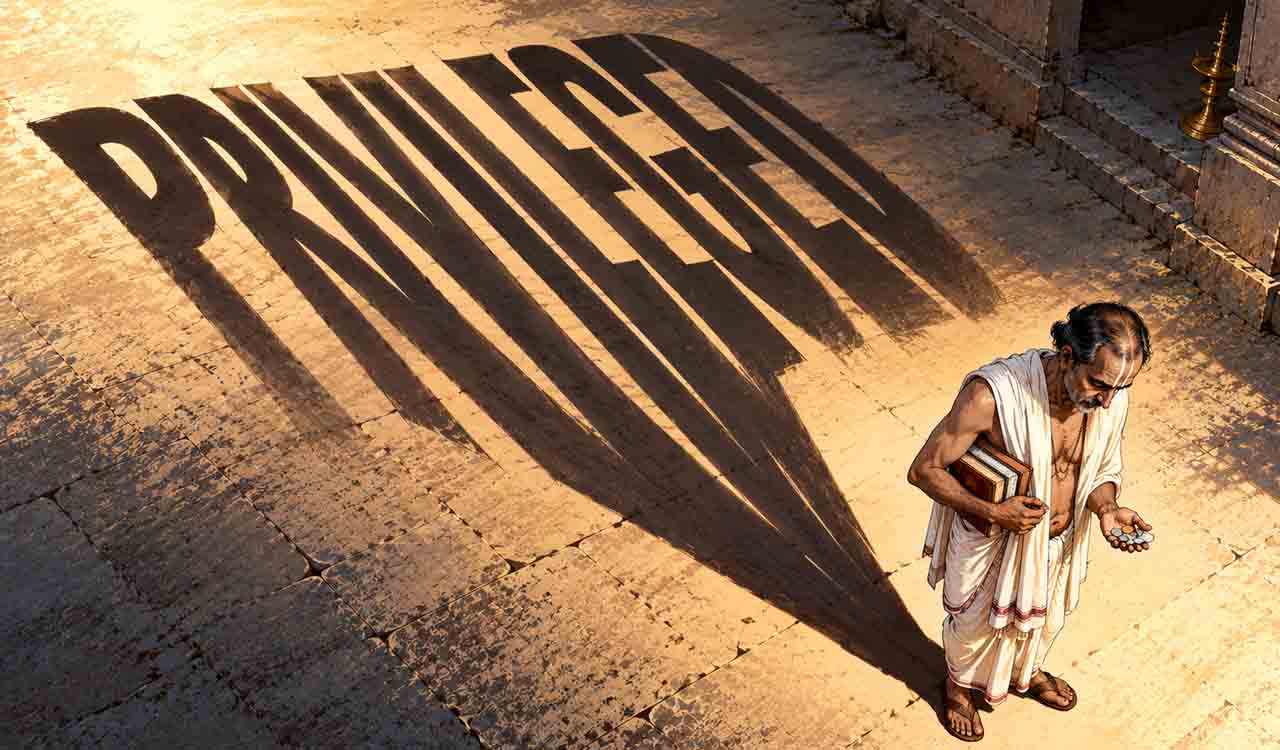
Think about a Brahmin family in a small town where the father performs traditional religious duties for a modest income. Or the student with the ability to become an engineer, doctor, civil servant or researcher, but whose family simply cannot afford to give that ability a chance. What does a surname do for them at the end of the month? Very little.
This is not an argument against affirmative action. Nor is it an argument for forgetting the discrimination and exclusion that other communities have endured for generations. India has legitimate reasons for creating reservations and targeted welfare programmes for communities that have suffered historic disadvantage.
But social justice cannot become a system in which a community’s historical image permanently determines the economic circumstances of every individual born into it. A poor child does not inherit privilege along with a surname. That distinction deserves a much more honest conversation. We recognise caste-based disadvantage, tribal deprivation and minority educational needs. We have also recognised economic disadvantage through the Economically Weaker Sections framework.
Social-justice framework can recognise poverty and lost opportunity among Brahmin families without diminishing the historic struggles of communities that have faced generations of exclusion
The state has a responsibility to ensure that the circumstances of one’s birth do not permanently determine one’s chances in life. That principle should apply consistently. So the case for helping economically vulnerable Brahmins should not be presented as a demand to take something away from another community. It should be about something much simpler: making sure that genuinely disadvantaged citizens do not disappear between the cracks of the welfare system.
Basic Question
There is another part of this conversation that we tend to overlook. Many Brahmin families still depend, wholly or partly, on traditional occupations connected with temples, Sanskrit learning, teaching, scholarship and religious services.
But we rarely stop to ask a basic question: can the people preserving these traditions actually make a dignified living from them? A tradition cannot be preserved indefinitely if the people who carry it forward are themselves struggling to survive. At the same time, government assistance should not become a permanent entitlement simply because someone belongs to a particular community.
The better approach is targeted and transparent. Identify genuine economic and social vulnerability. Give people educational opportunities. Help them find employment or build businesses. Strengthen social security. Support families whose traditional livelihoods have become economically fragile.
The Brahmin community, too, needs to look at this question honestly. The answer cannot be collective victimhood. Nor can it be the claim that every Brahmin is disadvantaged. Many Brahmins are prosperous, professionally successful and comfortably placed in society. They do not need special treatment simply because of their birth. But recognising privilege where it exists should not require us to pretend that hardship does not exist elsewhere within the same community. Perhaps India’s social-justice conversation should be less obsessed with deciding which community is permanently “privileged” and which is permanently “backward”.
Spotting Disadvantage
Perhaps we should spend more time asking where disadvantage actually exists. Can a family afford education? Does a child have access to the same competitive opportunities as others? Does a young person have a realistic path to employment? Can an elderly person live with dignity? Can someone following a traditional occupation earn enough to sustain a family? These are real questions. And a caste certificate, by itself, cannot answer them. India is far too large and far too complicated for such easy assumptions.
The Brahmin community, therefore, should not ask for sympathy. It should ask that an inconvenient reality be recognised: there are economically vulnerable Brahmins, and their difficulties deserve to be seen. The demand should not be, “Give us what others have.” It should be, “Do not make us invisible.” A mature democracy should be able to do two things at the same time: address historical injustice and respond to present-day deprivation.
We can protect the rights of communities that have endured centuries of exclusion while also ensuring that a poor family from a traditionally forward community is not denied opportunity simply because society assumes that it must be doing well.
Social justice should never become a competition over who has suffered more. It should be about making sure fewer Indians suffer unnecessarily. That, ultimately, is the case for supporting disadvantaged Brahmin families. Not privilege. Not resentment. And certainly not exclusion. Just a simple proposition: poverty has no caste, aspiration has no caste, and the right to live with dignity should have no caste either.
(The author is a writer-blogger and a communications professional)

Related News
-

Opinion: Excess liquidity in Indian banks—who gains and who loses?
-
Opinion: Telangana’s drought not caused by El Niño, but by the government
-
Opinion: 2026 Economics Nobel — why policymakers must prepare for the unpredictable
-
Opinion: The deepening distance of water beneath the earth—Telangana’s vanishing groundwater