Opinion: Rethink India’s Health Universities
India’s health universities must move beyond professional education to foster interdisciplinary research and innovation


By Dr Kattamreddy Ananth Rupesh
India’s experiment with dedicated health universities began with a clear administrative purpose: to bring a fragmented professional health education under a common academic framework. The combined State of Andhra Pradesh pioneered the model in 1986, and several States adopted it. Nearly four decades later, the time has come to ask whether they should remain largely focused on affiliation and examinations, or evolve into centres of interdisciplinary education, research and innovation.
When Andhra Pradesh established India’s first University of Health Sciences, it was responding to a problem of its time. The original health-university model brought professional colleges under a common authority, prescribed curricula, conducted examinations and awarded degrees. In doing so, it provided a degree of standardisation that was difficult to achieve when medical colleges were scattered across multiple universities. But a university is more than an examining and affiliating authority.
Beyond Administration
The 1987 Bajaj Committee report on health manpower and education envisaged Health Sciences Universities as multidisciplinary institutions and identified areas such as health management, health economics, social and behavioural sciences, educational technology and health information systems as integral to health education.
The conception was, therefore, not simply that of a central office administering professional examinations; it included a wider intellectual and research ecosystem. Nevertheless, much of the institutional evolution of health universities remained concentrated on affiliation, curriculum, examinations and degrees.
Global Scenario
International examples demonstrate that a specialised health university need not be defined by administration alone. Sweden-based Karolinska Institutet, for instance, is a specialised medical university organised around research departments and research environments spanning fields such as epidemiology, biostatistics, global public health, neuroscience, molecular medicine and environmental health.
US-based Harvard represents a different model. Health sciences are distributed across medicine, public health, dentistry, engineering, research institutes and affiliated hospitals within a broader university ecosystem. The institutional boundaries exist, but so do mechanisms for crossing them. The lesson is not that India should imitate Harvard or Karolinska. It is that a university should be an engine for knowledge creation and interaction, not merely an umbrella for professional colleges.
The real problem is working in a silo. A medical student generally learns with medical students. Nursing students train within nursing structures; pharmacy students within pharmacy; engineers and computer scientists within their own institutions. The separation is administratively convenient but intellectually limiting. Many of the most difficult challenges in healthcare can be solved only when these disciplines meet.
Health universities must become spaces where medicine, science, technology and the social sciences converge to address complex health challenges
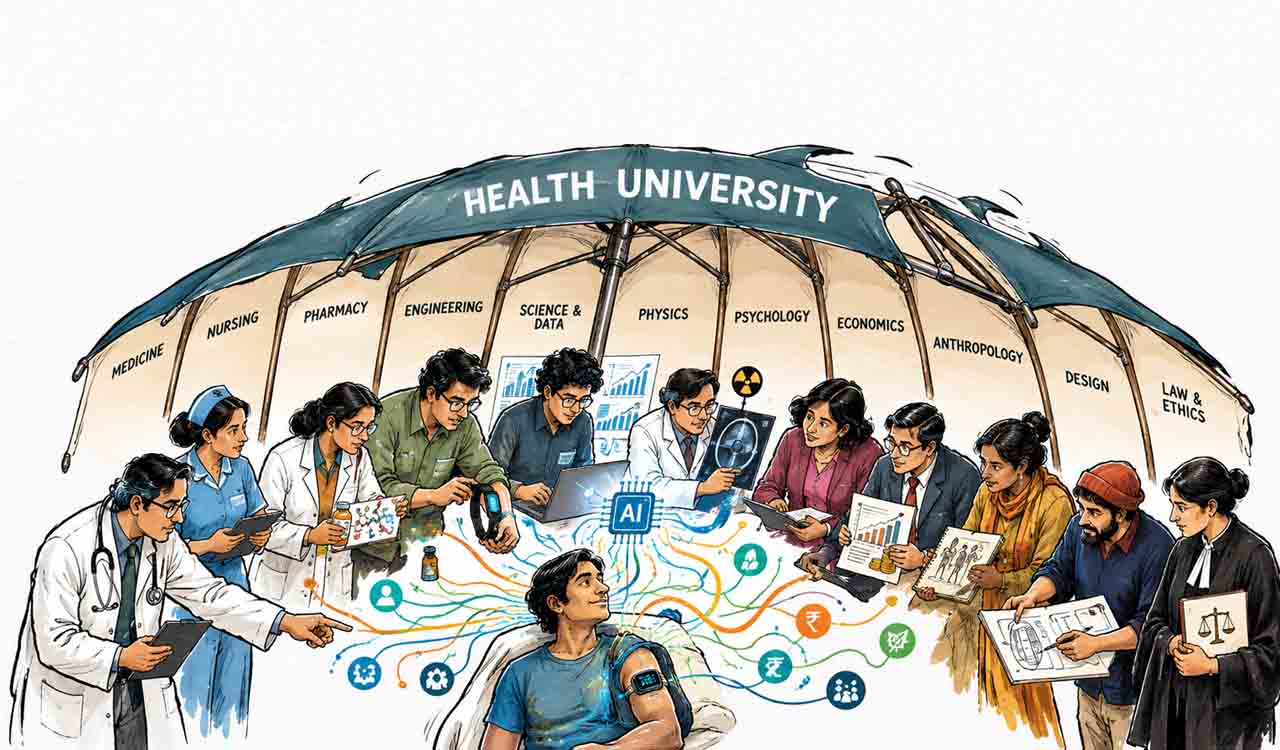
Consider a wearable device intended to monitor patients at home. Its success is not merely a medical question. Engineers must develop the device; data scientists must process the information; clinicians must determine its clinical relevance; psychologists must understand user behaviour; anthropologists may examine cultural acceptance; economists must consider affordability; designers must make it usable; and lawyers and ethicists must address privacy, consent and responsibility.
An Indian health university in its present form fails to integrate these disciplines. This becomes particularly urgent in the age of artificial intelligence. AI is rapidly becoming capable of assisting with literature retrieval, summarisation, coding, statistical analysis, image interpretation, pattern recognition and other tasks that once consumed substantial amounts of researchers’ time. The higher-value human contribution will increasingly lie in asking important questions, designing meaningful studies, interpreting evidence in context and connecting knowledge across domains. In such an environment, intellectual isolation becomes more costly.
The university of the future should be a place where a physician can work routinely with an engineer, a biologist with a data scientist, a public-health researcher with an economist and a clinician with an anthropologist. Interdisciplinarity should not depend on an unusually motivated individual finding a collaborator in another institution. It should be built into the institution itself.
The Missing Partners
A modern health university should consider a substantial School of Biomedical and Clinical Engineering, with joint academic and research programmes involving physicians, engineers and scientists. Medical devices, prosthetics, rehabilitation engineering, biomechanics, biomedical instrumentation, medical imaging, wearable sensors, physiological monitoring, robotics, assistive technologies and digital health are no longer peripheral to healthcare.
Medical physics deserves similar recognition. Radiotherapy, nuclear medicine, diagnostic imaging, radiation protection and advanced imaging technologies require expertise at the intersection of physics and medicine. These fields should not have to remain institutionally distant from the clinical environments in which their knowledge is applied.
Pharmacy raises a related question. Its separate professional and regulatory history in India is understandable. But academically, pharmaceutical sciences sit at the intersection of pharmacology, therapeutics, toxicology, pharmacovigilance, drug development and public health. The contemporary university should be capable of connecting these domains even where professional regulation remains separate. The same argument extends to nutrition, rehabilitation, environmental health, toxicology, health informatics and data science.
And then there are the humanities and social sciences. Medicine can explain a disease biologically without fully explaining why a community understands it differently, why patients do not follow an apparently rational treatment plan, why an intervention succeeds in one population and fails in another, or how social structures influence health. Medical anthropology, sociology, psychology, economics, ethics and law therefore belong in the intellectual conversation of a health university—not as decorative additions, but because they answer questions that biomedical science alone cannot.
The arts also have a legitimate place, provided their role is understood carefully. Narrative medicine, music and arts-based interventions, design, architecture and the creation of healing environments can contribute to communication, patient experience, rehabilitation and wellbeing. They do not replace evidence-based clinical care; they broaden the institutional understanding of what healthcare entails. The underlying principle is straightforward: being concerned with health does not require seeing every problem exclusively through a medical lens.
Future Health University
The National Board of Examinations in Medical Sciences (NBEMS) was established in 1975. Its mandate evolved around national standards for postgraduate medical examinations and, subsequently, accreditation and assessment of institutions and trainees.
Its significance extends beyond its particular functions. NBEMS demonstrates that standardisation, accreditation and assessment can be separated from the university function. This distinction deserves greater attention. Professional regulators can establish standards. Accreditation bodies can determine whether institutions meet those standards. National examining bodies can assess competence. Universities can concentrate on teaching, research, scholarship and innovation. There is no inherent reason why all four functions must reside in the same institutional structure.
The next generation of health universities should, therefore, be judged by a different set of questions. Do they generate original research? Do they facilitate collaboration across disciplines? Do they produce innovations that reach patients and communities? Do they train students to work with professionals outside their own discipline? Do they create shared laboratories, data infrastructure and research platforms? Do they contribute to public policy and societal wellbeing?
Universities would need common interdisciplinary courses, joint research grants, shared laboratories, interdisciplinary doctoral programmes, cross-faculty electives and innovation centres where clinicians and non-clinical specialists work on real healthcare problems together.
India’s health universities now have an opportunity to evolve from administrative umbrellas into genuine universities of health—institutions where medicine meets engineering, science meets the social sciences, technology meets ethics, and clinical experience meets the wider understanding of human life. The challenge is no longer to bring colleges together. It is to bring knowledge together.
(The author is Associate Professor of Forensic Medicine and Toxicology, Siddhartha Medical College, Vijayawada)

Related News