Opinion: Smart anganwadis, smarter kids
By Dr Sonal Mobar Roy Early childhood development is a prerequisite for an individual’s growth and development that would ultimately also reflect on the country’s human resource. Hence, the government has been focusing on planned interventions in this direction. The Integrated Child Development Scheme is one such programme that started in 1975. It provides food, […]


By Dr Sonal Mobar Roy
Early childhood development is a prerequisite for an individual’s growth and development that would ultimately also reflect on the country’s human resource. Hence, the government has been focusing on planned interventions in this direction. The Integrated Child Development Scheme is one such programme that started in 1975. It provides food, primary healthcare, pre-school education, health check-up, and immunisation and referral services for children under the age of six.
In continuation of such interventions, Poshan Abhiyaan was launched with great fanfare by the government on March 8, 2018, in Jhunjhunu, a city in Rajasthan, by the Prime Minister. The programme aims at reducing stunting, under-nutrition and anaemia in women and adolescents. It focuses on the health of a child for the first thousand days specifically. The key place for implementation of the programme is an anganwadi centre. It is seen that its effective implementation rests heavily on the efforts put in by anganwadi workers (AWWS), Accredited Social Health Activists (ASHA) and Auxiliary Nurse Midwife (ANMs). As per the Ministry of Women and Child Development (2018), the country has 13.63 lakh anganwadi centres (AWCs).
As per the World Bank (2013), approximately 60 million children in India were underweight, about 45% were stunted (too short for their age), 20% were wasted (too thin for their height, indicating acute malnutrition), 75% were anaemic, and 57% were Vitamin A deficient. The majority of them belong to the most vulnerable sections of society living in rural areas. To cater to this section, AWCs were created.
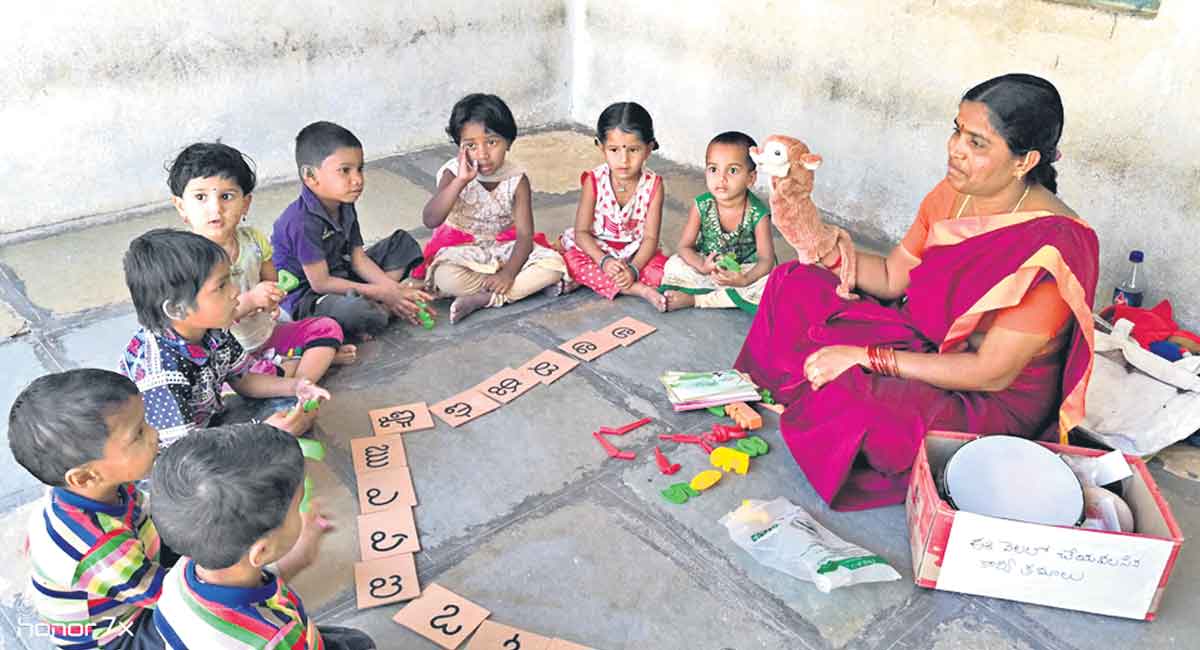
An AWW, along with a helper, is posted to provide immunisation, counselling, antenatal and postnatal care, non-formal pre-school education and a plethora of other services such as conducting health surveys, making home visits and assisting ANM.
Below Standards
However, it has been seen that the AWCs have not been able to perform as per the standards set for them. A study conducted by the researcher at a thanda (tribal hamlet) in 2021 revealed that unless AWCs do not have their own building, they cannot function properly. Scarcity of space leads to crunching all material in a small dingy room — be it ration, furniture or equipment to measure the height and weight of the beneficiaries. AWCs that had their own building tend to space out according to their requirement. It was also observed that the AWCs, especially the ones in tribal hamlets, lacked proper teaching and learning material, had no LPG cylinder, no drinking water facility, mats or furniture, and were in deplorable conditions.
Hence, the need was felt to establish ‘Smart’ Anganwadi. The aim of bringing in the ‘smart’ indicator was to improve the functioning and management of the AWC by way of digitising the monitoring mechanisms.
Technology has already paved its way in AWCs. AWWs have been provided with smartphones and the supervisors with tablets for recording the data accurately and digitally. As per a 2021 report, Kerala has sanctioned Rs 9 crore for the conversion of conventional anganwadi into ‘Smart’ anganwadis with better opportunities. The aim is to upgrade the AWC into a more child-friendly centre.
Nandghars
In many places, AWCs have been developed under CSR activities. The idea is to implement contextually appropriate innovative approaches for the holistic improvement of the early childhood education. When we say holistic, it indicates towards physical, social, emotional, cognitive and linguistic development of the child. Nandghars come under this category. Through Nandghars, televisions are used for e-learning, healthcare is catered to with a doctor at the doorstep, hygienic pre-cooked food for nutrition is provided and attempts are made to economically empower women through customised skill training across India. Started in Varanasi in 2015, now the reach is across India with more than 2,300 Nandghars in Chhattisgarh, Jharkhand, Karnataka, Madhya Pradesh, Odisha, Rajasthan, Uttar Pradesh, Himachal Pradesh, Punjab, Assam and Gujarat. The centres provide creative wall paintings, building and learning aid (BaLA), multimedia content to be shown on TV and so on.
Engaging Students
It cannot be denied that colourful animations, audio and video content, etc are engaging for students. They create a vibrant impact on the impressionable minds of the younger ones. Despite the attraction these digital interventions bring forth, the children’s psychomotor development gets affected. The practice of holding objects with nimble fingers is reduced. Social bonding gets affected as the time is consumed in looking at the screen. This binds children to sit at one place thus reducing physical activity unless they are asked to imitate and act as the character shown on the screen.
Another approach for engaging kids can be ‘gamifying’ — a process wherein small tasks are turned into games and lead to more fun participation. Children these days learn to navigate smart devices even before they can read and write. This also leads to a sort of addiction though it cannot be denied that their verbal ability increases if the instructor asks them to repeat the poems and stories shown on the screen. One also needs to distinguish between educational content and entertainment content. Now, kids are less curious, less inventive and less imaginative. The pedagogy even for the early years should be to help them think critically, frame questions, identify problems and come up with experiments and solutions.
It is a trade-off. Kids can become smarter if there is quality time interacting with staff at AWCs. Their queries are responded to and their doubts are cleared with patience. A balanced approach is indeed needed. The environment created should lead to stimulating experiences. Digital advancement is a good thing but the basic requirement should not be overlooked.
In 2015, the NITI Aayog recommended providing better sanitation and drinking water facilities, improved power supply and basic medicines for AWCs. There is a pressing need for transforming AWCs into better ecosystems. Before making a ‘smart’ Aanganwadi, there is a need to upgrade the existing AWCs with better facilities such as proper roofs, electrical connections, drinking water facility, toilets with running water, mats and furniture, and teaching and learning material. It is time the quality of services was up-scaled. The potential of technology and innovation needs to be harnessed. This would also lead to achieving the SDGs especially 2, 3 and 4 and others in a more realistic manner. Intensive efforts are required to improve the service delivery in collaboration with all the stakeholders.

(The author Assistant Professor, Centre for Post Graduate Studies & Distance Education, National Institute of Rural Development and PR, Hyderabad)
Now you can get handpicked stories from Telangana Today on Telegram everyday. Click the link to subscribe.
Click to follow Telangana Today Facebook page and Twitter .

Related News
-

India can become global leader in affordable caregiving: NITI Aayog
-
Telangana students trail national average in key learning competencies: NITI Aayog
-
E20 fuel rollout based on scientific validation, field trials and industry consultations: Government
-
Telangana Ease of Doing Business ranking fell under Congress, alleges K Sanjay