Opinion: Telangana’s drought not caused by El Niño, but by the government
Despite IMD warnings and engineers’ advice, the government allowed Godavari water to flow downstream instead of lifting it into drought-hit reservoirs, leaving farmers facing shortages and crop restrictions across the State


By Sridhar Rao Deshpande
During the four months of the 2026 monsoon season, several parts of Telangana experienced rainfall deficits. However, the lower Godavari continued to carry substantial quantities of water. At Medigadda Barrage, the flow ranged from at least 25,000 cusecs to as much as 7 lakh cusecs. The public knows this, and so does the government. While water was flowing through Medigadda, there was hardly any inflow into upstream projects such as Sriram Sagar, Singur, Nizamsagar, Kadam, Yellampally, Mid Manair, and Lower Manair, as well as medium irrigation projects such as Komaram Bheem.
Also Read
Any government department, including Agriculture, Irrigation, Mission Bhageeratha and HMWSSB, hoping for good rainfall and adequate runoff into reservoirs, should first have examined the rainfall situation and the forecasts issued by the India Meteorological Department (IMD). As early as July, the IMD warned that 20 of Telangana’s 33 districts could face severe rainfall shortages. It also warned that similar conditions could continue in August and September.
Between 1,500 and 3,000 TMC of Godavari water flows unused into the sea every year. Much of this water becomes available in the lower Godavari sub-basin after the Pranahita, Indravati and Sabari rivers join the Godavari
Given these warnings, why did the government fail to anticipate that reservoirs and tanks were unlikely to receive their normal inflows? By the end of the rainy season, Telangana had received 23 per cent less rainfall than normal. Against the normal rainfall of 795.7 mm, the State received only 615.8 mm. Andhra Pradesh recorded an even greater shortfall of 29 per cent.
What, then, should we call the government’s decision to ignore the IMD forecasts and allow the water available in the lower Godavari to flow downstream?
The government allowed water to flow into Andhra Pradesh
Opposition parties, farmers and engineers repeatedly urged the government to lift water from the Godavari at the Kannepalli Pump House intake point. However, the government remained adamant, citing the advice of the National Dam Safety Authority (NDSA), and allowed the water to flow downstream unutilised. According to Central Water Commission records, about 750 TMC of water flowed down from the Medigadda Barrage into Andhra Pradesh during this season.
The Andhra Pradesh government supplied at least 200 TMC of this water to irrigate crops in the command areas of Godavari and Krishna deltas. Even during this drought, Andhra Pradesh was able to protect crops across 25 lakh acres by effectively utilising the water released downstream by Telangana.
In contrast, Telangana announced a “crop holiday” in the command areas of major projects such as Sriram Sagar, Nizamsagar and Kaleshwaram, even though substantial quantities of water were available in the lower Godavari. The government could not even fill around 10,000 tanks and check dams falling within the command areas of these projects. Andhra Pradesh did not announce a crop holiday in the command areas of any of its major projects.
Govt targeted engineers who advised lifting the water
A group of retired Telangana engineers suggested a viable way to lift the water safely from the Kannepalli Pump House to Yellampalli reservoir utilising the lift system of Link-1 of the Kaleshwaram Project.
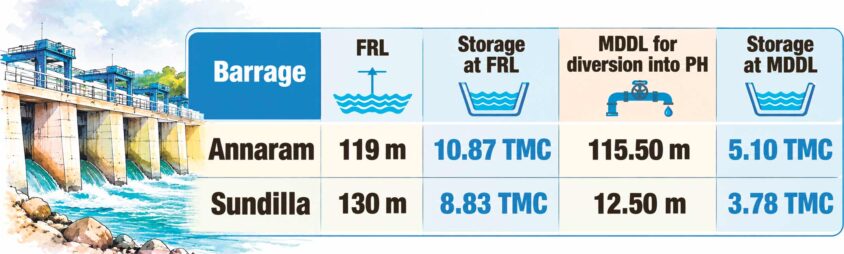
At a river level of 93.50 m, Godavari water could be diverted into the forebay of the Kannepalli Pump House without closing the gates of Medigadda Barrage. Annaram and Sundilla barrages could be filled only up to their respective minimum drawdown levels (MDDL), after which the water could be lifted to Yellampally reservoir. The MDDL and storage capacities of Annaram and Sundilla barrages are given in table below. The engineers proposed storing only 8.88 TMC in the two barrages, against their combined storage capacity of 19.70 TMC.
Instead of examining the proposal, the government reportedly abused the engineers. It called them a “paid group”, described their advice as foolish and even made abusive remarks about giving them a “belt treatment”. The Telangana Retired Engineers had around 30 years of experience working on various irrigation projects. They had also worked hard to develop Telangana’s water resources during the combined State of AP and after the formation of Telangana.
They had prepared plans for projects such as Pranahita-Chevella, Palamuru-Rangareddy, Dindi and Kantanapalli Lift Irrigation Schemes during the united AP era. They organised public meetings and technical seminars across the State to build support for these projects.
If the government had an alternative plan to deal with the drought, it should have explained it to the public. Instead, it remained silent and simply hoped that nature would bring enough rain. The impact of a “super El Niño”, however, dashed those hopes.
Govt ignored the advice to take a calculated risk and lift the water
Most people in the State, apart from the government, believed that water could be lifted into the Annaram and Sundilla reservoirs without putting them at risk. The public did not believe the government’s arguments and apprehensions. Prof PG Sastry, former Director of NIT Warangal and former Director General of WALAMTARI, Himayatsagar, and a respected teacher of engineers, also advised the government to take a calculated risk and lift the water, considering the prevailing drought conditions.
He offered simple examples: We do not stop flying because aircraft accidents are possible, nor do we stop travelling by car because road accidents can occur. The same approach, he argued, could be applied in this case. If the government’s apprehensions began to materialise, the pumps could immediately be switched off and barrages returned to free-flow conditions. In that event, nobody would be able to insist that the government continue lifting the water.
Even after the technical report, the govt did not act wisely
In August, the Central Water and Power Research Station (CWPRS), a premier institution in Pune, submitted a report on the strength of piers and other structural components of the Kaleshwaram barrages. The report unequivocally certified that the government’s concerns about the vulnerability of the barrages were not justified. Based on the results of various standard concrete tests, it was confirmed that the piers in all blocks, except Block 7 of the Medigadda Barrage, where some piers had subsided, were structurally sound. The report rated the quality of the piers at Annaram and Sundilla barrages as “excellent”.
The National Dam Safety Authority (NDSA) also informed the High Court in writing, in response to a Public Interest Litigation filed by senior High Court Advocate Sharath, that the decision on whether to lift water from the Kannepalli Pump House to Yellampalli using the lift system of Link-1 of Kaleshwaram Project rested with the State government. The NDSA stated that the government could take a decision based on the situation after consulting engineering experts, including the Oversight Committee constituted by the authority for the Kaleshwaram barrages.
After receiving these findings, the government should at least have acted wisely during August and September. It could have switched on the Kannepalli pumps and lifted water through Annaram and Sundilla to Yellampalli.
From there, the water could have been supplied to reservoirs further upstream, including Mid Manair, Lower Manair, Annapurna, Ranganayaka Sagar, Mallanna Sagar, Konda Pochamma Sagar, Nizamsagar and Sriram Sagar, as well as used to fill around 10,000 tanks and check dams. This could have prevented the present shortage of irrigation and drinking water in the State. Instead, the government missed this opportunity provided by nature and is now attributing the drought to El Niño. The government is now telling people that it cannot supply water or electricity, and is urging farmers not to cultivate rabi /winter crops.
This drought is not caused by El Niño alone. The government made the situation worse by refusing to lift the available water and people are suffering because of that unwise decision.
There is water in the lower Godavari in every season
Even during the current El Niño period, water continued to flow in the lower Godavari. It is often said that between 1,500 and 3,000 TMC of Godavari water flows unused into the sea every year. The important point is that much of this water becomes available after the Pranahita, Indravati and Sabari rivers join the Godavari in the lower Godavari sub-basin.
In other words, a substantial portion of the large inflows in the lower Godavari comes from the Penganga, Wainganga, Pranahita, Indravati and Sabari sub-basins. According to 40 years of CWC river-gauge records, substantial inflows are available after the Pranahita joins the Godavari near Kaleshwaram. These records show an average annual inflow of 1,651 TMC. The average monthly inflows are:
- June: 50.90 TMC
- July: 299.90 TMC
- August: 607.10 TMC
- September: 423.80 TMC
- October: 176.20 TMC
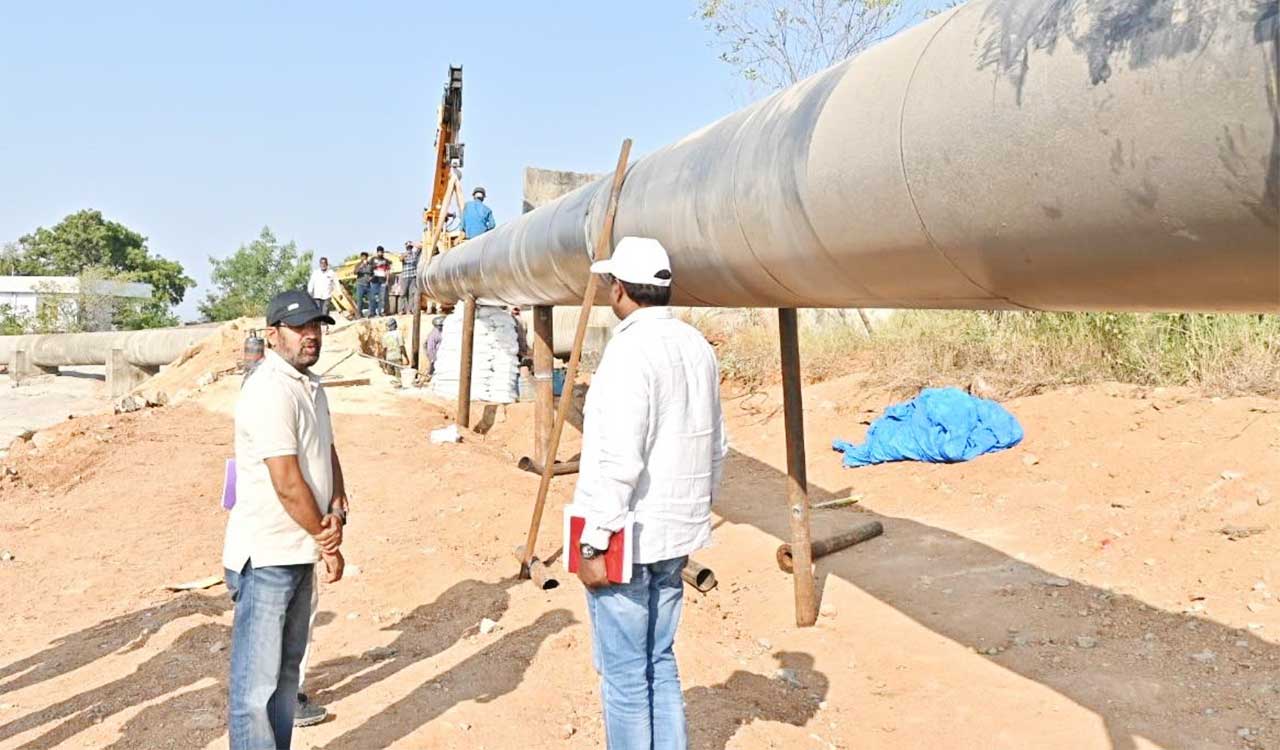
Lean flows of around 15,000 to 20,000 cusecs also continue from October to February. Until repairs to Medigadda Barrage are completed, a temporary ring bund could be constructed about 50 metres downstream of the Kannepalli intake. This could help raise the water level and facilitate the lifting of these lean flows.
These river-inflow patterns were studied before the Medigadda, Annaram and Sundilla barrages were proposed as part of the re-engineering of the project. The Link-1 lift system, constructed as part of the Kaleshwaram Project, was intended to provide an engineering solution to droughts such as the one the State is facing this year.
What should the govt do now
Taking the prevailing El Niño conditions and IMD forecasts into account, the government still has an opportunity to lift the 15,000 to 20,000 cusecs of water expected to be available in the lower Godavari until February.
In 2024, project engineers had suggested building a ring bund about 100 metres long downstream of the Kannepalli intake. If built to a level of 96 or 97 metres, it could raise the water level above the 93.5-metre level required at the Kannepalli intake and divert water into the pump house forebay.
The engineers estimated that a rubber dam for this purpose would cost about Rs 8 crore. For reasons known to the government, the proposal was kept in cold storage. If constructing the ring bund would take too long, the government could place sandbags to create a temporary barrier, raise the water level and lift the water. This would certainly provide some relief to the people.
Such steps could also prevent people from singing the song written by the late poet and singer Sadasivudu, which was widely sung during the Telangana statehood movement: Talaapuna paarutundi Godaari- Mana Chenu Mana Cheluka Edaari. (The Godavari flows right beside us, but our fields have become deserts)
(The author is Superintending Engineer [Retd], I&CAD Department)

Related News