Rewind: When the 2015–16 El Niño struck Telangana—the drought lesson Revanth needs today
When Telangana faced the 2015–16 El Niño drought, the KCR-led government focused on mobilising resources, protecting livelihoods and reassuring people. Today, the real test for Congress is whether it can deliver solutions to the State’s current challenges instead of repeatedly blaming its predecessor


By Pendyala Mangala Devi
A government’s leadership is tested not when the rains are plentiful and circumstances are favourable, but when people face hardship and uncertainty. In such moments, citizens expect decisive action, visible leadership and the assurance that their government is working to protect them.
Also Read
Yet the Congress government in Telangana increasingly appears to have made blaming K Chandrashekhar Rao (KCR) a political strategy in itself. Every problem becomes an occasion to revisit the previous government’s record, while the more pressing question — what is the government doing about the problem today? — often takes a back seat. Criticising a predecessor is easy; governing a State is not.
Telangana’s experience during the severe 2015–16 El Niño drought offers a useful benchmark for examining how a government responds when rainfall fails, groundwater declines, crops suffer and drinking-water supplies come under pressure. The KCR-led government faced a serious crisis through a combination of emergency water arrangements, financial assistance, agricultural support and longer-term infrastructure initiatives.
Severe Water Stress
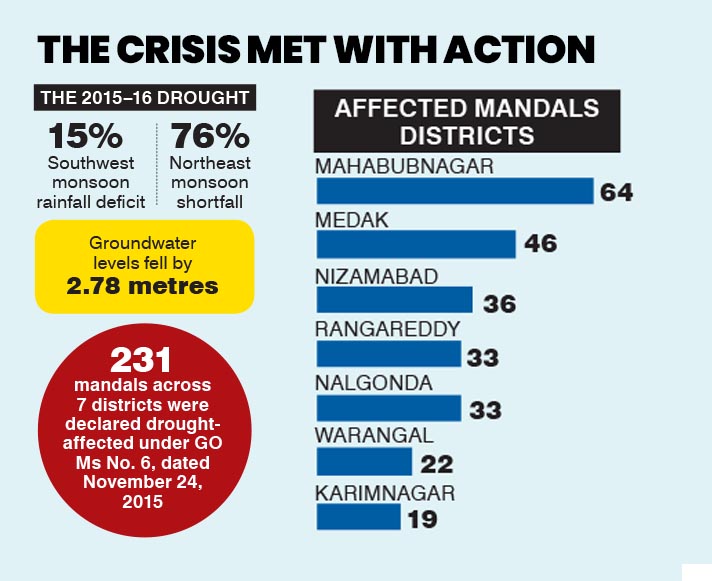
The 2015 southwest monsoon recorded a rainfall deficit of 15%, while the northeast monsoon suffered a shortfall of 76%. Groundwater levels fell by 2.78 metres, placing additional pressure on drinking-water supplies and agriculture. Through GO Ms No 6, Revenue (Disaster Management) Department, dated November 24, 2015, the government declared 231 mandals across seven districts drought-affected: Mahabubnagar: 64 mandals, Medak: 46, Nizamabad: 36, Ranga Reddy: 33, Nalgonda: 33, Warangal: 22 and Karimnagar: 19.
These figures establish the scale of the emergency. The State faced simultaneous pressure on drinking water, agricultural production and rural livelihoods. The administration had to respond quickly rather than wait for the drought to ease. The then KCR-led government responded effectively, instilling confidence among the people.
Taking Water to People
One of the most immediate challenges was ensuring that people did not go without drinking water. Where existing sources were inadequate, emergency measures were needed to bridge the gap.
Under GO Ms No 2, Revenue (DM-II) Department, dated June 15, 2015, Rs 55 crore was provided as revolving funds to district Collectors to meet urgent drought-related requirements. An additional contingency allocation exceeding Rs 100 crore was made through PR-RWS and Urban Local Bodies (ULBs).
District administrations were authorised to arrange private borewells on hire, deploy water tankers, repair pumps, deepen tubewells, and lay HDPE pipelines to supply drinking water to people in affected areas. Hiring private borewells was an important emergency option where public sources could not meet local demand: it allowed administrations to draw on available water sources while longer-term arrangements were pursued.
These measures were necessarily local and practical. A village facing an immediate shortage could not wait for a major irrigation project to be completed. It needed water from the nearest viable source, transport where necessary, functioning pumps and officials empowered to act.
The response also illustrates the importance of decentralised administration. District Collectors and local bodies had to identify shortages, mobilise available resources and arrange supplies according to local needs.
Emergency borewells and tankers were not permanent answers to drought. They were measures to prevent an immediate crisis from becoming a humanitarian disaster. Effective governance requires both: relief that reaches people today and infrastructure that reduces their vulnerability tomorrow.
Securing Hyderabad, Districts
Hyderabad’s drinking-water security was a major concern during the drought. The city’s dependence on water sources outside its immediate boundaries made reliable supplies especially important.
The Godavari Drinking Water Supply Project, drawing water from the Sripada Yellampalli Barrage, formed a significant part of the response. KCR inaugurated the project at Ghanpur and Shamirpet on November 24 and25, 2015. Its operating stages were reported to provide approximately 86–172 million gallons per day (MGD).
Emergency arrangements were also made to draw water from Nagarjuna Sagar and Akkampally to meet the city’s requirements. District-level measures were adapted to local water resources.
Credit, Crops and Electricity
The drought’s effects on agriculture were severe. The government pursued several measures to ease the pressure on farmers. Under GO Ms No 69, Agriculture and Cooperation (Agri II) Department, dated August 13, 2014, the second instalment of the farm-loan waiver involved approximately Rs 2,019 crore.
The government also sought to maintain nine hours of free three-phase electricity for agricultural connections and promoted subsidised short-duration crops, including pulses, bajra, castor and sunflower, as alternatives suited to difficult conditions.
Employment support complemented these measures. On September 14, 2015, the Ministry of Rural Development announced an increase in the Mahatma Gandhi National Rural Employment Guarantee Scheme entitlement from 100 to 150 days per rural household in designated drought-affected areas.
No single intervention could erase the consequences of a failed monsoon. However, credit relief, agricultural power, alternative crop options and supplementary employment addressed different dimensions of rural distress.
Protecting Livestock, Rural Livelihoods
Drought also threatens livestock through shortages of fodder and water. For rural households, cattle, sheep and other animals are productive assets, sources of income and a form of financial security.
The relief measures included cattle feed at a 50% subsidy, with an initial allocation of 50 tonnes per drought-affected mandal. More than 490 tonnes of silage bales were supplied, alongside fodder seeds and the promotion of neeti thotlu (water troughs) for livestock. Veterinary interventions included vaccination against enterotoxaemia, sheep pox and foot-and-mouth disease (FMD), while livestock markets were monitored.
From Emergency Relief to Long-Term Water Security
Immediate relief can manage a crisis, but recurring water scarcity requires structural solutions. The drought reinforced the need to restore local water bodies, improve storage and strengthen drinking-water infrastructure.
Through GO Ms No 44, Irrigation and CAD Department, dated March 13, 2015, the government advanced Mission Kakatiya. Its first phase covered 9,306 tanks, with the objective of restoring traditional water bodies and improving their storage and irrigation potential.
Mission Bhagiratha, launched by KCR at Medak on August 7, 2016, represented another major initiative towards household drinking-water security. It envisaged a pipeline network of approximately 1.3 lakh kilometres to provide treated drinking water across the State.
At the inter-State level, Telangana and Maharashtra entered into an agreement on irrigation projects on March 8, 2016. Subsequent redesign placed the proposed Kaleshwaram Lift Irrigation Project’s intake at Medigadda, downstream of the confluence of the Pranahita and Godavari rivers.
These initiatives, their implementation and their outcomes must be assessed on the evidence. No infrastructure project should be exempt from technical, financial or performance scrutiny. But equally, long-term water security cannot be built through emergency tankers alone. It requires planning, investment, coordination and sustained execution.
KCR faced the crisis; Congress must stop evading its own
The defining difference in a crisis is not whether a government faces criticism. Every administration does. It is whether the leadership confronts the situation, mobilises the machinery of government and gives people confidence that their problems are being addressed.
During the 2015–16 drought, the KCR-led government responded with emergency funds, he could successfully secure Rs 791.21 crore in assistance from the National Disaster Response Fund (NDRF), hired private borewells, tanker supplies, local water arrangements, agricultural assistance, livestock relief and longer-term water initiatives.
For people struggling to find irrigation and drinking water, reassurance matters when it is backed by action. Leadership means showing people that the administration is responding, resources are being mobilised and solutions are being pursued. It means confronting the crisis rather than allowing uncertainty to become despair.
That is the standard against which the Congress government should now be measured. The Congress inherited a State with excellent infrastructure for water and electricity. Its responsibility is to deliver better outcomes. It cannot govern by remaining permanently in campaign mode against its predecessor.
KCR faced a crisis and sought to give people confidence through emergency action and longer-term measures. The Congress must now demonstrate that same sense of responsibility, not by repeating its accusations, but by solving the problems people face today.
Blaming KCR will not fill a dry borewell, bring water to a village, irrigate a farmer’s field or protect a rural family’s livelihood. People do not need an endless political argument about yesterday; they need a government that works for them today. Telangana’s people deserve solutions, not excuses, blame games or another accusation that the previous government is responsible for the State’s problems.

Related News
-

BRS hits back at Congress, targets Revanth, Uttam over power, water crisis claims
-
Telangana Drought: Congress Blames KCR, But Where Are The Solutions?
-
Manjeera pipeline leak near Sadasivapet disrupts water supply to 4 mandals
-
KTR commends youngster for transforming government primary school into plastic-free campus