Opinion: Union Budget 2026-27 — high hopes, lean support for agriculture
Modest allocations and limited structural reforms raise concerns over income volatility, climate stress, and long-term agricultural resilience


By Dr Kedar Vishnu
Around 59 per cent of rural employment and about 40 per cent of Gross Value Added (GVA) are directly attributable to agriculture. As noted by economist Mahendra Dev, the sector plays a crucial role in realising the vision of a ‘Viksit Bharat.’ The agriculture and allied sector has experienced moderate but fluctuating growth over the past four years. Looking ahead, agricultural growth is projected to slow to 3.1 per cent in FY26, down from 4.5 per cent in FY25, underscoring the need for targeted policy support and investment in the Union Budget 2026–27 to stabilise productivity and safeguard rural incomes.
Also Read
Modest Attention
Despite agriculture being the backbone of India’s economy, the sector continues to receive modest attention in Union Budgets. Over the past three years, allocations have not increased significantly and have fluctuated without a clear long-term strategy in place. In 2023–24, agriculture was allocated Rs 1.267 lakh crore to strengthen farm incomes and rural infrastructure. This rose to Rs 1.414 lakh crore in 2024–25, with a focus on diversification, allied sectors, and digital initiatives, only to moderate to Rs 1.334 lakh crore in 2025–26, targeting rural demand revival, income enhancement, and flagship schemes such as the Dhan-Dhaanya Krishi Yojana and high-yield seeds.
In contrast, while these allocations offer some support, they fall short of the expectations set by the Union Budget 2026–27, as the relatively small and uneven increases fail to adequately address persistent income volatility, rising input costs, and continuing market uncertainties faced by farmers.
The Union Budget 2026–27 outlines strategies to provide much-needed support to boost farmers’ incomes, revive growth in agriculture and allied activities, and enhance innovation and productivity. Total government expenditure increased by 7.7 per cent between the Union Budget 2025–26 (RE) and 2026–27 (BE), rising from Rs 49.65 lakh crore to Rs 53.47 lakh crore, with capital spending growing by over 11.5 per cent to reinforce infrastructure-led growth. The government allocated Rs 1.63 lakh crore for agriculture and allied activities in UB 2026–27, an increase of 7.12 per cent over the revised estimate of Rs 1.52 lakh crore in UB 2025–26.
Agricultural allocations increased by just 2.01% in the Budget Estimates for 2026–27, indicating limited priority despite rising sectoral challenges
Specifically, the allocation pertains to the Ministry of Agriculture and Farmers’ Welfare, up by 5.37 per cent, from Rs 1.33 lakh crore in 2025–26 (RE) to Rs 1.41 lakh crore in 2026–27 (BE). A comparison of the BE figures for both years shows that the allocation has increased by only 2.01 per cent from Rs 1.37 lakh crore in 2025–26 (BE) to Rs 1.41 lakh crore in 2026- 27 (BE), indicating that Finance Minister Nirmala Sitharaman has not given much priority to allocation.
Important Initiatives
There are three important initiatives the government has taken in UB 2026-27:
- First, giving top priority to promoting commercial crops, including coconut, cashew, cocoa, sandalwood, and horticulture, particularly from the Northeast and hilly areas, which will benefit growers by increasing their income and productivity.
- Second, strengthening the fisheries supply chain and improving market linkages by involving women’s groups and FPOs (Farmer Producer Organisations) to boost the productivity of coastal fisheries and farmers.
- Third, introducing a multilingual artificial intelligence tool called ‘Bharat-VISTAAR,’ allocating Rs 150 crore to increase farmers’ knowledge of agricultural practices.
Overall, the Finance Minister has taken many initiatives in animal husbandry to boost domestic processing and exports of fisheries, and to foster entrepreneurship and generate quality employment in rural and peri-urban areas.
Shift in Strategy
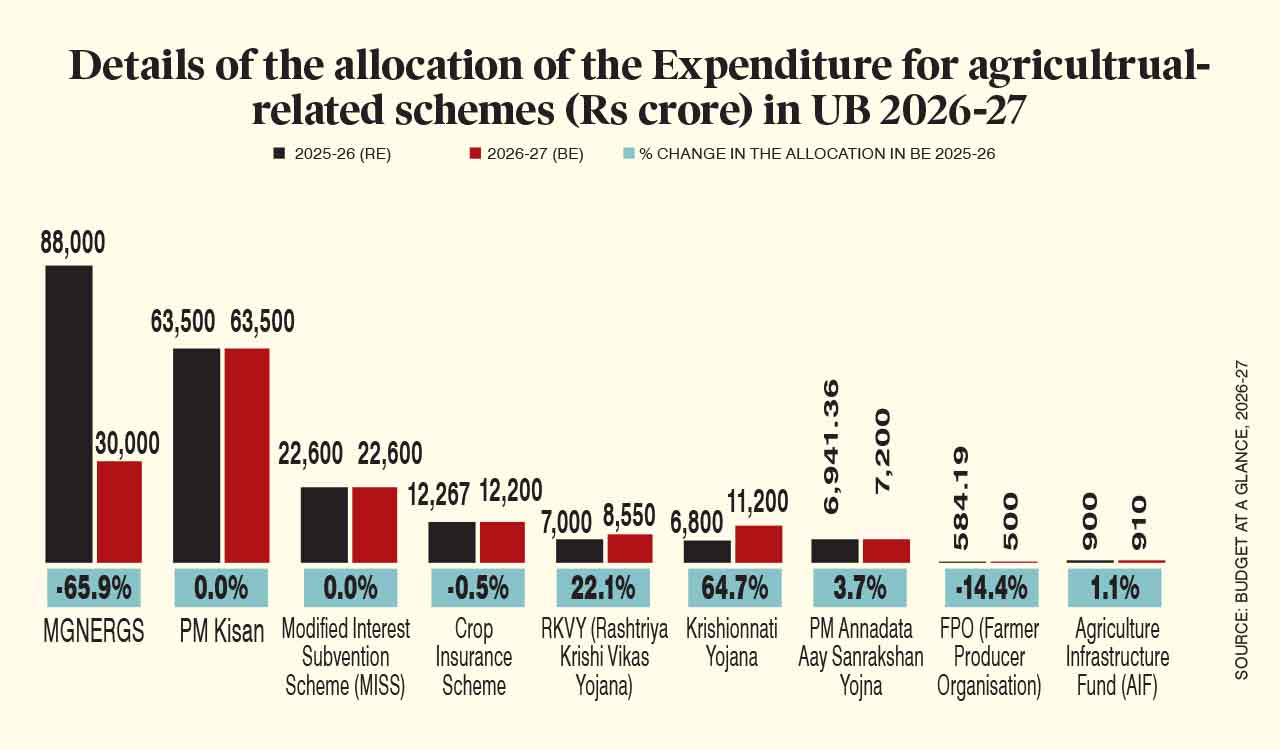
The 2026–27 Budget signals a clear shift in the government’s rural and agricultural strategy, moving away from broad-based income support and employment guarantees towards a slight improvement in productivity, market integration, and value-chain strengthening. While allocations for PM-Kisan and the Modified Interest Subvention Scheme remain unchanged, indicating continued income and credit support, the steep reduction in the MGNREGS allocation — from Rs 88,000 crore in 2025–26 (RE) to Rs 30,000 crore in 2026–27 (BE) — signals a shift away from wage-led rural support.
This change appears driven by the introduction of the new VB-GRAM-G scheme and changes in Centre–State cost-sharing, under which States are expected to bear a larger share of expenditure. While MGNREGS fully covers wage costs at the central level, the proposed increase in guaranteed employment from 100 to 125 days raises concerns about fiscal sustainability and implementation capacity at the State level.
Instead, higher allocations to schemes such as RKVY (Rashtriya Krishi Vikas Yojana), Krishionnati Yojana, and PM Annadata Aay Sanrakshan Yojana point to an emphasis on agricultural diversification, technological upgradation, price support mechanisms, and supply-side reforms. Increased spending on the Krishionnati Yojana and RKVY is likely to benefit farmers by improving extension services, enhancing productivity, and strengthening market linkages.
At the same time, the marginal rise in the Agriculture Infrastructure Fund reflects continued focus on post-harvest infrastructure. However, the cut in FPO allocations raises concerns about the pace of farmer collectivisation. Overall, the Budget reflects a strategic reorientation from short-term rural relief to longer-term agricultural resilience and market-oriented growth, with mixed implications for immediate rural livelihoods.
Falling Short
A major concern is that the Finance Minister has fallen short in adequately addressing the needs of the agricultural sector.
- First, the marginal increase in agricultural allocations is inadequate, and over the past three years, the sector has not been accorded priority.
- Second, the continued emphasis on welfare measures and subsidies may offer short-term relief but does little to strengthen the rural economy in the long run.
- Third, agricultural performance in FY25 has been weak, with farmers facing mounting challenges from climate change, groundwater stress, and declining soil quality; yet the Budget makes little attempt to address these long-term structural constraints that threaten productivity.
- Fourth, despite India exporting fresh fruits and vegetables to 123 countries and entering 17 new markets in recent years, the Union Budget 2026–27 misses an opportunity to build on this momentum. Higher allocations for quality upgradation and export-oriented infrastructure in the fruits and vegetables sector could have boosted farmer incomes while strengthening India’s presence in global agri-markets.
Overall, the Union Budget 2026–27 tries to reduce dependence on traditional crop farming by encouraging diversified rural livelihoods and non-farm jobs. While higher spending on fisheries and animal husbandry is a positive step, the lack of major reforms in agriculture, especially in research, technology, and investment, remains a concern.
More focused support for productivity, supply chain strengthening, and farmer skill improvement is urgently needed. Without strengthening the core of Indian agriculture, achieving the goal of Viksit Bharat will be difficult.

(The author is Associate Professor of Economics, Department of Liberal Arts, Humanities & Social Sciences, Manipal Academy of Higher Education, Bengaluru)

Related News