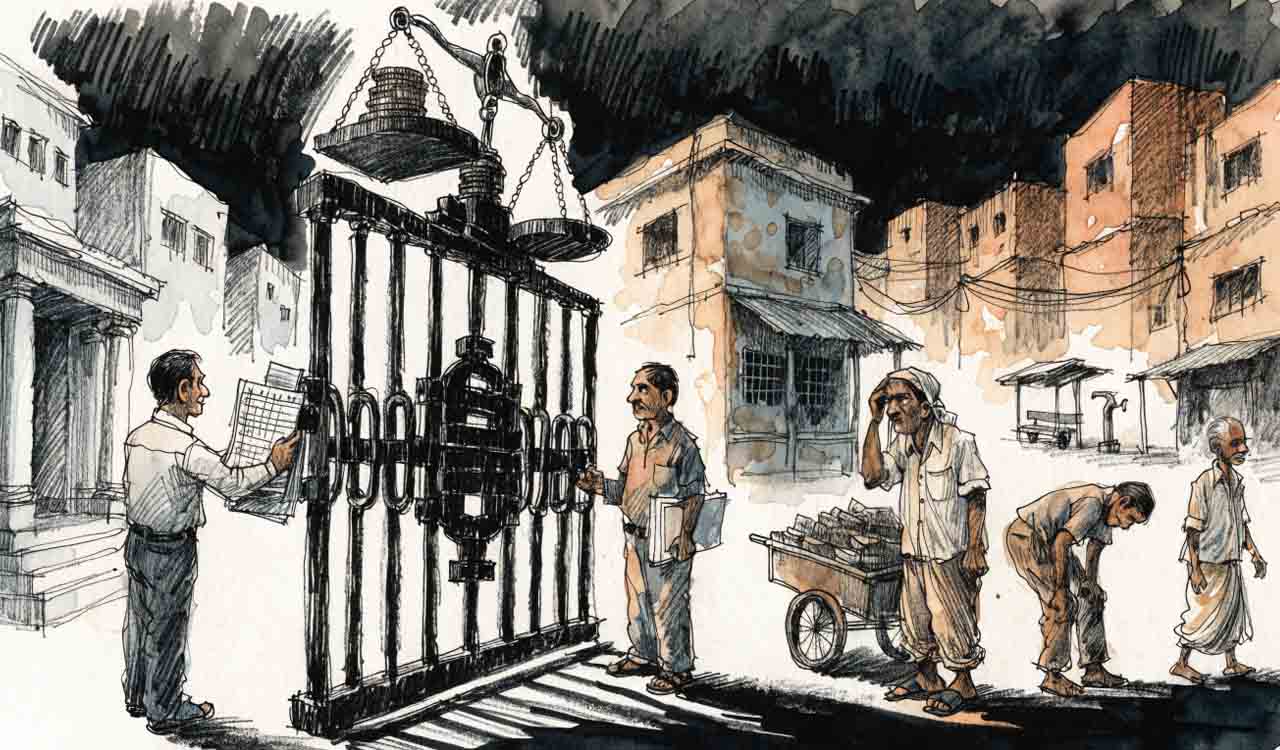
Opinion: India’s subsidy rationalisation: Fiscal discipline vs social protection
Union Budget 2026–27 signals a gradual rationalisation of subsidies while prioritising fiscal consolidation and capital expenditure


By Alok Aditya, Dr Prashant Kumar Choudhary
The Union government in the Budget 2026–27 presented what it called a calibrated approach to subsidies. Spending on food, fertilizer, and petroleum subsidies together amounts to over Rs 4.11 lakh crore and remains a formidable fiscal commitment. While their relative weight in the Budget has declined, this does not signal a retreat from welfare, rather, it reflects an effort to normalise post-pandemic excess and re-anchor fiscal discipline.
Also Read
Between 2015–16 and 2019–20, total subsidies remained roughly constant at Rs 1.9–2.4 lakh crore annually. However, during the pandemic, this surged to Rs 7.08 lakh crore in 2020–21, mainly driven by food expenditure, which accounted for more than 20% of the total expenditure, and was aimed at preserving consumption and social stability. Since then, with a steady rollback, it fell to Rs 3.85 lakh crore in 2024-25, followed by projected expenditure of Rs 4.11 lakh crore in 2026-27. While this shows an absolute increase, its share in total expenditure has declined sharply to roughly 8%, with overall government spending estimated at Rs 53.47 lakh crore in 2026-27.
The Economic Survey 2025-26 articulates the government’s approach to rationalising subsidies while emphasising expenditure quality, debt sustainability, and the protection of capital outlays. While this rationalisation aims to normalise subsidies after crisis-driven expansion and ensure that they do not crowd out infrastructure investment, fiscal arithmetic alone cannot settle this question.
Food Subsidy: Stabilised, But Structurally Heavy
At Rs 2.28 lakh crore, food subsidy remains the single largest component of the Budget. However, it has stabilised at a structurally elevated level, signalling that food security spending has been institutionalised following the pandemic expansion. The continuation of large allocations reflects the enduring scale of the National Food Security framework and allied programmes, including free grain distribution for vulnerable households. However, the system remains procurement-heavy, with high carrying and storage costs.
As fiscal space tightens, the question is not whether food subsidies should exist; they must. However, whether the present grain-centric model is the most efficient way to ensure nutritional security remains questionable. Without reforms in procurement policy and grain management, food subsidy risks becoming fiscally sticky even as other components compress.
Fertilizer Subsidy: The Real Stress Point
The fertilizer subsidy, pegged at Rs 1,70,781 crore, reflects moderation after the volatility induced by global commodity shocks. On paper, this looks like a welcome normalisation. In reality, this is where the sharpest trade-offs occur.
India’s fertilizer subsidy is largely product-based. The government compensates fertilizer manufacturers, especially chemical producers, for selling at controlled prices. Farmers benefit indirectly through lower retail prices, but the transfer does not flow directly to them. This structure has historically distorted nutrient use, especially by encouraging excessive urea consumption. If the subsidy bill declines without structural reforms, such as shifting toward farmer-based direct transfers, farmers may eventually face higher input costs. This matters because farm incomes remain structurally fragile.
The assumption that subsidy compression is harmless deserves caution: subsidies function not only as welfare transfers but also as shock absorbers in a structurally unequal economy
According to official data, the average agricultural household income increased between the 2012–13 and 2018–19 surveys, but much of the rise reflected diversification into non-farm activities rather than pure farm earnings. More recent trends show improvements in agricultural growth rates; however, small and marginal farmers continue to operate on thin margins, particularly amid climate variability and volatile crop prices. In this context, reducing fertilizer subsidies without strengthening income support mechanisms or productivity gains could tighten cost-of-cultivation pressures.
Petroleum Subsidy: Effectively Marginal
Petroleum subsidy, at Rs 12,085 crore, is now a minor line item in the Budget. Over the past decade, fuel pricing has steadily moved toward market alignment, thereby reducing fiscal vulnerability to global oil shocks. From a macroeconomic perspective, this represents a structural gain. The state no longer absorbs large crude price fluctuations.
However, the shift also signals a broader pattern in which price subsidies are increasingly being replaced with targeted or limited interventions. The era of open-ended fuel under-pricing appears to be over.
Are Subsidy Cuts Harmless?
The Budget projects a fiscal deficit of 4.3% of GDP for 2026–27, continuing the path of gradual consolidation. Interest payments alone exceed Rs 14 lakh crore, dwarfing the subsidy allocations. Capital expenditure is a declared priority. In the “Rupee Goes To” classification, subsidies account for roughly 8% of spending, far less than their prominence in political debate would suggest.
However, the assumption that subsidy compression is harmless deserves caution. Subsidies operate not only as welfare transfers but also as shock absorbers in a structurally unequal economy. Food subsidies smooth consumption. Fertilizer subsidies stabilise input costs. Petroleum interventions cushion transport inflation. When these buffers shrink, the adjustment burden shifts, often silently, onto households with limited resilience.
If farm incomes rise robustly in real terms, subsidy rationalisation would pose fewer risks. If rural wage growth is strong and non-farm employment expands steadily, fiscal tightening can be absorbed. Therefore, the debate is not about whether subsidies should be reduced; it is about sequencing and safeguards.
A Delicate Equilibrium
The Budget 2026–27 reflects neither aggressive expansion nor abrupt retrenchment. This signals continuity with caution. Subsidies remain substantial in absolute terms, but their relative role is shrinking as capital expenditure and interest obligations expand.
This rebalancing aligns with macroeconomic prudence. It strengthens fiscal credibility and preserves the space for infrastructure investment. However, its durability depends on complementary reforms, improved targeting, nutrient-balanced fertilizer policy, procurement rationalisation, and stronger farm income support. Rationalisation, properly understood, is about spending better. If it merely involves spending less, the equilibrium may not hold.
Currently, India’s subsidy architecture stands at a logical midpoint, neither populist largesse nor austere rollback. The true test will lie not in next year’s Budget numbers, but in whether rural incomes, food security, and agricultural productivity are strengthened enough to make consolidation socially sustainable. Fiscal realism is thus necessary, and social stability is indispensable; however, balancing the two remains a central policy challenge for India.

(Alok Aditya is Senior Research Fellow, Centre for Economic Studies and Policy, Institute for Social and Economic Change, Bengaluru. Dr Prashant Kumar Choudhary is Assistant Professor, Department of Public Policy, Manipal Academy of Higher Education, Bengaluru)

Related News