Opinion: Who are the “Dimagi Naxals”
Understanding the Maoists’ United Front tactics and urban movement is key to identifying the ideological networks that seek to advance their agenda through non-armed means


By PV Ramana
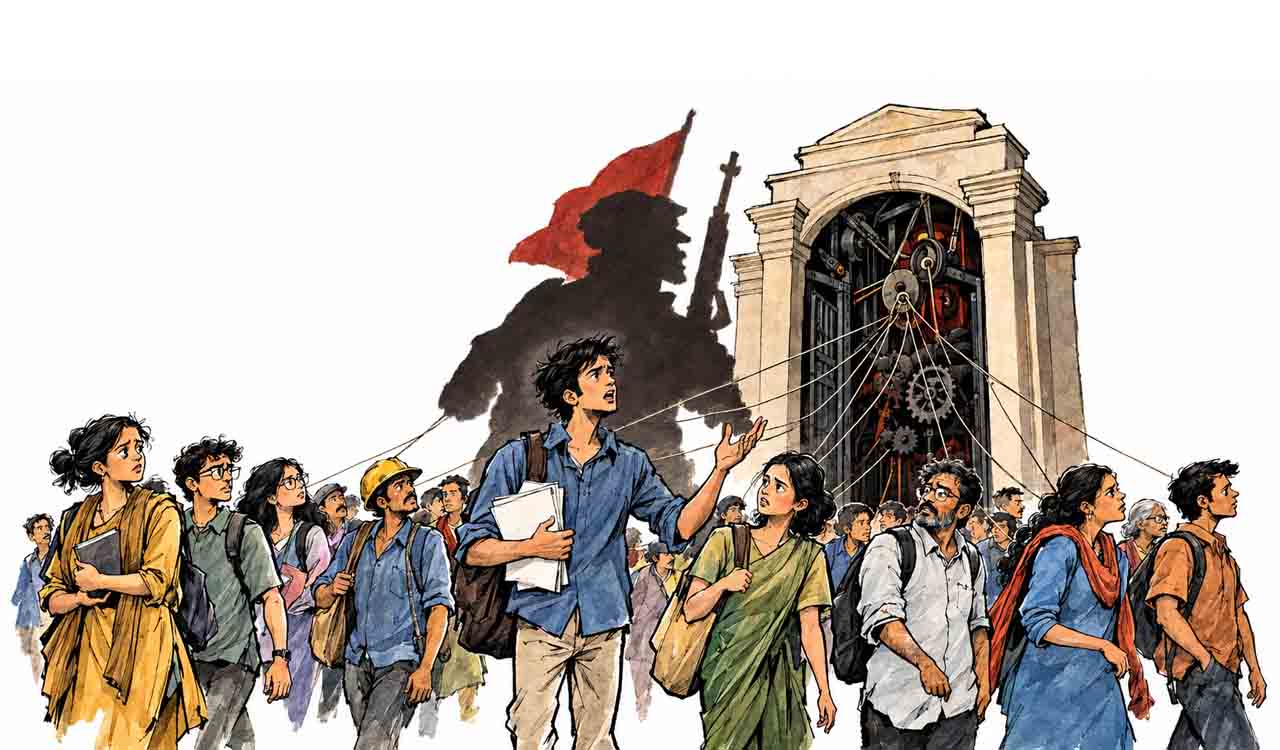
The Prime Minister’s caution, in his Independence Day address to the nation on August 15, 2026, to be watchful of “Dimagi Naxals” has stirred a debate in the media.
On August 25, West Bengal Chief Minister Suvendu Adhikari made a sharp remark: “Either us or them; I know the disease, and I know the treatment”. He was responding to developments at Jadavpur University, Kolkata. Graffiti on its walls read: “Azadi” and “Lal Salam Kishanji”.
Earlier, while conducting its State Conference at Jadavpur University from November 24-26, 2025, the Radical Students Front (RSF), a Maoist front organisation, renamed the Vivekananda Auditorium as Nambala Kesava Rao Auditorium and Jadavpur as Hidma Nagar. At that time, students said it was ‘merely symbolic’ and brushed it aside.
Meanwhile, there have been many attempts to understand what the Prime Minister meant. Call them whatever name one may—they don’t wield weapons; they incite. They are those who surreptitiously propagate the armed overthrow of the state, reject the Constitution and consider parliamentary politics a sham, and undertake various activities to delegitimise the elected government, and thus cause disaffection towards the state.
The problem is not with those who demand health, education, employment, inclusive opportunities and infrastructure. The real problem is with elements that surreptitiously and cleverly manipulate and influence the discourse to promote their own hidden agenda, provide space for armed rebellion and justify it.
To add to this cacophony and confusion, it would be useful to understand the Maoists’ United Front (UF) tactics and urban movement perspective and, thus, seek clarity on who is a “Dimagi Naxal”.
United Front
A United Front is of two types—‘tactical’ and ‘strategic’. “Dimagi Naxal” elements form the cog of the United Front tactics of the Maoists-Naxals. They steer the ‘tactical’ component of the United Front. They operate openly. They seek to form alliances or linkages with groups that would facilitate the ultimate goal of waging a protracted people’s war (PPW).
The emerging Maoist urban strategy, built around United Front tactics and efforts to influence organised sections of society, poses a serious challenge to India’s internal security and democratic institutions
In a Tactical United Front (TUF), through the formation of coalitions with persons and groups which are opposed to the state and its policies on some issue or the other, the Maoists seek to fight the state through ‘peaceful ’ political means, as well as broaden their support base. This United Front is a conglomeration or alliance of a number of organisations, which may or may not necessarily agree with the ‘revolutionary agenda’ of the Maoists.
Modus Operandi
With the long-term perspective of building the mass movement and preparing the people for the ultimate objective of heralding a New Democratic Revolution, besides forming completely secret (underground) revolutionary mass organisations, naxals seek to work among organisations that “can further be subdivided into three broad categories: fractional work, party-formed cover organisations, and legal democratic organisations”.
The naxals, thus, operate as a ‘fraction committee’ among existing legal organisations, or form their own cover organisations; members of legal organisations constitute the semi-legal element.
They penetrated civil society through ‘cover organisations’, for instance, in Assam. Maoist leaders formed the Assam Students and Youth Organisation (ASYO) and mobilised members, projecting a respected college principal as its leader, until its cover was blown.
In the immediate context, Dimagi Naxals would be located in loosely associating themselves with legal, democratic organisations and conduct fractional work in organisations that cater to particular interest groups (‘sectarian interests’) which are more oriented towards struggle, such as “trade unions, youth organisations, unemployed organisations, students associations and unions, women’s organisations, non-governmental welfare organisations, women’s welfare organisations, welfare organisations for oppressed castes, nationalities and minorities”. These are part of the TUF.
Utility
In a nutshell, the TUF serves the agenda of the Maoists in the following ways:
- Consolidates various ‘anti-imperialist’ struggles and brings them onto one platform based on a common working understanding
- Expands the reach of the Maoists by building contacts with them
- Expands over-ground cadre strength, thoroughly indoctrinates them and then completely incorporates them into organisational work, especially in urban areas
- Poaches partners for potential leaders and ideologues
- Serves as a good cover from the long arm of the state
- Essentially, being a political activity, reinforces military activities, that is, armed struggle.
At present, the organisations with which the Maoists seem to have formed the TUF include the Revolutionary Democratic Front, People’s Democratic Front of India, Committee against Violence on Women, Committee for the Release of Political Prisoners (CRPP), Indian Association of People’s Lawyers, and Committee Against State Repression.
Urban Movement
TUF activities are best visible in urban centres —towns and cities—and function as a part of the urban movement. Therefore, it is necessary to understand the urban movement of the Maoists, its functions and its objectives.
Way back in January 2007, the Central Committee of the CPI (Maoist), at its meeting, constituted an Urban Sub-Committee (USCO). USCO comprised five Central Committee members. It prepared an Urban Perspective Plan to build and guide the urban movement, which is a roadmap to the type of activities they would undertake in towns to enhance their support base.
Objectives and Role
The objectives/tasks of the urban movement could be classified under three broad heads or categories: mobilise and organise the basic masses and build the party on that basis; build the United Front; and military tasks. In the long-term, the CPI (Maoist) holds that “[they] should, by building up a strong urban movement, ensure that the urban masses contribute to creating the conditions that will obtain success for the armed struggle in the countryside.”
The urban movement has a defined role in the political strategy and military strategy of the CPI (Maoist). According to the CPI (Maoist), “…being the centres of concentration of the industrial proletariat, urban areas play an important part within the political strategy of the New Democratic Revolution”. The Maoists envisage that they would mobilise and organise industrial workers and channelise them towards playing a “leadership role in organising the agrarian revolution by sending…advanced detachment to the rural areas.”
Surely, the Maoists envisage penetrating the trade union movement in industrial centres of the country. Besides, the rebels would essentially seek to work among the youth and unemployed sections of society, as well as the student community.
Challenge
The task ahead for the government in various States is to first trace existing urban bases (dens) and cadres who have slipped into towns and cities over the past couple of years. These dens had earlier served as sources of logistics support and places of rest and recuperation. Besides, they might also serve as sources of finance. The government has to locate naxal elements among various organisations, proscribe such organisations, and prosecute them.
For this, a whole-of-government approach, ie concerted action, is essential. Proscription of an organisation or declaring it unlawful should be done across the country. They can be dealt with by building a tight case within the available legal measures. Andhra Pradesh, Chhattisgarh, Maharashtra and Telangana have specific public security acts. The other States need to follow suit.
(Parts of this article are excerpted by the author from his book ‘Tactical United Front and Urban Movement’, in India’s Maoists: Glimpses into Red Insurgency, New Delhi: Vivekananda International Foundation, 2026)

Related News
-

Opinion: The new Tollywood-Telangana directors are rewriting Telugu cinema
-
Opinion: Singareni at a crossroads—beneath the coal, a crisis of accountability
-
Opinion: India’s Urban Challenge Fund—bankable isn’t the same as vulnerable
-
Internet shutdown during October 10 CJP protest was necessary: Centre to SC