Rewind: Mainstreaming Maoists — India’s real fight against naxalism begins now
The March 31 deadline may signal a retreat of Red Terror and a battle won, but without deep, inclusive development — jobs, education, infrastructure and rehabilitation — the war remains far from over


By PV Ramana
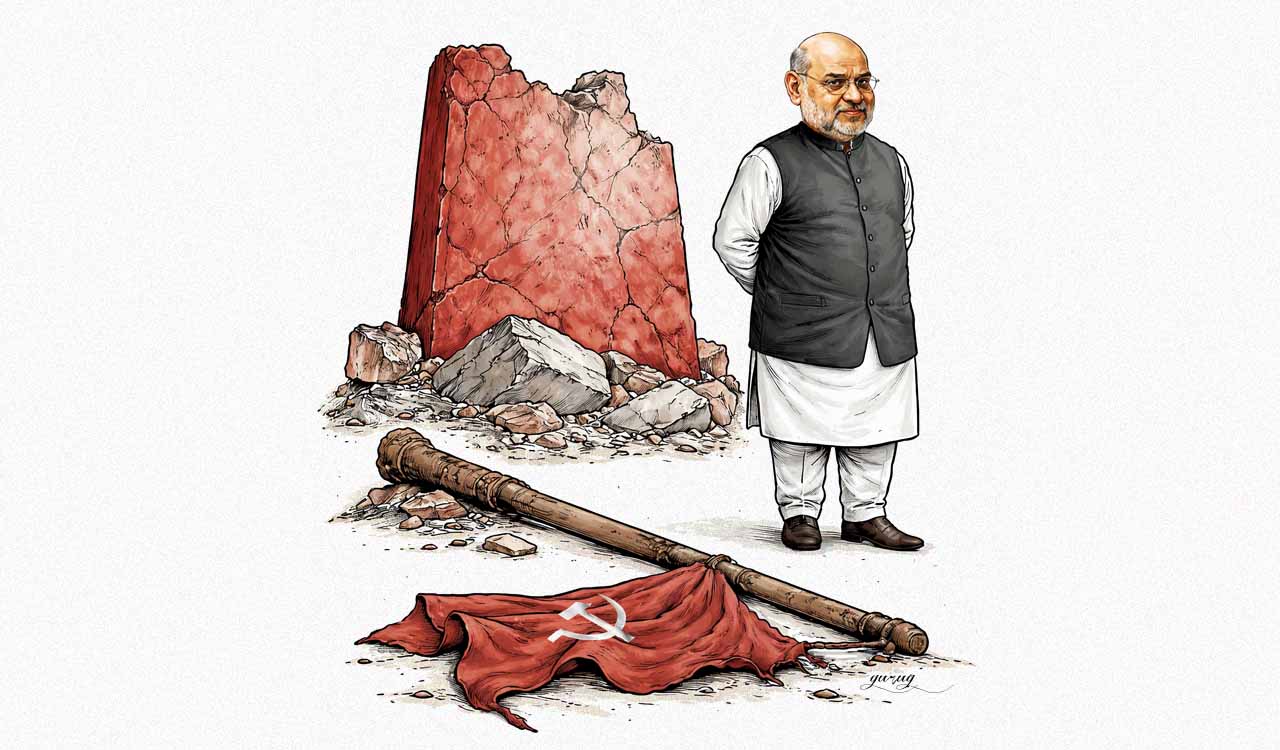
The Union government declared on March 31 that the country had been rid of the Maoist challenge. However, remnants still remain. Home Minister Amit Shah said in the Lok Sabha, “Naxalism has now been almost completely eradicated from Bastar, and a campaign has begun to build schools and open ration shops in every village there”. He also said, “Red Terror was not there because there was no development; rather, development could not happen there because of Red Terror.” It is also true that Maoists destroyed, to some extent, whatever little had been achieved.
Also Read
Quibbling is unnecessary at this stage. The challenge now is to extinguish the embers. Development efforts must, therefore, be given the highest priority. It is imperative that governments at the Centre and in the affected States take the lead.
Thrust, Legacy Districts
In 2008, the Centre stated that, of the total 610 districts, 196 were affected by the Maoist challenge at varying levels — high, moderate and low. It has now introduced a new classification. While reducing the number of affected districts over time, it has grouped 36 of them as ‘thrust’ and ‘legacy’ districts where development projects will be implemented under Special Central Assistance. Thrust districts are those that may quickly slip into the Maoist fold, while legacy districts may take longer to do so.
However, the reasons for the emergence of naxalism have not vanished in the remaining 160 districts. It is necessary to extend welfare and development measures to all 196 districts to prevent them from ‘slipping into the Maoist fold’. For this, a ‘consortium approach’ is suggested.
Consortium Approach
To ensure development becomes the peace dividend, all stakeholders must work together. Union and State governments, public and private industry, non-governmental organisations (NGOs), people living in forests, ie, moolvasis, and rural areas, and surrendered Maoists should join hands. They should pool financial, material and human resources.
Surrender and Rehabilitation (S&R)
This must be accorded the highest priority. While expenditure on S&R is borne by the Union government, States need a uniform policy on rehabilitation.
Currently, each State has a different amount of reward money for those surrendering. For example, a Central Committee member receives Rs 25 lakh in Telangana but Rs 1 crore in Odisha. Likewise, for a State Committee member, it is Rs 20 lakh in Telangana, while Rs 50 lakh in Odisha. There is also no clarity on the retrospective applicability of revised rewards. Besides, revision hardly matters when there is almost none left to surrender.
Further, the government has no clear idea on the actual position such a person holds in the Maoist hierarchy; its understanding is dependent on individual claims. It is also unclear if benefits would be given in the State of their surrender or where the person was active in the underground. This leads to confusion. The choice of place to settle down should be left to those surrendering, and the reward disbursed accordingly. Moreover, there is also no clarity on whether the rewards are cumulative or limited to only the State where the surrender has taken place.
Delay in delivering the benefits remains a major concern. Many surrendered cadres are yet to receive housing, ration or Aadhaar cards. Such is the case even with very senior leaders and cadre. What is the point then in extending an olive branch? It is, thus, necessary to conduct a monthly review at the district level to address administrative delays.
Development
Development must be ‘need-based’. Current efforts are largely limited to plain and semi-plain (rural) areas; their reach has to go beyond such areas. Moolvasis have different priorities than the urban population. Their standard of living should be improved through financial empowerment rather than consumer goods such as a TV, fridge.
Education, Skill Development
Enrollment in Eklavya and other schools must be encouraged, and dropouts discouraged. Surrendered Maoists should be included in the literacy programmes. There are also several militants, sympathisers, displaced persons, and unemployed youth who are a veritable catchment group for future recruitment.
They need to be made part of such programmes. A wide range of vocational training –– masonry, electrical and mechanical, plumbing, and automobile repair — should be offered. Instructors from local polytechnic colleges can support training.
The inherent bias that moolvasis have lower cognitive abilities must be eliminated. Providing opportunities to learn skills of their choice, such as carpentry, making bamboo products for household use, metalwork, and packaging local produce, will help.
Health and Water
Cerebral malaria remains a major health threat, requiring treatment within 24 hours. Finding transport in such cases becomes a difficult task. The government should deploy ‘bike-ambulances’ in forest areas. The Telangana government has announced free health cards to surrendered Maoists and medical facilities in government super specialty hospitals. This should be replicated across the country.
The reach of Public Health Centres (PHCs) is limited in tribal hamlets. Surrendered Maoists could form their own medical teams to supplement the government’s efforts. They can supply routine medicines for normal ailments sourced from PHCs. Urgent steps need to be undertaken to provide safe drinking water, especially in tribal hamlets and expand its reach.
More importantly, when surrendered Maoists and the moolvasis undertake development work by being physically involved, there is ownership. This would ensure quality and safety.
Roads and Other Infrastructure
Large tracts of land do not have road connectivity. The government already has an ongoing programme, Rural Roads in Left Wing Extremism (LWE) Affected Areas. Maoists could supplement this effort by encouraging the local populace. If people in two adjoining villages or hamlets join hands, they could provide connectivity between them and extend it to the next and last.
The moolvasis could lay internal roads within the village by themselves. Small bridges and culverts can also be constructed. These works should be outside the Viksit Bharat — Guarantee for Rozgar and Ajeevika Mission Gramin (VB — G Ram G) scheme. Qualified civil engineering graduates and diploma holders should be employed in these projects, thereby generating employment. The more, the better. Many such candidates are already available from local polytechnics situated in the Integrated Tribal Development Agency (ITDA) project areas.
Livelihoods: Timber, Mining
The government should award contracts for felling and selling timber to local communities as a collective —moolvasis — rather than to large contractors. The income generated by these collectives could serve, in both the short and long term, as seed money for development activities in their areas.
In mining projects, the local population should be given priority for employment, initially in roles such as labour, security personnel, support staff, and drivers. With appropriate skill development, they can gradually be employed in technical positions as well.
Displacement
It is essential to ensure the holistic rehabilitation of people, invariably moolvasis, displaced by mining projects. This includes providing housing and civic amenities, alternative land (or monetary compensation in lieu of it), and ensuring that they fully receive and benefit from due compensation.
The descendants of those displaced by the Damodar Valley Corporation multipurpose project, a flagship initiative of the 1950s, claim that their grandparents were not able to make informed choices. The compensation did not reach them, and only a few secured employment, that too after protracted legal battles that eventually reached the Supreme Court.
Around the same period, and later in the 1970s, moolvasis were further displaced under Project Dandakaranya and pushed deeper into interior regions. Lack of land titles worsened their conditions. The Maoists found a ready sympathiser base among them. These factors must be carefully considered when planning future mining projects.
Public and Private Industry
Both public sector undertakings (PSUs) and private industry have enormous funds at their disposal in the form of Corporate Social Responsibility and District Mineral Fund (DMF). These amounts should be utilised for improving health, education and livelihoods. Employment should be generated in the affected areas by employing moolvasis and other locals, not outsiders. Lloyd Steel in Maharashtra recently employed some surrendered Maoists and gave them shares in the company, a good example that can be replicated in other industries.
Non-governmental organisations (NGOs) should supplement the government’s efforts by providing skill development and pooling in other resources. Vernacular media must highlight the surrender and rehabilitation programmes of the government, and engage in constructive criticism.
Finding Finances
PSUs have the District Mineral Fund (DMF), which mandates spending ‘at least 70 per cent of funds in directly affected mining areas on high-priority sectors like health, education, water, and environment, with a focus on livelihood, skill development, and housing’. There are also large private industries, which have funds earmarked for CSR. These should be used for the development and welfare of these areas.
A great deal of blood has been shed over the past few decades. People, police and revolutionaries have made numerous sacrifices. With peace emerging, this should quickly translate into development and prosperity.
As Sun Tzu wrote in The Art of War: There is no instance of a country having benefited from prolonged war.
(The author keenly follows the Maoist movement in India)

Related News