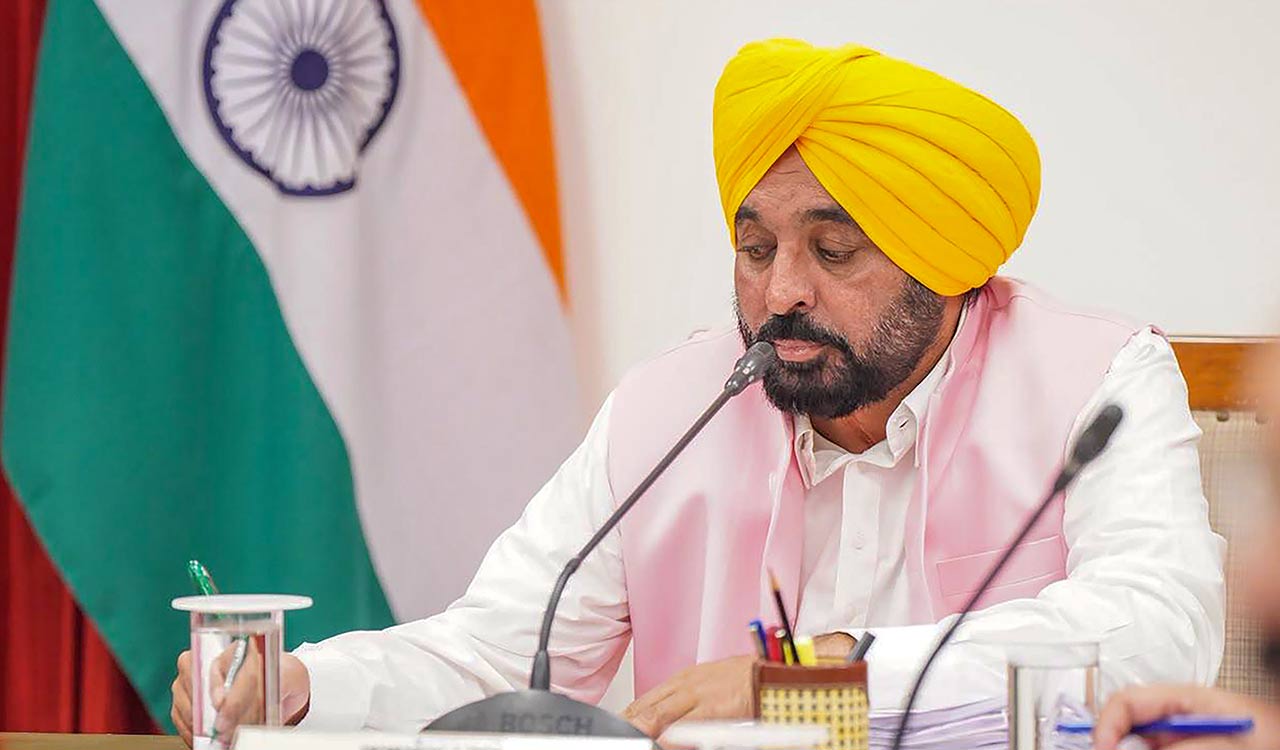
Punjab governor gives assent to anti-sacrilege Bill
Gulab Chand Kataria approved the Punjab sacrilege amendment law, making the Sri Guru Granth Sahib protection act stricter with life imprisonment and heavy fines for desecration. The move aims to deter sacrilege and preserve religious sanctity in Punjab



Chandigarh: Punjab Governor Gulab Chand Kataria has given his assent to the Jaagat Jot Sri Guru Granth Sahib Satkar (Amendment) Bill, 2026, Chief Minister Bhagwant Mann said on Sunday.
The Bill proposed stricter punishment, including life imprisonment and a fine of up to Rs 25 lakh, for any act of sacrilege against the Guru Granth Sahib.
It was unanimously passed by the Punjab Assembly on April 13 and was sent to the governor for his assent.
In a post on X in Punjabi, CM Mann said, “The Bill passed in the Vidhan Sabha against the sacrilege of Sri Guru Granth Sahib ji has been signed by the Honourable Governor Shri Gulab Chand Kataria ji.
“Now this Bill has become a law. I am very grateful to Waheguru ji for taking this service from a humble person like me. Thanks to the entire ‘Sangat’.” The AAP government on April 13 had convened a special session of the Vidhan Sabha to amend the Jaagat Jot Sri Guru Granth Sahib Satkar Act, 2008, for stricter punishment against sacrilege of the Guru Granth Sahib.
The Jaagat Jot Sri Guru Granth Sahib Satkar (Amendment) Bill, 2026, proposes stricter punishments to deter incidents of ‘beadbi’ (sacrilege) and uphold the sanctity of the Guru Granth Sahib.
The acts of sacrilege against religious scriptures have been an emotive issue in Punjab. There were demands from various quarters for stringent punishment for acts of sacrilege against religious texts.
According to the Bill, any person who commits an offence of sacrilege of the ‘Saroop(s)’ (sacred scripture) of the Guru Granth Sahib under this Act shall be punished with imprisonment of either description for a term which shall not be less than seven years but which may extend to 20 years.
There shall also be a fine of not less than Rs 2 lakh but may extend to Rs 10 lakh.
Any person, who in criminal conspiracy, commits sacrilege with an intention to disrupt peace or communal harmony shall be punished with imprisonment of either description for a term which shall not be less than 10 years but may extend to imprisonment for life, and shall also be liable to fine which shall not be less than Rs 5 lakh but may extend to Rs 25 lakh, as per the Bill.
Any person who attempts to commit an offence shall be punished with imprisonment of either description for a term which shall not be less than three years but may extend to five years, and shall also be liable to a fine which shall not be less than Rs one lakh but may extend to Rs three lakh.
Sacrilege for the purpose of this Act means any wilful and deliberate act committed with the intent of desecration by way of physical damaging, defacing, burning, tearing or theft of ‘Saroop(s)’, the Guru Granth Sahib or part thereof, or by words, either spoken or written, or by signs or by visible representations or through electronic means or otherwise, which is of such a nature as to hurt the religious feelings of persons professing the Sikh faith, the Bill said.
Reacting to the governor’s assent, Punjab Assembly Speaker Kultar Singh Sandhwan said it was the demand of the ‘sangat’ that a strict law be enacted against the sacrilege of the Guru Granth Sahib. He thanked the governor for giving his assent to the Bill.
Finance Minister Harpal Singh Cheema said, “This historic step by the government led by @BhagwantMann ensures strict punishment for sacrilege and sends a clear message – ”such acts will not be tolerated.” Congress leader and Leader of the Opposition Partap Singh Bajwa said the governor’s assent to the Bill is a welcome step, “but laws mean little without intent and action”.
“If CM @BhagwantMann is serious, this must become a real deterrent against sacrilege – not just another headline,” said Bajwa.
He further said the people of Punjab are still awaiting justice in the 2015 sacrilege incidents and police firing at anti-sacrilege protesters.

Related News