Opinion: What Telangana failed to learn from Finland’s education system
The Telangana government’s Finland tour appears to have reinforced existing ideas rather than producing fresh insights for vocational education reform


By Adama Srinivas Reddy
A 40-member delegation from Telangana, led by Principal Secretary for Education Yogita Rana, recently undertook a study tour to Finland to examine its acclaimed education system. The team, comprising around 12 senior officials and 28 educators and stakeholders, was expected to draw insights to strengthen vocational education in the State.
Also Read
While such international exposure visits are often projected as opportunities for transformative learning, a closer look at the outcomes raises an important question: has the tour produced meaningful new directions, or merely reiterated ideas already present in Telangana’s own education policy framework?
Media reports on the Finland study tour present an optimistic narrative: vocational education must become flexible, modular, and closely linked to employment. It recommends credit transfer systems, integration with higher education, industry-linked learning, and efforts to remove the social stigma attached to vocational streams.
At first glance, these appear progressive. However, many of these ideas are neither new nor transformative. More importantly, they remain disconnected from the deeper foundations that make Finland’s education system successful.
Overlap of Features
Media reports highlight key features of Finland’s vocational model: modular curricula, student-paced progression, seamless movement between vocational and academic streams, strong industry integration, and high employability. It contrasts this with Telangana’s system, described as rigid, socially stigmatised, and weakly linked to employment.
To address these gaps, it proposes short-term measures like modularisation and bridge courses, medium-term plans such as a TVET excellence blueprint and credit frameworks, and long-term strategies, including integration of vocational and general education.
However, when these recommendations are compared with the Telangana Education Policy 2026, a clear overlap emerges. The policy already emphasises employability skills, apprenticeships, industry linkages, student-centred learning, and strengthening vocational pathways. It is based on extensive consultations, field visits, and comparative studies. In essence, many of the “new” insights from Finland are already embedded in the State’s policy vision.
This raises a critical question: if the policy already contains these ideas, what additional value did the Finland tour provide?
A Known Idea
Moreover, Finland’s education system has been the subject of global discussion for more than two decades. Anyone with even a minimal interest in educational reform is today familiar with the broad features of the Finnish model, especially in the age of social media and widespread policy discourse. The ideas associated with Finland’s success are neither inaccessible nor unknown.
If Telangana is serious about strengthening vocational education, it must invest in teacher preparation, strengthen public institutions, regulate private players, and create genuine pathways for social mobility through vocational routes
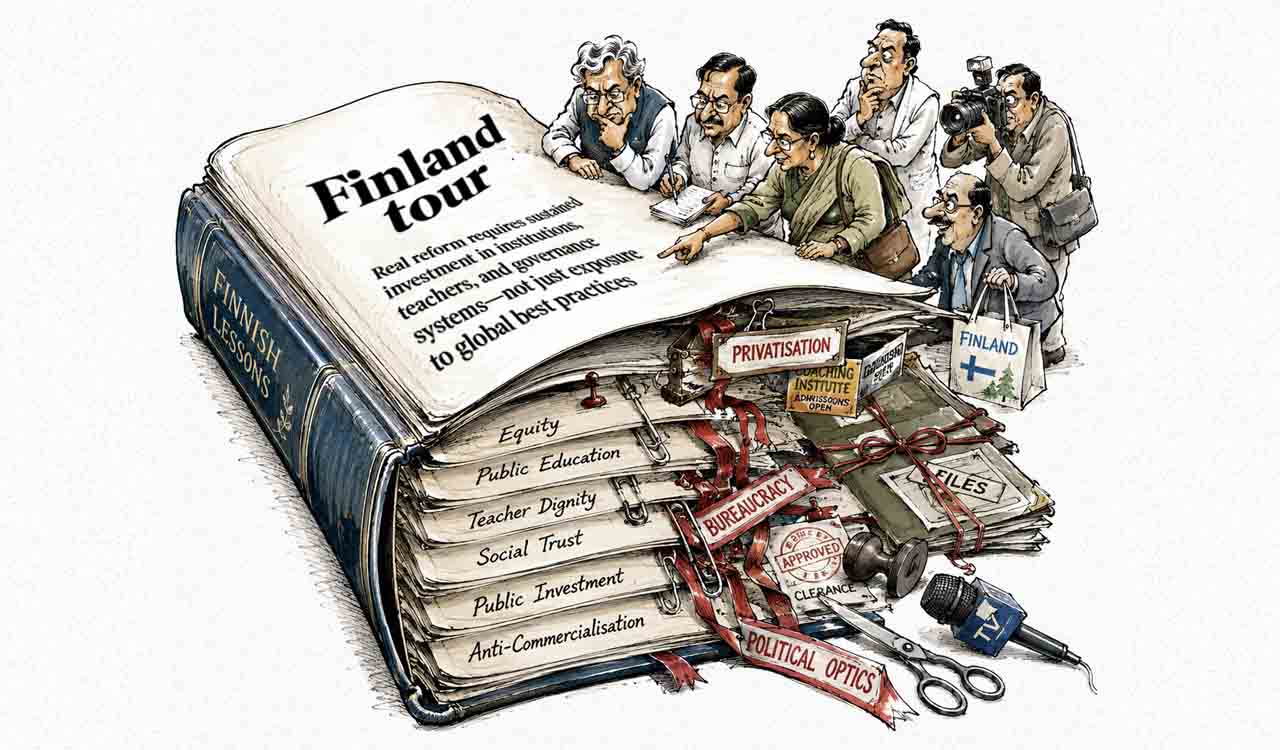
In fact, more than a decade ago, Finnish education scholar Pasi Sahlberg systematically documented these experiences in his widely discussed book Finnish Lessons, which explained in detail the philosophical, institutional, and pedagogic foundations of Finland’s educational transformation. Much of what is now being highlighted through the study tour has, therefore, long been available in the public domain and extensively debated in educational circles.
The answer is uncomfortable. The tour appears to have reinforced existing knowledge rather than generating fresh, context-specific insights. Its recommendations remain largely at the level of structural adjustments—curriculum flexibility, credit systems, and institutional linkages. These are necessary, but not sufficient to transform vocational education.
The real challenge in Telangana is not just structural rigidity but a deeper socio-cultural and institutional problem. Vocational education is widely perceived as inferior to engineering and academic streams. This perception is rooted in historical inequalities, labour market hierarchies, and the commodification of education. While the media reports acknowledge this stigma, their solutions remain limited to awareness campaigns.
The Actual Gap
Here lies the fundamental gap. In Finland, vocational education is respected not merely because of flexible curricula or credit systems, but because of a broader ecosystem built on trust, equity, and strong public investment. Teachers are highly trained and enjoy professional autonomy. Private commercialisation is minimal. Institutions collaborate rather than compete. Education is treated as a public good, not a market commodity.
These foundational aspects receive little attention in the media. For instance, Finland’s success is closely tied to its rigorous teacher education system and the high social status of teachers. In Telangana, however, teacher preparation, recruitment, and professional autonomy remain unresolved challenges. Without addressing these, vocational reforms will remain superficial.
Similarly, Finland limits excessive privatisation and ensures strong public provisioning. In contrast, Telangana’s education landscape—especially in technical and intermediate sectors—is increasingly dominated by private institutions, pushing vocational education further to the margins.
Governance is another concern. The State’s education policy emphasises decentralisation, stakeholder participation, and accountability. Yet, in practice, decision-making remains centralised, and access to policy processes is limited. When educators and stakeholders cannot engage meaningfully, reforms lose their democratic character.
The financial context further complicates matters. Telangana is currently facing a severe fiscal crisis, struggling to meet obligations such as employee retirement benefits and GPF payments. In such a situation, spending more than Rs 1 crore on an international study tour demands justification. If the outcomes merely reiterate existing policy directions, the expenditure becomes difficult to defend.
State’s Priority
This leads to a broader concern: is the state prioritising symbolic actions over substantive reforms? International exposure visits often create an impression of proactive governance and generate media attention. However, without deep contextualisation and implementation, they risk becoming performative exercises. Real reform requires sustained investment in institutions, teachers, and governance systems—not just exposure to global best practices.
To be sure, learning from global models is valuable. Finland offers important lessons on equity, trust, and the integration of education with social values. But these lessons cannot be transplanted through short-term visits or reduced to policy rhetoric. They require a fundamental rethinking of the purpose and structure of education.
If Telangana is serious about strengthening vocational education, it must go beyond modular curricula and credit systems. It must invest in teacher preparation, strengthen public institutions, regulate private players, and create genuine pathways for social mobility through vocational routes. Above all, it must build a culture that respects labour and skills—something that cannot be achieved through administrative reforms alone.
In conclusion, the Finland study tour raises more questions than answers. It exposes a gap between policy rhetoric and institutional reality. The challenge is not a lack of ideas, but a lack of commitment to implementing them in their true spirit. Unless this gap is addressed, vocational education will remain a peripheral concern—regardless of how many study tours are undertaken.
(The author is a faculty member at Kakatiya Government College [Autonomous], affiliated with Kakatiya University, Hanumakonda, and serves as the General Secretary of the Society for Change in Education, Telangana)

Related News