Rare banded krait or Bangaru Katlapamu found dead in Mulugu district after several years
Mulugu/Bhupalpally: Much to the surprise of the herpetologists and wildlife enthusiasts, a banded krait was found dead on a road near the Project Nagar village under the Medaram Forest Range in the district on Sunday. Though it is not a threatened species, it is not commonly sighted in Telangana, according to Eco-Club, Bhupalpally, secretary Sajid. […]
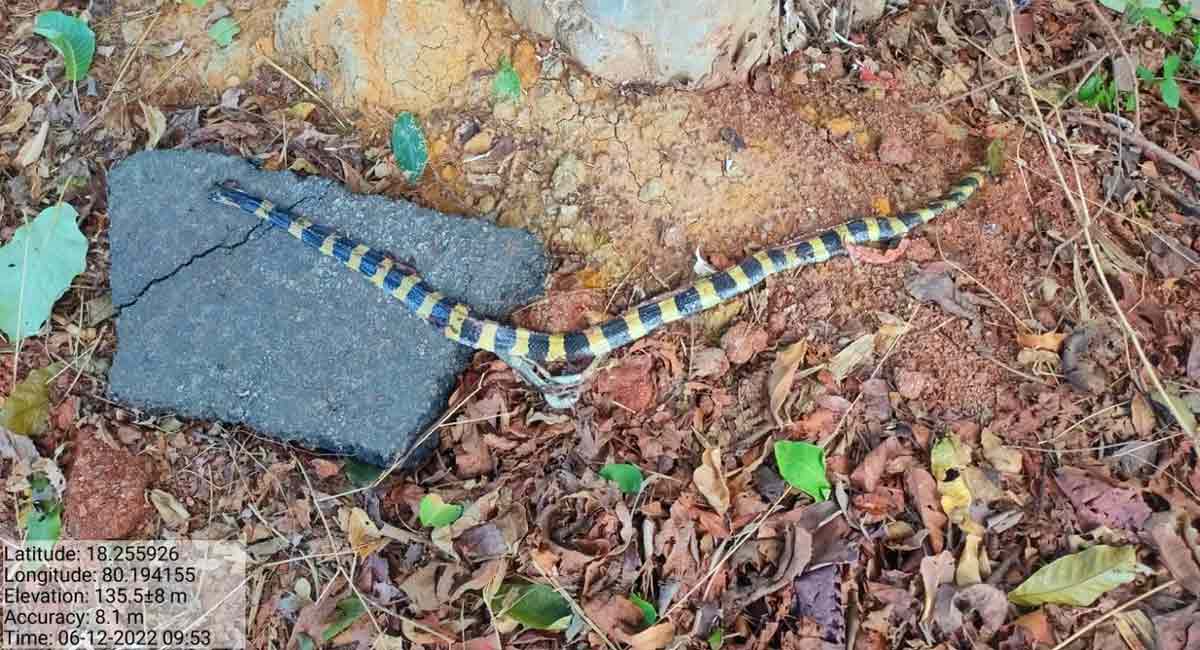


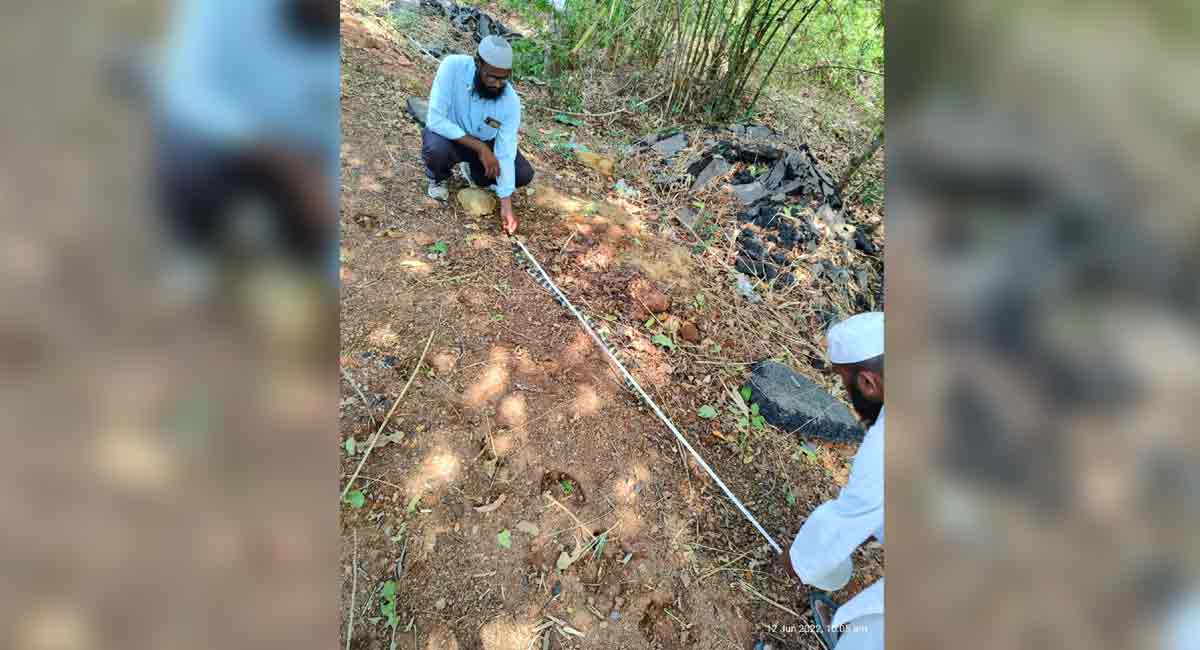
Mulugu/Bhupalpally: Much to the surprise of the herpetologists and wildlife enthusiasts, a banded krait was found dead on a road near the Project Nagar village under the Medaram Forest Range in the district on Sunday. Though it is not a threatened species, it is not commonly sighted in Telangana, according to Eco-Club, Bhupalpally, secretary Sajid. This venomous snake might have died as it was run over by an unknown vehicle while it was crossing the road. The length of the snake is four feet and eight inches, and the weight is four kgs, said Sajid, who measured the snake, informed the same to the Medaram FRO for the purpose of record.
The banded krait, whose scientific name is Bungarus fasciatus, is one of eight species of kraits in India. It is also known as ‘Bangaru Katla Pamu’ in Telugu.
It is seen from South Asia, parts of peninsular India and northeast India, to Southeast Asia, the whole Indo-Chinese region from Myanmar to Malaysian peninsula and archipelago.
In India, its range includes the northeast, West Bengal, Orissa, parts of Maharashtra, Bihar, Jharkhand, Madhya Pradesh, Chhattisgarh, Andhra Pradesh and Karnataka.
According to the herpetologists, the banded krait is easily recognizable by a combination of characters like the distinct equal-width alternating bands of canary yellow or buff, and black or purplish-black on a body that is distinctly triangular in cross-section, and by its blunt, rounded tail tip. “Fully grown adults average around five feet six inches and rarely grow up to six to seven feet in length. The head is not broader than the neck; the body is smooth and glossy. Each colored band completely encircles the body and involves five to seven scales in the length. The head is black with an inverted yellow ‘V’ and the chin and throat are yellow,” according to the researchers of the Wildlife Biology Section, Department of Zoology, University College of Science, Osmania University (OU), Hyderabad.
The banded krait was reported from Narsampet in erstwhile Warangal district based on a single specimen that was shot by GEC Wakefield on December 26, 1912 while it was swimming in a stream.
The re-sighting of the banded krait in erstwhile Warangal district was made after a gap of 95 years at Roheer in the Eturnagaram Wildlife Sanctuary in the about 70 kilometers north northwest of Narsampet.
In November 2006, it was first spotted by one D Venkateshwarlu of the Wildlife Biology Section, Department of Zoology, University College of Science, OU, while it was crossing the road at dusk near Roheer in Eturnagaram Wildlife Sanctuary. After that the researchers came across dead specimens of Banded Krait on three occasions in Eturnagaram Wildlife Sanctuary from November 2006 to November 2007.
Locals said that they had never seen this kind of snake and believed it might have migrated from elsewhere along the Godavari.
The intact head of the last specimen was deposited as a voucher specimen in the Natural History Museum of Osmania University, Hyderabad.
Although the banded krait is venomous and its bite may be deadly to humans, it is shy, primarily nocturnal, and not particularly aggressive so its overall risk to humans is low.

Related News