Rewind: Under a cloud: El Niño looms over Telangana farms
With El Niño intensifying, Telangana faces drought and rainfall deficits, making the Kaleshwaram Lift Irrigation Project vital to the State’s water security


By Dr Ramesh Chennamaneni
With global warming, the monsoon is changing, breaking well-established “rules” of the phenomenon, becoming increasingly erratic and unpredictable. This trend was clearly highlighted by a 10-year Indo-German research project. These findings underscore the need to refine the criteria for defining monsoon onset and withdrawal. Furthermore, climatological norms, which are based on 30-year averages of weather variables, must be re-evaluated in the context of climate change.
Also Read
The study focuses on the two most relevant climate variables:
• Very strong monsoon rain events — defined as rainfall exceeding 80 mm per day — are the major cause of flooding and uneven distribution of rainfall during the monsoon season. Currently occurring once every two years, the frequency of such events is expected to increase by 60% by 2050, irrespective of the emission scenario.
• Extremely hot days cause direct adverse health effects and a multitude of indirect impacts, including accidents and reduced labour productivity. Compared with the current averages, the high-emission scenario projects around 20 such days annually by 2050 and 40 in 2100. Even under the low-emission scenario, the projected figures of eight days by 2050 and 13 days by 2100 present significant challenges, as Telangana is already experiencing.
More importantly, the El Niño weather pattern is contributing to extreme weather conditions. The primary factor behind the weak monsoon dynamics at present is the rapid warming of the equatorial Pacific. Since the Indian Ocean Dipole (IOD) remains in a neutral phase, there is no offsetting warming in the western Indian Ocean to strengthen the monsoon with additional moisture. This is causing severe delays in the onset of the monsoon.
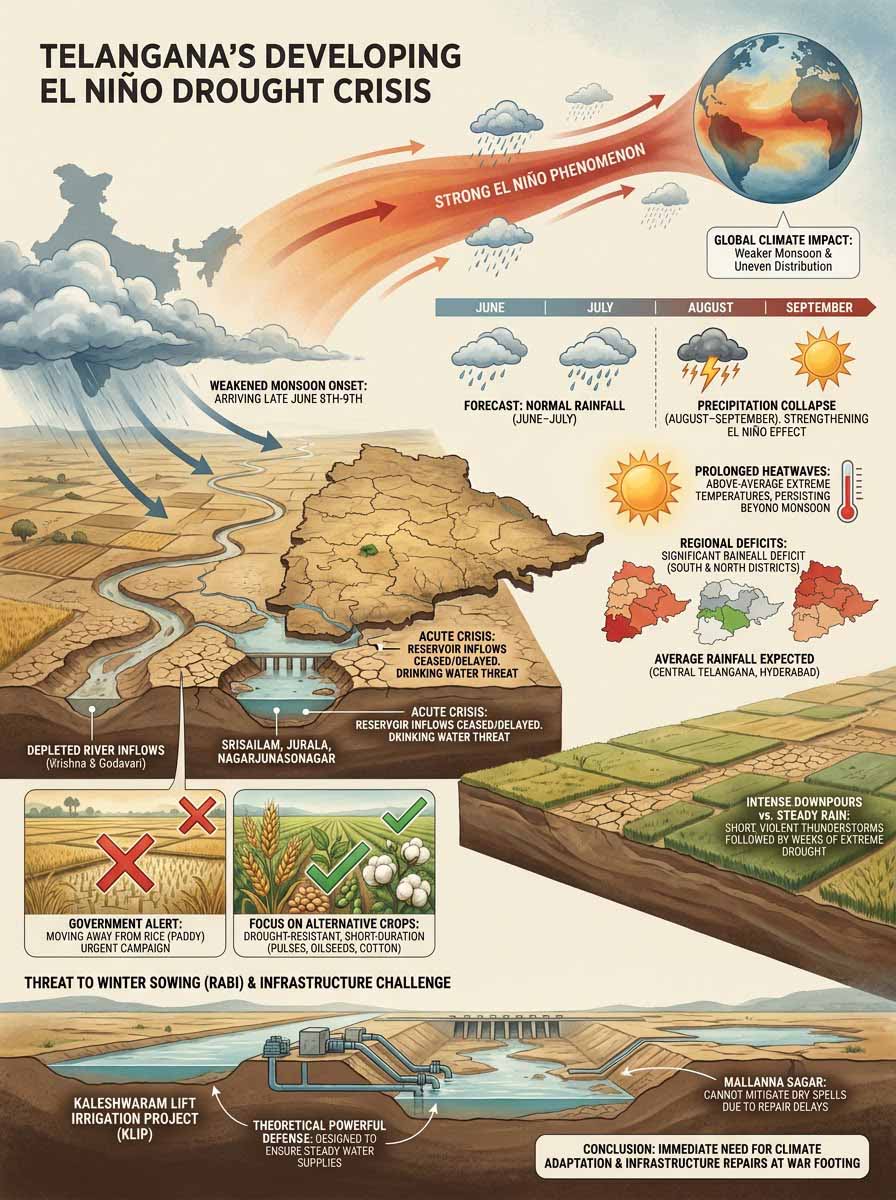
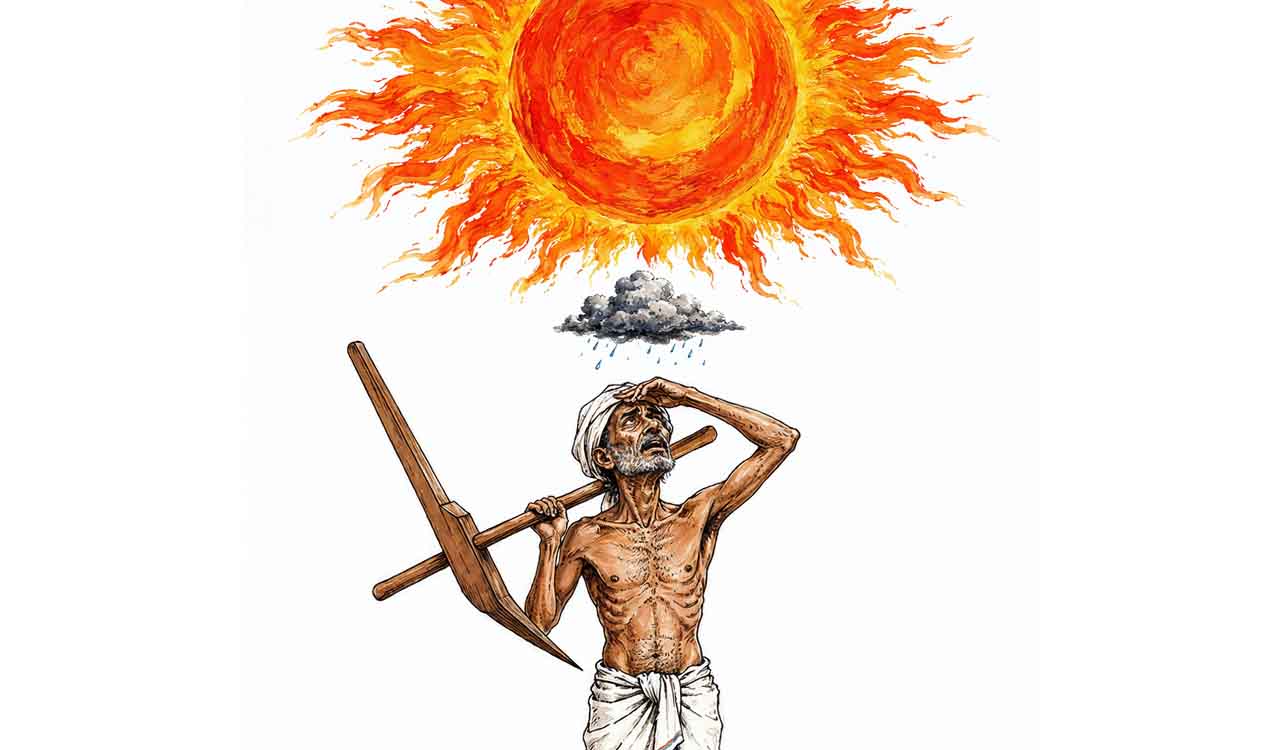
For Telangana, the developing El Niño phenomenon carries serious consequences, including acute drought and far-reaching implications for agriculture. The Indo-German study and the India Meteorological Department (IMD) have warned that this could be one of the most challenging monsoon seasons in recent years. These include:
Weakening of the monsoon and uneven distribution: This year, the Southwest Monsoon reaches Telangana late, entering via the southern districts (formerly Mahabubnagar). The onset is extremely weak.
A two-part season: While meteorologists still anticipate largely normal rainfall during June and July, precipitation dynamics are expected to weaken significantly in August and September as El Niño strengthens. This is a very dangerous phenomenon if it occurs fully.
Regional deficits: Telangana’s climatic profile indicates that districts in South and North Telangana will experience significant rainfall deficits. Only Central Telangana, including Hyderabad, is expected to receive near-average rainfall.
Intense downpours instead of steady rain: El Niño tends to shift weather patterns towards short, intense, violent thunderstorms, followed by prolonged dry spells lasting several weeks.
Prolonged heatwaves: The arrival of the monsoon in June typically brings cooler temperatures. This year, however, the El Niño effect is expected to result in an above-average number of heatwave days and extreme temperatures across large parts of the State, persisting well beyond the official start of the monsoon season.
Acute crisis in water management: Telangana’s water resources depend heavily on inflows from neighbouring States through the Krishna and Godavari river systems. Since extreme drought conditions also prevail in the upstream catchments of Karnataka and Maharashtra, inflows into key reservoirs such as Srisailam, Jurala, and Nagarjunasagar have either ceased or been significantly delayed. This could threaten not only irrigation but also drinking water supplies to cities and municipalities later in the year.
In light of El Niño forecasts, the Telangana government has officially declared a drought alert. Two important strategies have been proposed to combat the serious situation:
- Moving away from rice (paddy): Agricultural authorities have launched an urgent campaign to dissuade farmers from engaging in traditional, water-intensive rice cultivation. In 2026, large-scale rice cultivation is proposed to be permitted exclusively in areas with guaranteed canal irrigation systems.
- Focus on alternative crops: Farmers are being encouraged to switch to short-duration, drought-resistant crops such as pulses, oilseeds, including soybeans, and cotton, which are better suited to withstand the prolonged dry spells during August.
Kaleshwaram as Safeguard
There is also a significant threat to winter sowing (rabi) in Telangana. As reservoirs are expected to be depleted by autumn, it is becoming increasingly evident that the subsequent winter cropping season may face severe water shortages.
In this context, the full and proper functioning of the Kaleshwaram Lift Irrigation Project (KLIP) could serve as a powerful safeguard against drought. By pumping floodwater from the Godavari River into a vast network of reservoirs and minor irrigation tanks, KLIP was designed to ensure steady water supplies for agriculture and drinking purposes even during years of below-normal rainfall.
However, because of significant delays in repair works, the interconnected reservoir network, including Mallanna Sagar, cannot currently be utilised to its full potential to mitigate dry spells or replenish groundwater levels on a large scale. The government must expedite repairs on a war footing to ensure agricultural sustainability in Telangana.
Within this context, reliable long-range monsoon forecasts and climate adaptation measures are becoming increasingly critical for informed decision-making at every level, from farmers’ fields to rapidly urbanising cities. In the agriculture sector, crop selection, irrigation management, timely inputs supply, subsidies under Rythu Bandhu, strict implementation of food procurement policies, and ensuing food security are all likely to become more critical in the years ahead.
(The author is former Adviser to the Government of Telangana)
Big, Bad and Costly
El Niño, nature’s chaotic climate agent, has formed in a warmed-up Pacific Ocean and is expected to grow to historic strength. Experts said the El Niño, a natural warming cycle, should further heat a globe already warming from fossil fuel pollution and will likely turbocharge extreme weather across the planet.
Meteorologists forecast it will rival — or exceed — arecord El Niño that began in 1997 and helped trigger billions of dollars in damage from heat waves, floods, droughts, tornadoes and wildfires.
The US National Oceanic and Atmospheric Administration (NOAA) said there’s a 63% chance that the El Niño will get so intense this late autumn and early winter that it, would rank among the largest El Niño events in the historical record going back to 1950. “The warm, deep waters of an El Niño affect weather patterns by bringing “a lot of extra heat to the surface, fuelling a lot of extreme events for a lot of places around the world,” said Clark University climate scientist Abby Frazier.
United Nations Secretary-General Antonio Guterres described El Niño as an “urgent climate warning.” “El Nino conditions will pour fuel on the fire of a warming world,” Guterres said in a video message. AP

Related News