Rewind: The mystery behind Telangana’s zero-population villages
Many of Telangana’s 1,080 zero-population villages may not be abandoned at all. Duplication, GPS errors and conflicting entries expose flaws in Mission Antyodaya data, raising serious questions about the reliability of Union government’s rural development database



One village, three entries
• Narkhuda (Village code: 574731) in Shamshabad block of RangaReddy district was recorded under three separate gram panchayats: Narkhuda, Kavvaguda, and Chowderguda, across all four Mission Antyodaya surveys. Population figures for the same village varied sharply across these entries: Narkhuda GP recorded a decline from 5,179 in 2017-18 to 4,620 in 2019 and 2020, and 3,057 in 2022-23; the Chowderguda GP recorded a population of 3,459 in 2017-18, 4,620 in 2019, a single resident in 2020 and zero in 2022-23. The Kavvaguda entry showed a constant population of 2,010 in all survey rounds. The infrastructure data is equally inconsistent. While Narkhuda and Kavvaguda recorded some infrastructure data, Chowderguda reported virtually none.
Also Read
• Keli Khurd (Village code: 569270) in Kerameri block, Kumuram Bheem Asifabad district, was recorded under three separate gram panchayats: Khairi, Sangvi, and Keli-B, across all four survey rounds. The population under Khairi GP declined from 417 in 2017-18 to 285 in 2019 and 2020 to zero in 2022-23. Sangvi recorded 545 in 2017-18, 285 in both 2019 and 2020, and 505 in 2022-23. The Keli-B GP entry, absent in 2017-18, recorded 285 in 2019 and 2020, increasing to 505 in 2022-23. Infrastructure-wise, Khairi recorded substantive data in earlier rounds but minimal infrastructure data in 2022-23, while Keli-B and Sangvi recorded conflicting infrastructure indicators across all rounds.
This is not an aberration. The coordinates of more than 90% of villages supposedly with no residents are glaringly off the mark, strongly indicating that many of the Mission Antyodaya surveys in Telangana may never have properly reached the ground.
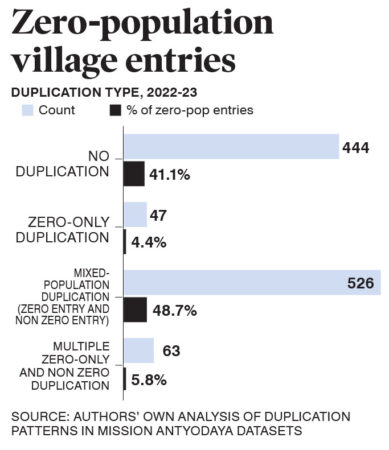
Nearly half the villages listed as having ‘zero population’ in the Union government’s rural development database are not abandoned settlements at all. Though the latest Mission Antyodaya survey for 2022-23 identified 1,080 villages in Telangana as having zero population, analysis of duplication patterns, infrastructure records and GPS coordinates suggests that only around 491 villages can genuinely be classified as depopulated.
The findings put a question mark on the reliability of one of the country’s most important rural development databases, which is used for welfare planning, infrastructure allocation and village-level governance.
Rural Depopulation
Rural depopulation is becoming increasingly significant in Telangana as people migrate to Hyderabad in search of better employment opportunities. In this context, large-scale village-level surveys become crucial for identifying emerging patterns of rural decline and settlement vulnerability.
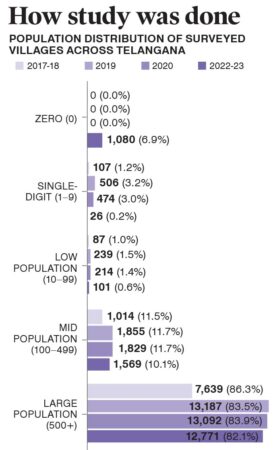
In the first three Mission Antyodaya survey rounds, several villages were recorded as having single-digit populations, indicating an ongoing process of demographic decline, even though complete rural depopulation was not observed. The latest survey recorded 1,080 villages with zero population, nearly 7% of all the entries. A closer inspection of the data, however, reveals a stark contrast.
The Ministry of Rural Development launched Mission Antyodaya in 2017-18 as a programme aimed at creating village-level data for effective policy implementation and rural development. As part of the Mission, annual surveys were planned to track over 200 indicators, ranging from road connectivity to the availability of schools, hospitals, banks and other infrastructure facilities. To date, four survey cycles have been conducted — 2017-18, 2019, 2020, and 2022-23.
Mission Antyodaya
Mission Antyodaya was launched as a policy correction to address concerns that rural welfare schemes run by different ministries were duplicated and operated in isolation, leading to wastage of public funds. By creating a comprehensive dataset for all villages, the programme aimed to address this institutional drawback.
Given its role in local planning and resource allocation, the accuracy and reliability of the survey data are of critical importance.
Study Steps
The authors gathered data from all four Mission Antyodaya surveys for their primary dataset. In addition, the 2011 Census data of undivided Andhra Pradesh was used to track historical consistency. While the first three survey rounds appear normal, the most recent iteration showed a sudden increase in zero- population villages, far too extreme to be considered natural. This anomaly was flagged and analysed further for discrepancies.
- Same village, recorded twice
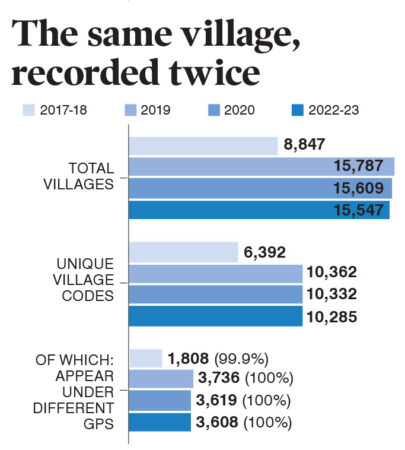
The dataset showed significant irregularities in the way villages were recorded. The most concerning issue was the scale of duplication, which remained a consistent feature across all Mission Antyodaya surveys. Around half the village entries in each survey appeared to be duplicated. This issue extended to the zero-population villages as well. - Infrastructure mistmatch
If a village were counted twice, it would imply that all the features of the village would also have been counted twice. To investigate this, infrastructure indicators were compared across duplicated entries. The assessment revealed worrying inconsistencies. Villages having zero population should logically have no infrastructure, yet the data shows that such villages are also recorded as having infrastructural facilities. This suggests that the Mission Antyodaya data may have been compiled without a ground-level survey. - GPS errors
A spatial assessment was conducted for the zero-population villages. Comparison of the official village locations with their actual locations based on open-source maps showed that more than 90% of these villages had incorrect GPS coordinates. In some cases, the official locations of multiple villages were recorded under a single mandal office. In others, the official locations of some depopulated villages were incorrectly shown within Hyderabad city limits. These findings strengthen the possibility that the Mission Antyodaya surveys were conducted without ground-level assessments.
There are two possible reasons why these errors may have occurred. First, the duplication may stem from unclear boundaries between adjacent villages, resulting in the same village being reported twice with conflicting characteristics. Second, the lack of a robust verification framework to identify inaccuracies. If enumerators had recorded locations on the ground, such widespread GPS errors would be unlikely.
Census Comparison
Zero-population villages are not a new phenomenon in Telangana. The 2011 Census recorded 648 depopulated villages across the 10 districts of undivided Andhra Pradesh that later became part of Telangana. However, none of the first three Mission Antyodaya surveys recorded any zero-population villages, raising questions about data consistency.
Of the 1,080 zero-population villages recorded in the 2022-23 survey, only 491 were found to be true zero-population settlements. When compared with the 2011 Census data, 299 villages had previously been identified as depopulated, while 192 were newly recorded in the survey.
Findings Matter
What began as an investigation into depopulated villages in a survey database ultimately revealed a much larger systemic issue in the way rural data is collected and recorded in India.
The research identified three major concerns. First, nearly half of all the entries across the survey rounds are duplicated. Second, the infrastructure availability reported for duplicated villages shows sharp inconsistencies. Third, over 90% of the zero-population villages carry incorrect GPS coordinates. Together, these irregularities raise serious concerns about the reliability of the Mission Antyodaya survey data.
Mission Antyodaya was designed to ensure that the rural welfare resources reach the right places. However, if the underlying data is affected by duplications, mislocated villages and unverified indicators, then development plans and resource allocations based on such data are unlikely to be effective.
India’s Census 2027 is currently under way. This presents a rare opportunity to create a baseline population register that could help correct some of the deficiencies in the Mission Antyodaya database. Accurate data is a powerful tool for equity. But when inaccurate, it becomes a dangerous instrument of neglect.
(The write-up is based on the project ‘An Empirical Analysis of Zero-Population Settlements: A Case Study of Mission Antyodaya Findings in Telangana’ by Madavaram S, Sreevinayak J, Aarohi Kesari [Department of Sociology], Subin Manohar AM, and Kathi Ganesh, School of Economics, University of Hyderabad. The project was taken up under the supervision of Prof Gummadi Sridevi [UoH], and Prof Amalendu Jyotishi [Azim Premji University, Bengaluru])

Related News