Opinion: What a Telangana village tells us about social security
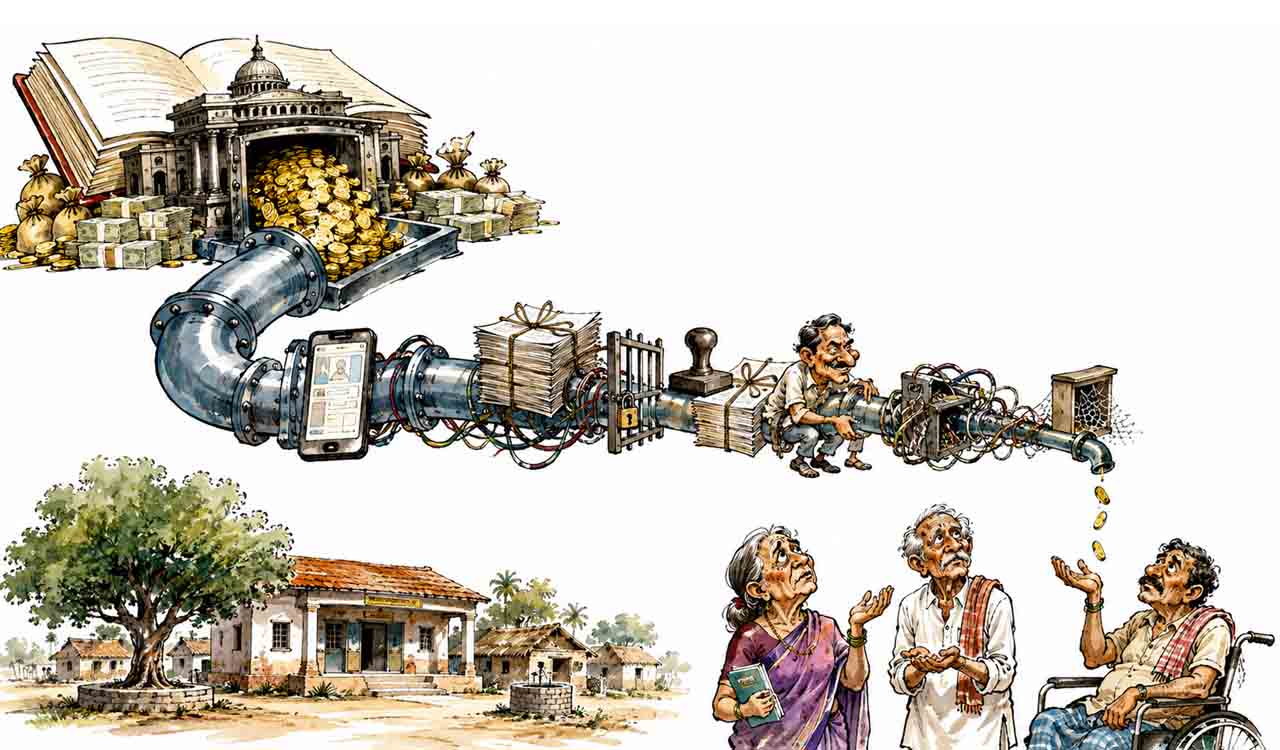
The real test of welfare is simple: money should reach the person it is intended for, on time. Narkuda shows that the social security challenge lies in the last mile


By Jayavarma Addepalli, Dr Pratyusna Patnaik
Every year, Telangana’s budget documents announce large sums of money for social security. Lakhs of names are added to pension rolls, accompanied by growth percentages that sound like a success story in themselves. But numbers on a spreadsheet cannot tell us whether an elderly widow in a small hamlet actually gets her pension on the first of the month. They cannot tell us whether a disabled daily-wage worker even knows that a scheme exists for her.
Also Read
To understand that, we have to leave the Budget book behind and walk into a village. That is what a closer look at Narkuda Gram Panchayat in the district lets us do—not as a stand-in for the whole State, but as a small window into a much bigger picture.
Concept Created with Noble Intentions
There are two levels of social security in Telangana. The Centre’s National Social Assistance Program (NSAP) covers old-age, widow, and disability pension as well as a family benefit scheme for households whose main earner dies. These schemes provide at least a couple of hundred rupees a month, which is insufficient for most beneficiaries.
On the other hand, Telangana’s Aasara pension scheme (now known as Cheyutha) pays around Rs 2,160 per month to the elderly, widows, persons with disabilities, single women, weavers, and other vulnerable groups. The State has so far paid around Rs 4,700 crore in pensions to nearly 37 lakh people from October 2018 to June 2021. Allocations have continued to rise, from Rs 22,085 crore for the sector in 2024-25 to Rs 23,158 crore in 2025-26.
However, the money available through central funds under national schemes does not flow easily, and this is an early indicator that money does not always ‘flow the way it is meant to flow’ as envisaged in policy documents.
On paper, therefore, it seems like a generous and well-planned system. However, the true success of any welfare initiative is not measured by the amount of money spent. It is measured by whether the person for whom the scheme is intended actually receives what was promised, on time. From there onward, a spreadsheet is of little help, while a village can tell a great deal.
What Narkuda shows
Narkuda is relatively small with a population of 3,057, comprising 1,585 males and 1,472 females across 611 households. More than a third of the population—1,035—belong to Scheduled Caste communities, while 109 belong to Scheduled Tribe communities.
These are precisely the households for whom social security is most important, particularly if a family member falls ill, grows old, or dies as the main earner. It’s a village like this that a promise such as “inclusion” in welfare policy is put to the test, not in theory, but household by household.
Not all eligible persons are aware of the full pension options available, especially older and less educated people, as outreach efforts end at a poster at the panchayat office. Even those who are aware of the scheme can struggle with applications, which increasingly involve digital processes. Elderly applicants are not always able to navigate these systems without smartphone assistance or access to a help desk.
Additionally, the identification process imposes another barrier to inclusion. When surveys are not regularly updated or are not sufficiently localised, people, particularly informal workers, who genuinely meet the eligibility criteria may not be listed in a survey that was completed elsewhere.
While coverage, enrolment and crores invested are useful measures of success, they can be misleading when it comes to excluded beneficiaries, delayed payments, and low awareness among those for whom the schemes are intended
Even when the person has enrolled for a pension, the payment is not always forthcoming. Administrative delays and technical problems can result in payments being delayed by two or three weeks. For families living close to the poverty line, such a delay can matter, particularly when there is no explanation for it.
The real value of the pension also declines over time if the amount remains unchanged while the cost of living rises. Informal demands for assistance in paperwork from intermediaries make it difficult for beneficiaries to lodge grievances. Many also have limited access to grievance redressal systems. This means that a lot of grievances are never resolved. These are not problems specific to Narkuda, but they are seldom addressed in budget documents.
What Narkuda shows is the well-known policy intent vs last-mile delivery disconnect. While coverage, enrolment, and crores invested are good measures of success, they can be misleading when it comes to the number of excluded beneficiaries, delayed payments, and low awareness among those for whom the schemes are intended. Digital systems, designed to make things quicker, can be another hurdle if they are not properly coordinated to assist users in navigating them, and if the Centre’s coordination with the State is not robust enough.
The Solution
There’s no need for a new law for any of these fixes. Awareness campaigns need to go beyond posters and websites. Door-to-door drives, panchayat meetings, local radio, and community volunteers could reach households with low literacy rates that are not adequately served by awareness campaigns. There should be an offline and assisted process for applying and renewing pensions, in addition to the digital process, with a help desk at every panchayat office and basic digital training for those who need it.
If the beneficiary list is incorrect, none of this will work. Identification should, therefore, rely on fresh, local surveys rather than static lists to identify informal workers or households that have been missed. Disbursement timelines need to be monitored and reported at the panchayat level rather than being lost in a Statewide average. A fixed payment date and SMS alerts should also be introduced to ensure that delays become visible and can be resolved. There should be regular adjustments to pension levels to take inflation into account.
Direct bank transfers of pension payments should be expanded to eliminate middlemen. There should also be a functional grievance-redressal system rather than a distant helpline, so that people can raise issues directly. Information sharing between the Centre and the State must improve.
The Real Measure of Success
No single village can represent the whole State, and the case of Narkuda does not conclude the debate on Telangana’s social security system. However, it demonstrates something that Budget papers cannot. When a scheme is announced, and a budget approved, welfare policy does not end. It starts when somebody — a widow or an old farmer or a handicapped man — receives the money, on time, without having to struggle for it.
The real measure of success is not the number of people covered or the crores invested, but whether a story like Narkuda is the exception rather than the rule. It will not be another announcement, but the discipline to fix the last mile.
(Jayavarma Addepalli is pursuing Master of Public Policy, Indian Institute of Technology Tirupati, and Dr Pratyusna Patnaik is Assistant Professor, National Institute of Rural Development & Panchayati Raj [NIRDPR], Hyderabad)

Related News