Scientists find key building block for life on Saturn’s moon
Scientists found that ice grains on Saturn's satellite Enceladus contain a rich array of minerals and organic compounds
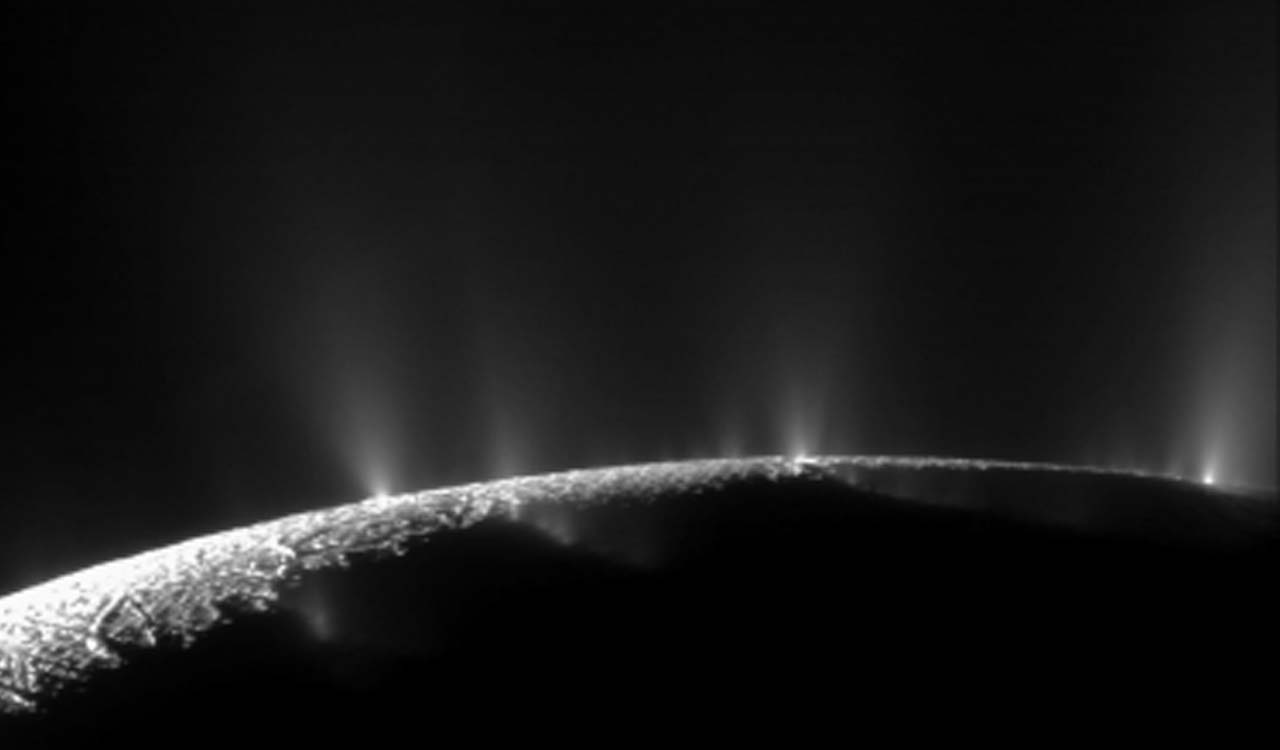


Washington: Scientists found that ice grains on Saturn’s satellite Enceladus contain a rich array of minerals and organic compounds — including the ingredients for amino acids associated with life.
The Cassini spacecraft, which explored Saturn and its system of rings and moons for over 13 years, from 2004 to 2017, discovered Enceladus’ subsurface liquid water. They analysed samples in a plume of ice grains and gases erupting into space from cracks in the moon’s icy surface.
Also Read
Data from Cassini’s Cosmic Dust Analyzer showed the presence of sodium phosphates, suggesting that phosphorus is readily available in Enceladus’ ocean as phosphates.
Phosphorus, the least abundant of the essential elements necessary for biological processes, hadn’t been detected until now. The element is a building block for DNA, which forms chromosomes and carries genetic information, and is present in the bones of mammals, cell membranes, and ocean-dwelling plankton.
Phosphorus is also a fundamental part of energy-carrying molecules present in all life on Earth. Life wouldn’t be possible without it.
“We found phosphate concentrations at least 100 times higher in the moon’s plume-forming ocean waters than in Earth’s oceans,” said Dr. Christopher Glein, a planetary scientist and geochemist at Southwest Research Institute’s (SwRI) in Texas.
Previous analysis of Enceladus’ ice grains revealed concentrations of sodium, potassium, chlorine, and carbonate-containing compounds, and computer modelling suggested the subsurface ocean is of moderate alkalinity – all factors that favour habitable conditions.
“High phosphate concentrations are a result of interactions between carbonate-rich liquid water and rocky minerals on Enceladus’ ocean floor and may also occur on a number of other ocean worlds,” Glein said.
“This key ingredient could be abundant enough to potentially support life in Enceladus’ ocean; this is a stunning discovery for astrobiology,” he added.
Although the science team is excited that Enceladus has the building blocks for life, Glein stressed that life has not been found on the moon — or anywhere else in the solar system beyond Earth.
“Having the ingredients is necessary, but they may not be sufficient for an extraterrestrial environment to host life. Whether life could have originated in Enceladus’ ocean remains an open question.”
The Cassini-Huygens mission was a cooperative project of NASA, ESA (European Space Agency), and the Italian Space Agency. Cassini’s mission came to an end in 2017, with the spacecraft burning up in Saturn’s atmosphere, but the trove of data it collected will continue to be a rich resource for decades to come.

Related News
-

Spectacular cosmic show to light up Hyderabad skies in November, December
-
Hyderabad: Three GRIET professors feature among Stanford’s World’s Top 2 pc Scientists
-
Kamoʻoalewa may be moon fragment, scientists continue investigation
-
Scientists discover new gene-linked type of diabetes in babies under six months