Saturday, Oct 10, 2026
English News
  • Hyderabad
  • Telangana
  • AP News
  • India
  • World
  • Entertainment
  • Sport
  • Science and Tech
  • Business
  • Rewind
  • ...
    • NRI
    • View Point
    • cartoon
    • My Space
    • Education Today
    • Reviews
    • Property
    • Lifestyle
E-Paper
  • NRI
  • View Point
  • cartoon
  • My Space
  • Reviews
  • Education Today
  • Property
  • Lifestyle
Home | Lifestyle | Study Explains How Breast Cancer Evolves

Japanese researchers have revealed mechanism how breast cancer evolves as entire process

The team from the Kyoto University showed the mechanism by which breast cancer is formed in the cells of the mammalian epithelium, whose main function is to secrete milk.

By IANS
Updated On - 4 September 2023, 04:29 PM
Japanese researchers have revealed mechanism how breast cancer evolves as entire process
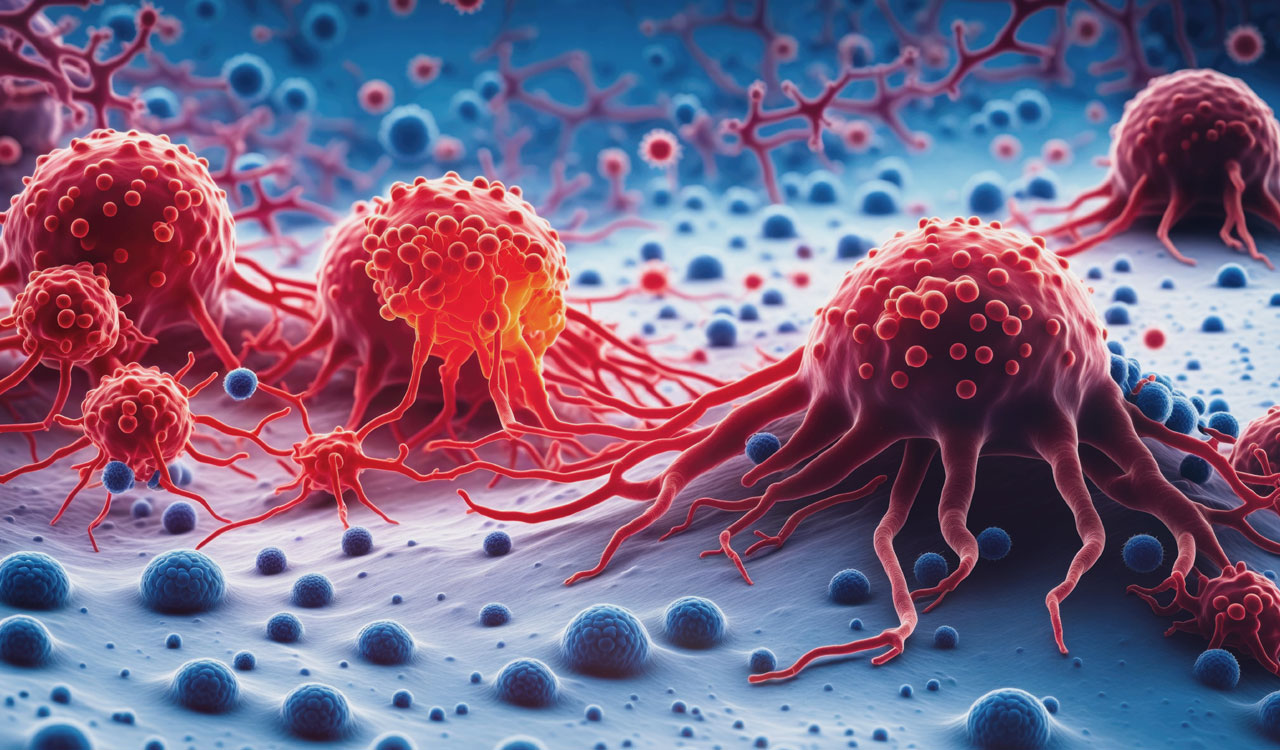
Representational image.
whatsapp facebook twitter telegram

Tokyo: Japanese researchers have revealed the mechanism how breast cancer evolves as the entire process — from the early stages of cell mutations starting in puberty to their manifestations as breast cancer in later years — has remained shrouded in mystery.

The team from the Kyoto University showed the mechanism by which breast cancer is formed in the cells of the mammalian epithelium, whose main function is to secrete milk.

Also Read

  • Breast cancer predominantly a lifestyle disease, is preventable: Experts
  • Study demonstrates how to avoid cardiac damage in breast cancer patients

The findings are published in the journal Nature. According to the team’s first analysis, approximately 20 mutations accumulate annually in each epithelial cell until menopause. After menopause, however, the mutation rate significantly decreases.

“Additionally, our results suggest that oestrogen influences mutation accumulation in mammary epithelium, which correlates with our discovery of decreased accumulation after childbirth,” said Seishi Ogawa from the varsity’s Graduate School of Medicine.

As 70 per cent of breast cancers are understood to be oestrogen-sensitive, Ogawa’s team may shed light on oestrogen’s role in the initiation of breast cancer. Further investigation of the genetic relationship between breast cancer, its surrounding lesions, and normal epithelial cells led to mapping breast cancer’s translocation-positive expansion.

During this expansion process, cells of multiple origins that would subsequently develop breast cancer manifested themselves at the average age of 30. Previous studies have focused on driver mutations — the genetic changes in cells that are already cancerous — leading to abnormal growth.

But these findings only paint a partial picture of the process and do not reveal the timing and order of driver mutations or cancer formation. “Normal-looking tissues may already contain numerous populations of non-cancer cells — or clones — that have acquired mutations in cancer-related genes,” said co-author author Tomomi Nishimura from the Graduate School of Medicine at the varsity.

After examining the similarities and differences in the mutations of both cancer and non-cancer lesions originating from the clones, the team reconstructed an evolutionary tree to visualise the unique pattern of cancer evolution. “Our study brings us closer to exposing the clinical profile of oestrogen-sensitive breast cancer, particularly in pre-menopausal women, potentially aiding cancer risk monitoring and prevention,” Ogawa said.

Join Our Whatsapp Channel
  • Follow Us :
As preferred source
  • Tags
  • breast cancer
  • mammary epithelium

Related News

  • Preventable infections linked to thousands of cancer cases in Telangana

    Preventable infections linked to thousands of cancer cases in Telangana

  • SC takes suo motu cognisance of access to life-saving cancer medicines

    SC takes suo motu cognisance of access to life-saving cancer medicines

  • Editorial: Alarming rise in breast cancer cases in India

    Editorial: Alarming rise in breast cancer cases in India

  • Hyderabad and Kolkata scientists develop smart metal agents to combat aggressive breast cancer

    Hyderabad and Kolkata scientists develop smart metal agents to combat aggressive breast cancer

Latest News

  • Mohammed Siraj set to lead Hyderabad against Tripura in Ranji opener

    5 minutes ago
  • KTR demands action against Gajwel MRO over alleged remarks to farmer

    10 minutes ago
  • Vaidehee Chaudhari clinches third Fenesta Open crown

    14 minutes ago
  • Telangana men’s and women’s baseball teams prepare for South Zone championships

    20 minutes ago
  • Mamata, Kejriwal and Pinarayi Vijayan detained amid anti-CEC protest

    26 minutes ago
  • Archery Premier League takes 80 tribal school students closer to the sport

    30 minutes ago
  • Priyanka Gandhi slams detention of protesters, accuses Centre of undermining democracy

    34 minutes ago
  • Truck owner found dead in lorry cabin in Khammam; police investigate

    40 minutes ago

company

  • Home
  • About Us
  • Contact Us
  • Privacy Policy

business

  • Subscribe

telangana today

  • Telangana
  • Hyderabad
  • Latest News
  • Entertainment
  • World
  • Andhra Pradesh
  • Science & Tech
  • Sport

follow us

  • Telangana Today Telangana Today
Telangana Today Telangana Today

© Copyrights 2024 TELANGANA PUBLICATIONS PVT. LTD. All rights reserved. Powered by Veegam

Telangana Today App