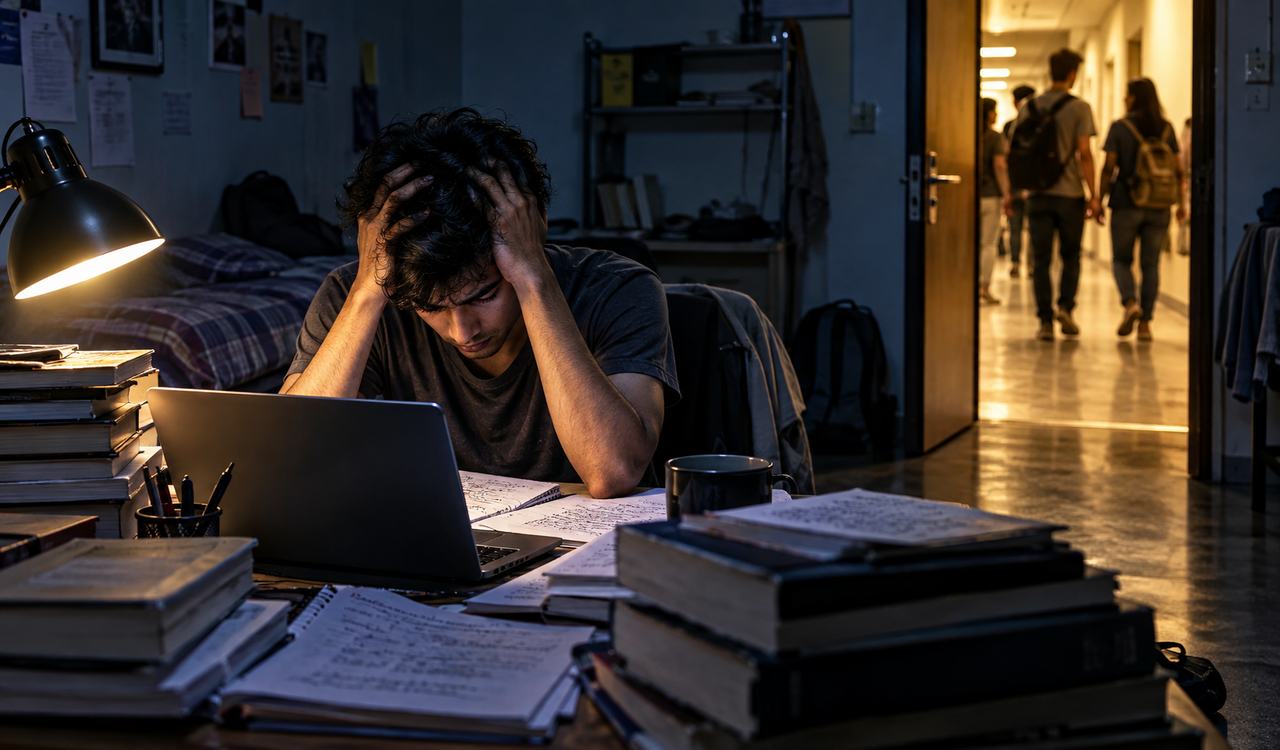
Suppressing negative thoughts may be good for mental health
Suppressing thoughts even improved mental health among participants with likely post-traumatic stress disorder



London: The commonly-held belief that attempting to suppress negative thoughts is bad for our mental health could be wrong, suggests a new study Scientists at the University of Cambridge trained 120 volunteers across 16 countries to suppress thoughts about negative events that worried them, and found that not only did these become less vivid, but that the participants’ mental health also improved.
“We’re all familiar with the Freudian idea that if we suppress our feelings or thoughts, then these thoughts remain in our unconscious, influencing our behaviour and well-being perniciously,” said Professor Michael Anderson from the varsity’s Medical Research Council (MRC) Cognition and Brain Sciences Unit.
Also Read
“The whole point of psychotherapy is to dredge up these thoughts so one can deal with them and rob them of their power. In more recent years, we’ve been told that suppressing thoughts is intrinsically ineffective and that it actually causes people to think the thought more — it’s the classic idea of ‘Don’t think about a pink elephant’,” he said.
These ideas have become dogma in the clinical treatment realm, said Anderson, with national guidelines talking about thought avoidance as a major maladaptive coping behaviour to be eliminated and overcome in depression, anxiety, Post-traumatic stress disorder (PTSD), for example.
Dr. Zulkayda Mamat, from Trinity College, Cambridge believed that inhibitory control was critical in overcoming trauma in experiences occurring to herself and many others she has encountered in life.
She had wanted to investigate whether this was an innate ability or something that was learnt and hence could be taught. “Because of the pandemic, we were seeing a need in the community to help people cope with surging anxiety. There was already a mental health crisis, a hidden epidemic of mental health problems, and this was getting worse. So with that backdrop, we decided to see if we could help people cope better,” Dr. Mamat said.
In the study, published in Science Advances, each participant was asked to think of a number of scenarios that might plausibly occur in their lives over the next two years — 20 negative “fears and worries” that they were afraid might happen, 20 positive “hopes and dreams,” and 36 routine and mundane neutral events.
The fears had to be worries of current concern to them, that have repeatedly intruded in their thoughts. “It was very clear that those events that participants practised suppressing were less vivid, less emotionally anxiety-inducing, than the other events and that overall, participants improved in terms of their mental health. But we saw the biggest effect among those participants who were given practice at suppressing fearful, rather than neutral, thoughts,” Dr. Mamat said.
Suppressing thoughts even improved mental health among participants with likely post-traumatic stress disorder.
Among participants with post-traumatic stress who suppressed negative thoughts, their negative mental health indices scores fell on average by 16 per cent (compared to a 5 per cent fall for similar participants suppressing neutral events), whereas positive mental health indices scores increased by almost 10 per cent.
In general, people with worse mental health symptoms at the outset of the study improved more after suppression training, but only if they suppressed their fears.
This finding directly contradicts the notion that suppression is a maladaptive coping process. “What we found runs counter to the accepted narrative,” said Professor Anderson.
“Although more work will be needed to confirm the findings, it seems like it is possible and could even be potentially beneficial to actively suppress our fearful thoughts.”

Related News