Telangana files petition in Supreme Court challenging AP’s Polavaram-Nallamala Sagar link project
The Telangana government has approached the Supreme Court challenging Andhra Pradesh’s Polavaram–Nallamala Sagar Link Project, alleging violations of water-sharing laws and lack of clearances. The case could affect interstate river management and national river-linking plans.
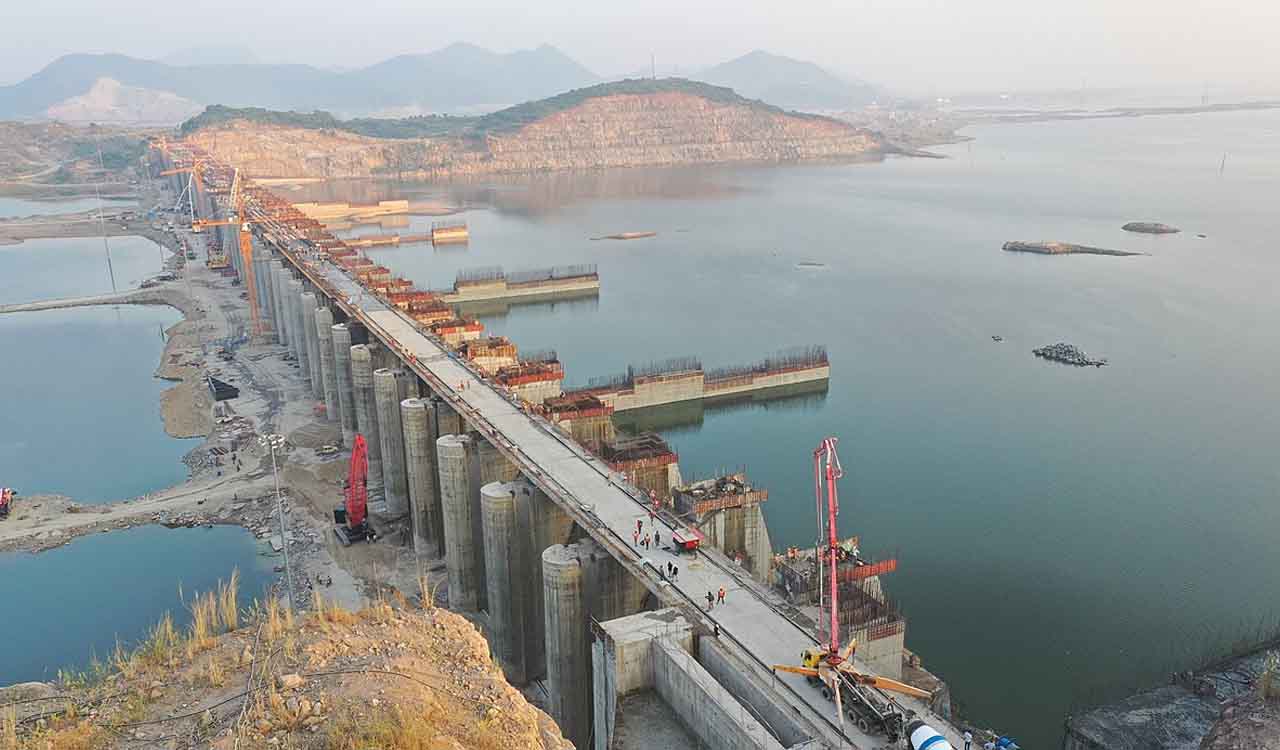


Hyderabad: In a fresh escalation of the interstate water dispute between Telangana and Andhra Pradesh, the Telangana government moved the Supreme Court on Tuesday, challenging the Polavaram-Nallamala Sagar Link Project (PNLP), formerly known as the Polavaram-Banakacherla Link Project (PBLP). The writ petition, filed under Article 32 of the Constitution, seeks a mandamus to restrain Andhra Pradesh from proceeding with the project, which aims to divert surplus floodwaters from the Godavari River to the Krishna and Gundlakamma basins.
The petition accuses Andhra Pradesh of unilaterally advancing the project in violation of the Godavari Water Disputes Tribunal (GWDT) Award of 1980, the Andhra Pradesh Reorganisation Act (APRA) of 2014, and Central Water Commission (CWC) guidelines. It specifically requests an interim stay on ongoing expansion works of the Polavaram project’s Right Main Canal (RMC) and a recent e-procurement tender for preparing the Detailed Project Report (DPR), floated on November 21 and modified on November 24.
The PNLP, estimated at around Rs 58,000 crore, is designed to divert 2 TMC of water per day from the under-construction Polavaram dam on the Godavari. The project comprises three segments: first, enhancing the capacity of the Polavaram RMC from 17,500 cusecs to over 35,000 cusecs or building a parallel canal to feed into the Krishna River; second, constructing the Bollapalli reservoir with a potential storage capacity of up to 400 TMC; and third, lifting water through tunnels in the Nallamala hill range to the Nallamala Sagar reservoir in Prakasam district. It will benefit the Rayalaseema and south coastal regions in Andhra Pradesh.
Telangana contends that the project relies on “flood waters” not apportioned by the GWDT, which allocated dependable flows but left surplus waters undistributed. The petition highlights that Andhra Pradesh has proceeded despite lacking in-principle clearance for the Pre-Feasibility Report (PFR), submitted to the CWC in May 2025 and still under scrutiny.
Key concerns raised include interstate implications, potential submergence risks in Telangana due to Polavaram backwaters, and environmental violations. The petition notes that the Expert Appraisal Committee (EAC) of the Ministry of Environment, Forest and Climate Change returned the proposal in June 2025, directing Andhra Pradesh to first resolve interstate issues with the CWC. Objections have also come from Karnataka and Maharashtra, with the former claiming compensation for Krishna basin diversions and the latter seeking clarity on flood-based project guidelines. Despite these, Andhra Pradesh formed a Special Purpose Vehicle, Jala Harathi Corporation, in April 2025 for execution and issued tenders for the DPR even as the PFR appraisal continues.
The CWC, in its letter on December 4, reportedly directed Andhra Pradesh not to proceed with DPR preparation without clearance, yet bids were received, and an award is imminent, according to the petition. Andhra Pradesh has defended the project as essential for supplying Godavari surplus to backward regions. It cited provisions in the APRA for special development packages. Chief Minister’s letters to the Union Finance Minister in November and December 2024 sought approval and funding under the Godavari-Krishna-Pennar linkage. Telangana argues that allowing unilateral diversion sets a dangerous precedent for equitable management of interstate rivers.
With hearings likely to be scheduled soon, the case could impact national river-linking ambitions and bilateral relations between the sibling States.

Related News