Telangana’s fertility rate projected to fall to 1.5 by 2035, nearing zero population growth
Telangana is set to become one of India’s most demographically mature States as its Total Fertility Rate is projected to fall to 1.5 by 2035. Census and UN reports warn that the State will soon slip below replacement levels, necessitating strong ageing-focused policies.


Hyderabad: Telangana is poised to become one of India’s most demographically mature States, a status that means there will be a near halt to population growth. Projections indicate its Total Fertility Rate (TFR) is to drop to a mere 1.5 by the year 2031-35, based on the ‘Population Projections for India and States 2011-35′, a recent report by Census of India.
The sharp decline, which is accompanied by increased longevity among Telangana’s population, is not just a state-level phenomenon. It is a reflection of the national fertility levels, highlighted in last month’s UNFPA (United Nations Population Fund) in its 2025 ‘State of World Population’ report.
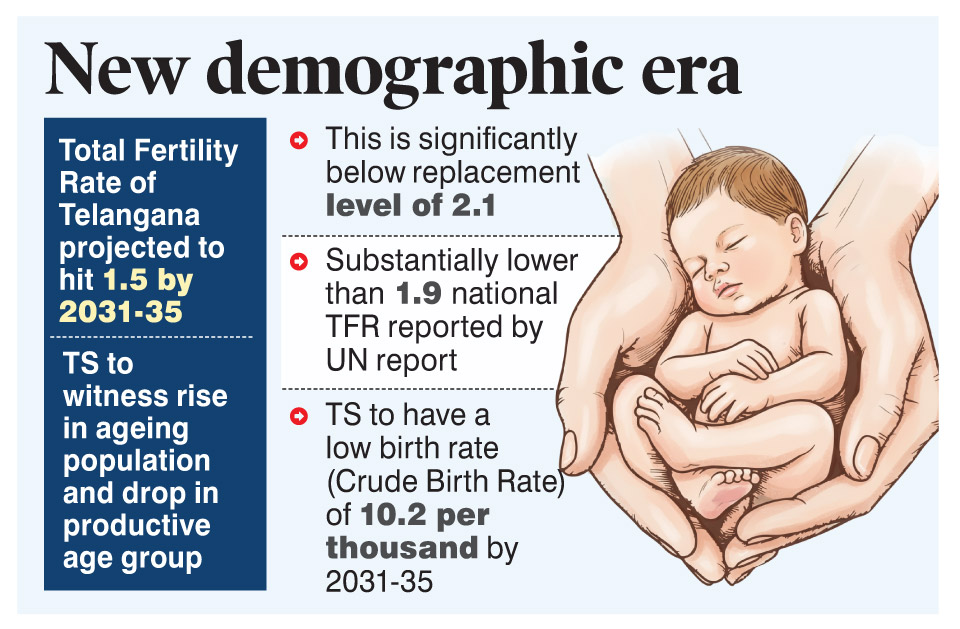
The 1.5 TFR for Telangana is significantly lower than the 1.9 national TFR recently highlighted by the UNFPA (United Nations Population Fund), which makes Telangana a vital state that is driving the country’s shift towards below-replacement fertility.
The ‘Population Projections for India and States 2011-35’ (Census of India), indicates that Telangana’s success in socio-economic development, health access, and education, is resulting in this near halt to population growth.
The State’s Population Growth Rate, at 7.1 per thousand in 2011-15, a period overlapping the erstwhile undivided state, is projected to collapse to a near-zero rate of just 0.3 per thousand in 2031-35.
The sharp decline is evident across decades with the rate dropping from 5.4 (2016-2020) to 3.5 (2021-23) and further to 1.7 by 2026-2030.
The recent population report by the United Nations has indicated that the the real crisis due to dropping total fertility rate is not due to over-population or underpopulation.
The UN report framed the impending drop in fertility rates as a failure to address the reproductive goals and needs of individuals., a clear indication of the preference of the general population to either have fewer children or to postpone the decision to have children.
Based on these reports and data, the population in Telangana, in the coming decades, will reach below replacement levels of population, which means the population is no longer producing enough children to replace the previous generations.
In its report, the United Nations has urged regions that will witness such population crisis to focus on policies supporting ageing population, managing their healthcare demands and ensuring adequate social security measures.

Related News