Andhra’s Pothireddypadu expansions threaten Telangana’s Krishna River share
Telangana has accused Andhra Pradesh of unauthorised expansions of the Pothireddypadu Head Regulator, alleging excessive Krishna water drawals that threaten its share and aggravate the inter-State river dispute amid low reservoir levels.
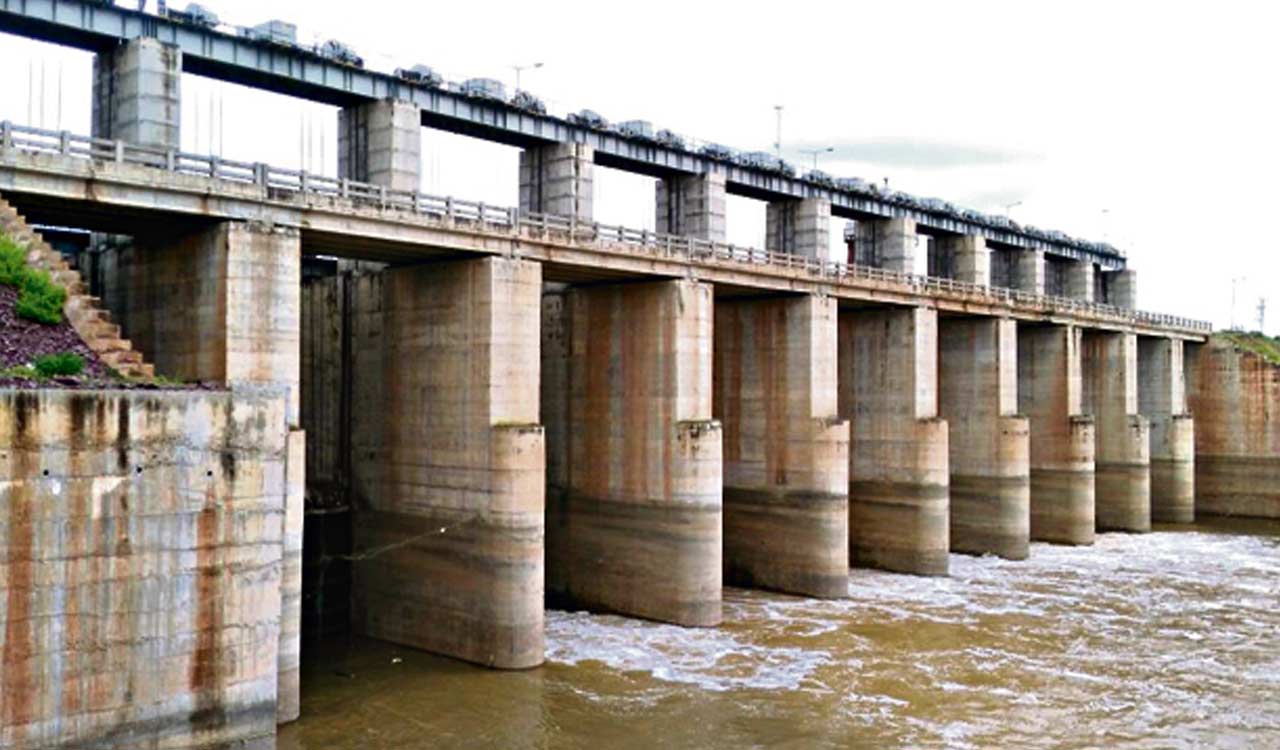


Hyderabad: What began as a modest inter-State agreement to supply drinking water to Chennai and irrigate drought-prone Rayalaseema has evolved into a major flashpoint in the ongoing Krishna River water dispute between Telangana and Andhra Pradesh.
The Pothireddypadu Head Regulator (PRP), located on the foreshore of the Srisailam Reservoir in Andhra Pradesh’s Nandyal district is turning out to be the centre of escalating tensions, with Telangana accusing Andhra Pradesh of unauthorized expansions that could deprive it of its minimum entitlements.
Originally conceived as part of the Telugu Ganga Project, the PRP was formalized in 1983 under accords where Maharashtra, Karnataka, and undivided Andhra Pradesh agreed to spare 15 TMC (thousand million cubic feet) annually, 5 TMC each, for Chennai’s drinking water needs. The initial capacity was limited to 1,500-4,960 cusecs during flood periods (July-October), strictly for surplus water.
However, over decades, successive Andhra Pradesh governments have enhanced the regulator’s capacity. From 11,150 cusecs in the 1980s to support the Srisailam Right Bank Canal, it rose to 44,000-55,000 cusecs by 2006 under Y.S. Rajasekhara Reddy, and further proposals aimed at 80,000-88,000 cusecs or more. Recent works include lining and widening the linked Srisailam Right Main Canal (SRMC) from enhancing its water carrying capacity enabling potential daily lifts of 7 TMC over 30 flood days, totaling up to 210 TMC annually.
These expansions feed multiple projects including Telugu Ganga, Galeru-Nagari Sujala Sravanthi (GNSS), Handri-Neeva Sujala Sravanthi (HNSS), and KC Canal, primarily benefiting Rayalaseema’s Kurnool, Anantapur, YSR Kadapa, and Chittoor districts, besides upland Nellore areas. In 2025, under Chief Minister N. Chandrababu Naidu, fresh priorities have been set including completion of the HNSS canal widening (554 km at Rs 3,873- Rs 3,890 crore), with water reaching tail-end reservoirs like Jeedipalli for the first time in decades, boosting groundwater and irrigating lakhs of acres.
Telangana views this as a grave threat. Lacking adequate storage compared to Andhra Pradesh’s downstream advantages, Telangana argues that excessive drawals through PRP, often exceeding entitlements, leave it disadvantaged. In the 2025-26 water year so far, Andhra Pradesh has drawn approximately 533-535 TMC from joint Krishna projects, including around 195 TMC via PRP alone, against Telangana’s 117-120 TMC. Over the past 11 years, similar patterns have persisted, with Andhra Pradesh allegedly guzzling hundreds of TMC beyond allocations, even in deficit years.
Telangana has repeatedly complained to the Krishna River Management Board and tribunals, labeling expansions ‘illegal’ and violative of the Andhra Pradesh Reorganisation Act 2014, which requires approvals for new and enhanced projects. Complaints in 2025 highlighted brisk lining works on SRMC and unauthorized capacity increases, urging KRMB restraints. Telangana demands equitable sharing based on its 68 percent catchment area contribution, seeking ~70% of the 811 TMC allocated to undivided Andhra Pradesh by KWDT-I (currently split 512:299 TMC favouring Andhra Pradesh).
As the common reservoirs like Srisailam and Nagarjuna Sagar hold limited stocks (total 299 TMC above minimum drawdown levels recently), the conflict has started escalating. Telangana warns of irreversible harm to in-basin needs, including Nagarjuna Sagar ayacut and Hyderabad’s drinking water. With KWDT-II proceedings still in progress for redistribution, and potential Apex Council interventions likely, the PRP’s transformation from a limited off-take to a massive diversion channel triggered serious riparian concerns.

Related News
-

TGSRTC to pick up Dasara travellers from residential colonies, hostels
-
‘Their courage will forever inspire generations’: T’gana, Andhra leaders greet air warriors on India Air Force Day
-
Chikitha Taniparthi looks to build on Asian Games gold in APL Season 2
-
Chandrababu Naidu, Pawan Kalyan congratulate PM Modi on 25 years in public office