Congress opens Telangana’s doors for global lenders
The political confrontation between Chief Minister A Revanth Reddy and Union Minister G Kishan Reddy over Metro Rail funding has highlighted Telangana's increasing dependence on international lending agencies, marking a significant departure from the borrowing strategy followed by previous governments.


Hyderabad: The ongoing war of words between Chief Minister A Revanth Reddy and Union Minister G Kishan Reddy over the Hyderabad Metro Rail has inadvertently exposed a significant shift in Telangana’s fiscal strategy. The Congress government has thrown open the doors to international lending agencies that the previous BRS government had largely kept at arm’s length due to concerns over policy-linked conditions and external oversight.
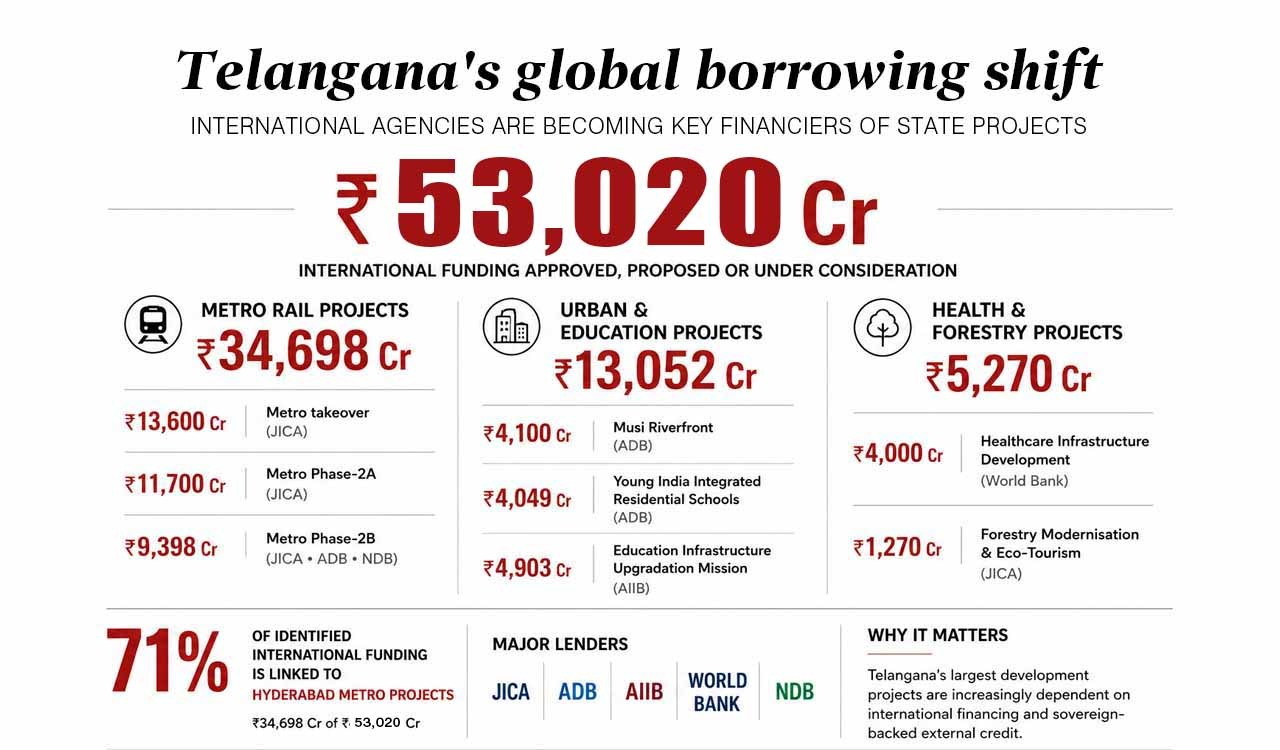
While accusing the Centre of blocking a proposed Rs 13,600-crore loan, Revanth Reddy revealed that the funding was being sourced from a Japanese organisation, with the Indian Railway Finance Corporation (IRFC) acting merely as a facilitator. Officials have since confirmed that the organisation is the Japan International Cooperation Agency (JICA).
Kishan Reddy responded by highlighting that the Centre had already facilitated a Rs 4,100-crore loan from the Asian Development Bank (ADB) for the Musi rejuvenation project and had also provided Telangana with another Rs 11,000 crore in interest-free loans.
However, the larger story lies beyond the political sparring. Since assuming office, the Congress government, which has been borrowing extensively through the auction of State securities as well as from the Centre, public sector banks and private banks, has now turned to international agencies to finance its ambitious projects.
Apart from the proposed Rs 13,600-crore JICA loan for the Metro Rail takeover, the State has sought another Rs 11,700 crore from JICA for Hyderabad Metro Rail Phase-2A. In June last year, the State Cabinet approved a proposal to raise Rs 9,398 crore in the form of loans from agencies such as JICA, ADB and the New Development Bank (NDB) for Metro Phase-2B.
The Centre also approved external multilateral funding of Rs 4,049 crore from the ADB for Young India Integrated Residential Schools and another Rs 4,903 crore from the Asian Infrastructure Investment Bank (AIIB) for the Telangana Education Infrastructure Upgradation Mission.
In addition, the World Bank has agreed in principle to extend around Rs 4,000 crore for strengthening Telangana’s healthcare infrastructure. Surprisingly, the Forest department too has proposed a Rs 1,270-crore JICA-funded programme for forestry modernisation and eco-tourism initiatives. Earlier, JICA had also signed a loan agreement to support Telangana’s startup and innovation ecosystem.
The cumulative picture suggests that international lenders are becoming increasingly central to Telangana’s development financing model, a trend that was largely witnessed in undivided Andhra Pradesh during the TDP regime.
For the uninitiated, loans obtained by the then TDP government from international agencies led to the implementation of electricity reforms, which eventually culminated in the Basheerbagh firing incident in 2000, in which three persons were killed during protests. The episode is widely believed to have contributed to the eventual decline of the TDP government.
In the aftermath, successive Congress governments in erstwhile Andhra Pradesh and later the K Chandrashekhar Rao government after Telangana’s formation largely avoided international lending agencies. The previous BRS government relied on domestic institutions such as the Rural Electrification Corporation (REC) and other central financing agencies despite comparatively higher interest rates.
Financial experts point out that multilateral funding from international agencies often comes with extensive compliance requirements, monitoring mechanisms and policy conditions that could constrain government decision-making. They cautioned that while Revanth Reddy has highlighted the availability of loans at around four per cent interest, such arrangements could potentially increase the influence of external agencies on policy decisions.
Ironically, while the Congress government frequently accuses the Centre of withholding support, many of its flagship projects now depend on foreign credit lines that require New Delhi’s approval and sovereign backing. In fact, the Centre approved such loans worth nearly Rs 15,000 crore over the last year. The Revanth Reddy-Kishan Reddy confrontation may have begun as a political blame game, but it has laid bare Telangana’s growing reliance on international financial institutions to fund its development agenda.

Related News