Fish waste to wealth: Telangana’s Gorrekunta shows the way
On World Fisheries Day, the Gorrekunta initiative demonstrates how discarded fish resources can be transformed into economic assets, creating livelihood opportunities for fisherwomen and promoting a sustainable circular rural economy


By Pittala Ravinder
On World Fisheries Day, November 21, while governments, fisheries experts and fishing communities discuss the future of the fisheries sector, perhaps it is time to ask a different question: How much wealth are we throwing away after harvesting and selling fish?
Also Read
Fish is a valuable source of nutrition, livelihood and economic activity. Yet, every day, fish markets across the country generate enormous quantities of discarded material in the form of fish heads, entrails, scales, bones, skin and other processing residues. Much of this material is dumped without proper treatment, creating foul odour, unhygienic conditions and environmental concerns.
But what if this so-called waste could become a source of additional income? What if the discarded portions of fish could be converted into organic fertilizers, compost and protein-rich animal-feed ingredients? And what if fishing communities, particularly fisher-women, could become entrepreneurs in this emerging field? An interesting experiment taking shape at Gorrekunta, near Warangal in Telangana, offers a possible answer.
Small beginning, larger vision
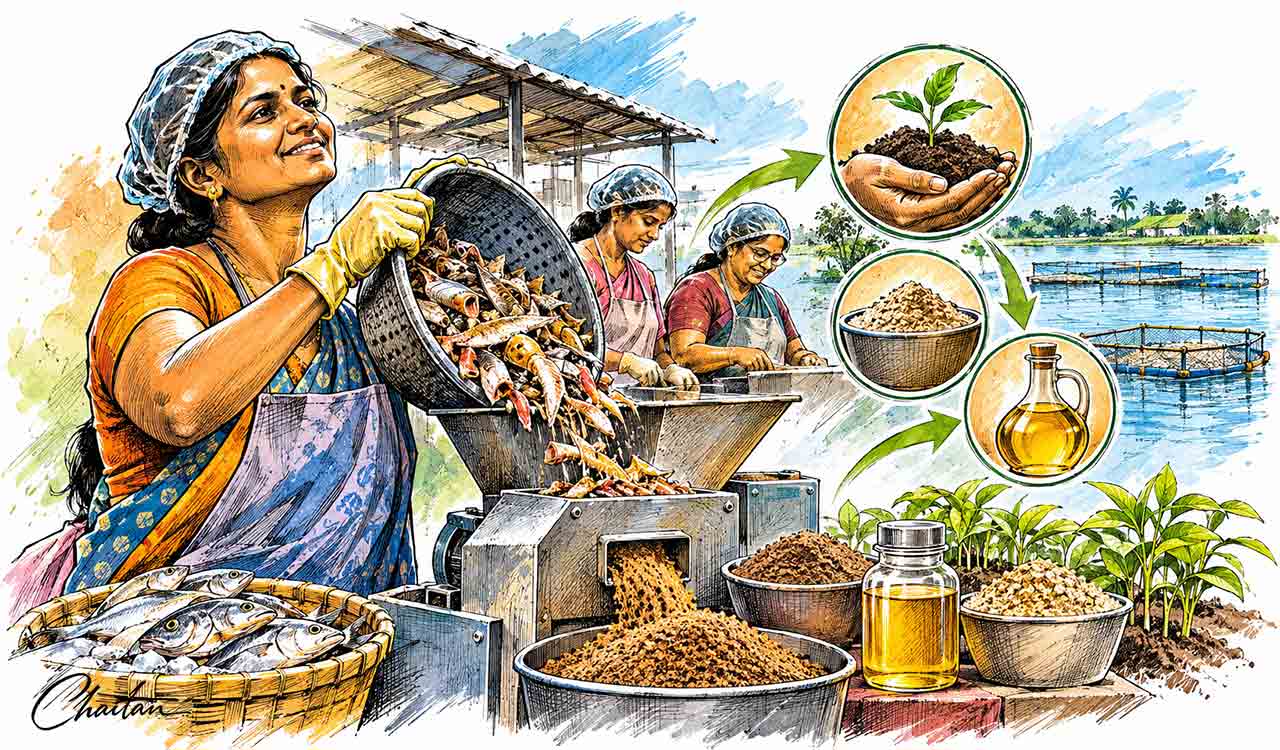
Approximately three years ago, an initiative was introduced at Gorrekunta to help local fisherwomen convert fish-market waste into useful agricultural products. With the initiative of this writer and the technical support of Prakriti Environment Society (PES), the Gorrekunta Fisher-women Cooperative Society began producing Fish Amino Acid (FAA) and organic fish compost on a small scale.
The process was relatively simple. Fresh fish waste was mixed with jaggery in equal quantities and allowed to ferment for approximately 45 days. The mixture was stirred regularly, after which the liquid was separated, filtered and bottled. The remaining solid material was retained for further processing into organic compost.
What began as a modest experiment gradually developed into an encouraging community-level activity. The fisherwomen acquired practical experience, farmers showed interest in the products and the initiative demonstrated that discarded fish material could be converted into economically useful agricultural inputs.
Laboratory testing of the existing Fish Amino Acid recorded 0.58 per cent nitrogen, 5.13 per cent calcium and 0.16 per cent potassium, along with zinc and trace minerals. The findings indicated a distinctive calcium-rich composition, although further technical improvements are necessary to enhance and standardise its nutrient profile.
The experience has now attracted the attention of the Warangal district administration. The District Collector and District Fisheries Officer, encouraged by local Parkal MLA Revuri Prakash Reddy, have responded positively to the proposal for expanding the small venture into a medium-scale commercial unit. The district administration has proposed allotting approximately two acres of land at Gorrekunta free of cost.
This is an encouraging development, particularly because it recognises the potential of a grassroots innovation and the entrepreneurial capabilities of local fisherwomen.
Three products, one resource
The proposed Gorrekunta project is not intended to remain confined to manufacturing liquid fertilizer and compost. Its larger vision is to develop an integrated fish-waste processing facility capable of recovering multiple useful products from the available raw material. The proposed unit will have an initial processing capacity of one tonne of fish waste per day and will focus on three principal products.
• Fish Amino Acid – Liquid agricultural input
Fish Amino Acid is obtained through controlled fermentation of fish material. It contains organic matter and nutrients that may support plant growth and soil biological activity. Its actual agricultural performance depends on its composition, quality and application.
With appropriate machinery, standardised fermentation, filtration and quality-control systems, the existing Gorrekunta product can be developed into a more consistent commercial agricultural input.
Research institutions can help improve the process through better fermentation techniques, enzymatic hydrolysis and appropriate formulation methods. The objective should be to develop a scientifically validated product rather than simply increase production.
• Organic fish compost—turning residues into soil wealth
The solid material remaining after the extraction of liquid FAA can be converted into organic fish compost. By mixing the residue with suitable agricultural waste and carbon-rich organic materials, followed by controlled composting and approximately six months of maturation, a valuable organic manure can be produced. This offers an opportunity to recover nutrients from discarded fish material while supporting farmers seeking alternative organic soil inputs.
• Fish protein powder—recovering nutritional wealth
The third product could open an entirely new avenue for fisheries-based entrepreneurship. Fish waste contains valuable proteins, particularly in the flesh, heads, skin and other protein-bearing portions. Through appropriate segregation, drying, grinding and processing, selected material can be converted into fish protein meal or powder.
An initial technical assessment of a dried fish-waste sample reported approximately 41 per cent crude protein. However, it also identified a high calcium-to-phosphorus ratio and potential microbial and heavy-metal concerns.
Therefore, the present powder cannot be recommended as a human dietary supplement. The immediate opportunity lies in developing a properly processed, tested and certified feed-grade product for aquaculture and animal-feed industries.
Institutions such as the ICAR-Central Institute of Fisheries Technology (CIFT) and ICAR-Central Institute of Freshwater Aquaculture (CIFA) could provide valuable assistance in developing suitable processing methods, nutritional standards and quality-control protocols.
The three products offer different commercial opportunities and can diversify the income base of the proposed enterprise. However, all three cannot be produced by counting the same material twice. A scientific assessment must determine how much of the incoming fish waste should be allocated to fermentation, composting and protein recovery. Their respective yields and production economics must be established through pilot trials.
From waste disposal to a circular economy
The real significance of this initiative lies in its underlying philosophy. For decades, the fisheries sector has largely concentrated on increasing fish production, improving marketing facilities, providing cold storage, promoting exports and supporting fishermen’s livelihoods. These remain important priorities. But the next stage of development must also address what happens to the material left behind after fish is processed and marketed.
The Food and Agriculture Organization (FAO) recognises circular-economy approaches as an important means of reducing losses and converting fish-processing by-products into useful products such as fishmeal, fertilizers, animal feed and other valuable resources.
The Gorrekunta proposal seeks to translate this principle into a practical community-owned enterprise. Its objective is to achieve maximum utilisation of collected fish-derived material. The liquid fraction will be processed into FAA, selected protein-rich material will be diverted for protein recovery, and suitable remaining solids will be converted into compost. Proper treatment and management of process water will also be essential.
In other words, the intention is to move from a waste-disposal approach towards a resource-recovery system. Such an approach can improve fish-market sanitation, reduce environmental nuisance, generate additional income and create new economic linkages between fisheries and agriculture.
An opportunity for fisherwomen, entrepreneurs
One of the most encouraging aspects of the Gorrekunta initiative is the central role assigned to fisherwomen. Women are actively involved in fish vending, cleaning, processing and marketing, but their participation in organised value addition and manufacturing remains limited in many places.
A properly supported fish-waste processing enterprise can provide them with an opportunity to move beyond traditional activities and become owners and managers of a manufacturing unit. The proposed two-acre facility could accommodate fermentation vessels, processing machinery, composting yards, drying equipment, packaging sections, storage facilities and a basic quality-control laboratory.
At a proposed intake capacity of one tonne per day and approximately 300 working days annually, the unit could handle around 300 tonnes of fish waste. The preliminary project estimate is Rs 1.50 crore, although the introduction of the fish-protein processing section will require a revised technical and financial assessment.
More importantly, the model need not remain confined to Gorrekunta. Similar enterprises could be established through fisherwomen cooperatives, fishermen’s societies, self-help groups and rural entrepreneurs in other fish-producing districts.
The availability of fish waste in local markets can provide the raw material, while agricultural and aquaculture enterprises can become potential customers for the finished products.
Role of scientific institutions
While the concept offers considerable promise, its commercial success will depend on scientific validation and professional management. The fermentation process must be standardised. Product quality must remain consistent. The compost must satisfy applicable organic-manure specifications. The fish protein product must meet the relevant feed-safety and nutritional standards.
Research institutions such as ICAR-CIFT, ICAR-CIFA, ICAR-CIFRI and ICAR-CIFE, along with agricultural and veterinary universities, can play an important role in this transformation. The National Fisheries Development Board (NFDB), the Department of Fisheries, Government of Telangana, and the Union Ministry of Fisheries, Animal Husbandry and Dairying should explore appropriate technical and financial support under applicable programmes.
The Agriculture and Horticulture Departments can facilitate field demonstrations and market linkages for FAA and compost, while aquafeed and animal-feed manufacturers can help evaluate the commercial potential of the protein product.
A phased approach, beginning with the proven small-scale experience and gradually introducing scientifically validated products, would minimise investment risks and improve commercial sustainability.
Let Gorrekunta become a national example
India’s fisheries sector has made remarkable progress in fish production, aquaculture, exports and infrastructure development. Yet, the potential of fish-waste utilisation remains an area that deserves much greater attention.
World Fisheries Day should not merely be an occasion to celebrate production achievements or discuss the welfare of fishing communities. It should also encourage fresh thinking, technological innovation and new avenues of income generation.
The Gorrekunta initiative offers an opportunity to bring these objectives together. It demonstrates how a discarded resource can become an economic asset, how fisherwomen can become entrepreneurs and how fisheries can establish productive linkages with agriculture and animal nutrition.
Perhaps the future of fisheries development should not be measured only by how much fish we produce and sell, but also by how intelligently we utilise every part of the resource we harvest. The fish we sell feeds people. The waste we recover can feed farms, support livestock and aquaculture, and generate new livelihoods. That is the larger promise of Gorrekunta.
From pond to farm, from waste to wealth – it is time to turn India’s fish markets into centres of resource recovery and rural entrepreneurship.
(The author is a senior journalist, Convener of the Singareni Affected Areas Research Community — SAARC and State Convener of the Telangana Astitva Vedika-TAV)

Related News