ICRISAT, University of Queensland partner to accelerate climate-resilient crop breeding for dryland farmers
ICRISAT has partnered with the ARC Training Centre in Predictive Breeding for Agricultural Futures to integrate advanced genomic prediction tools into crop improvement programmes, aiming to accelerate the development of climate-resilient dryland crop varieties for farmers facing growing climate challenges.
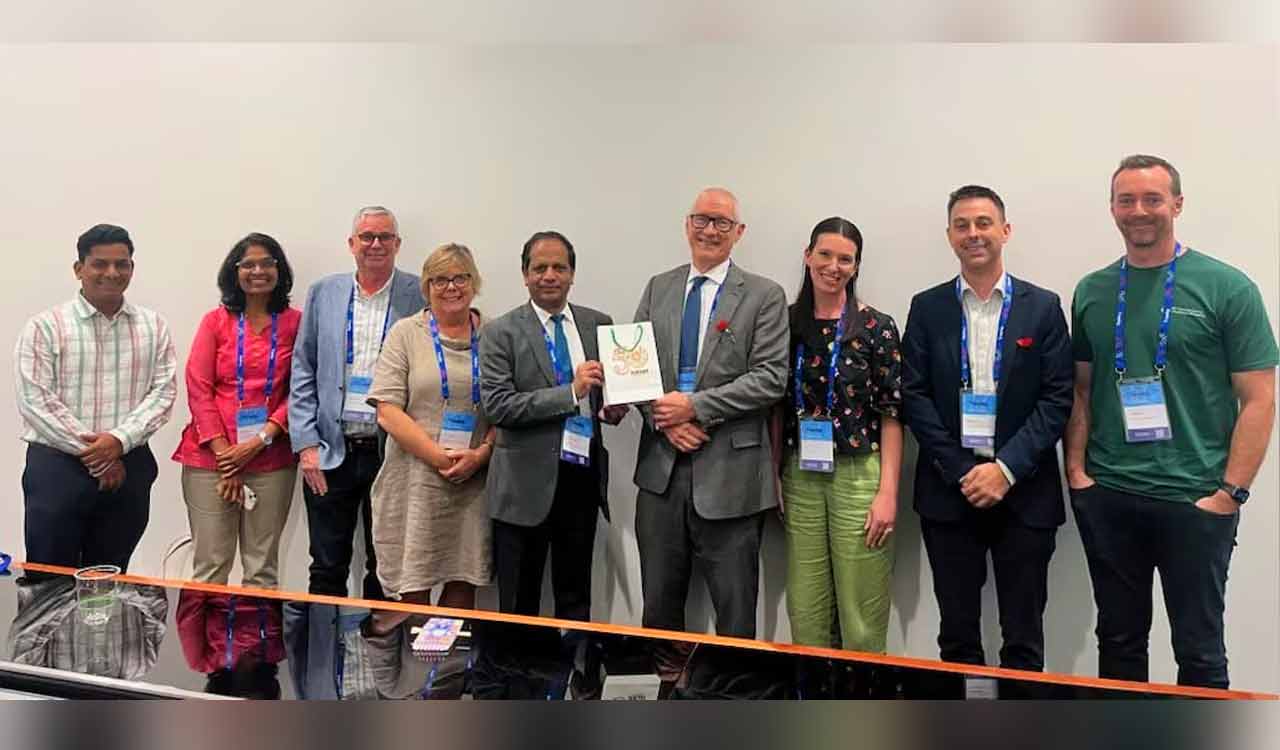


Sanagreddy: Through a newly signed Memorandum of Understanding, International Crop Research Institute for Semi-arid Tropics (ICRISAT) will collaborate with the ARC Training Centre in predictive breeding for agricultural futures to integrate cutting-edge genomic prediction tools and simulation-based breeding strategies into its crop improvement pipelines.
The partnership aims to significantly accelerate the development of improved varieties of key dryland crops, helping farmers adapt to intensifying climate stress, emerging pests and diseases, and growing food demand. By combining predictive breeding technologies with ICRISAT’s extensive breeding networks, the collaboration will optimise breeding strategies and shorten the time required to deliver improved crop varieties. These innovations are expected to increase genetic gains while reducing the cost, time, and resources required to develop new cultivars, according to a press release.
Director General of ICRISAT Dr Himanshu Pathak said dryland agriculture was on the frontline of climate change . “Farmers in these regions cannot wait decades for improved crop varieties. Predictive breeding allows us to anticipate which genetic combinations will perform best before they are even field-tested,” he said.
ICRISAT has already implemented rapid breeding cycle protocols for chickpea, pigeonpea, and more recently finger millet, significantly shortening breeding timelines. The new partnership is expected to further strengthen these efforts by integrating genomic prediction into breeding pipelines.
The ARC Training Centre in predictive breeding for agricultural futures, supported by the Australian Research Council and led by the University of Queensland, focuses on developing and applying next-generation predictive breeding technologies in plant and animal breeding.
Professor Lee Hickey, Director of the ARC Training Centre also spoke.

Related News
-

PNGRB, EESL ink MoU to deploy smart PNG meters in CGD sector
-
Kakatiya University inks MoU with Germany’s Reutlingen University
-
Iran to make amendments to text of potential MoU after receiving latest US response: Report
-
SC signs MoU with Bhutan apex court for exchange of law clerks, says CJI Surya Kant