Monkeys make a stink in response to human noise
According to new research, monkeys increase their usage of scent markings in order to compensate for human noise pollution.
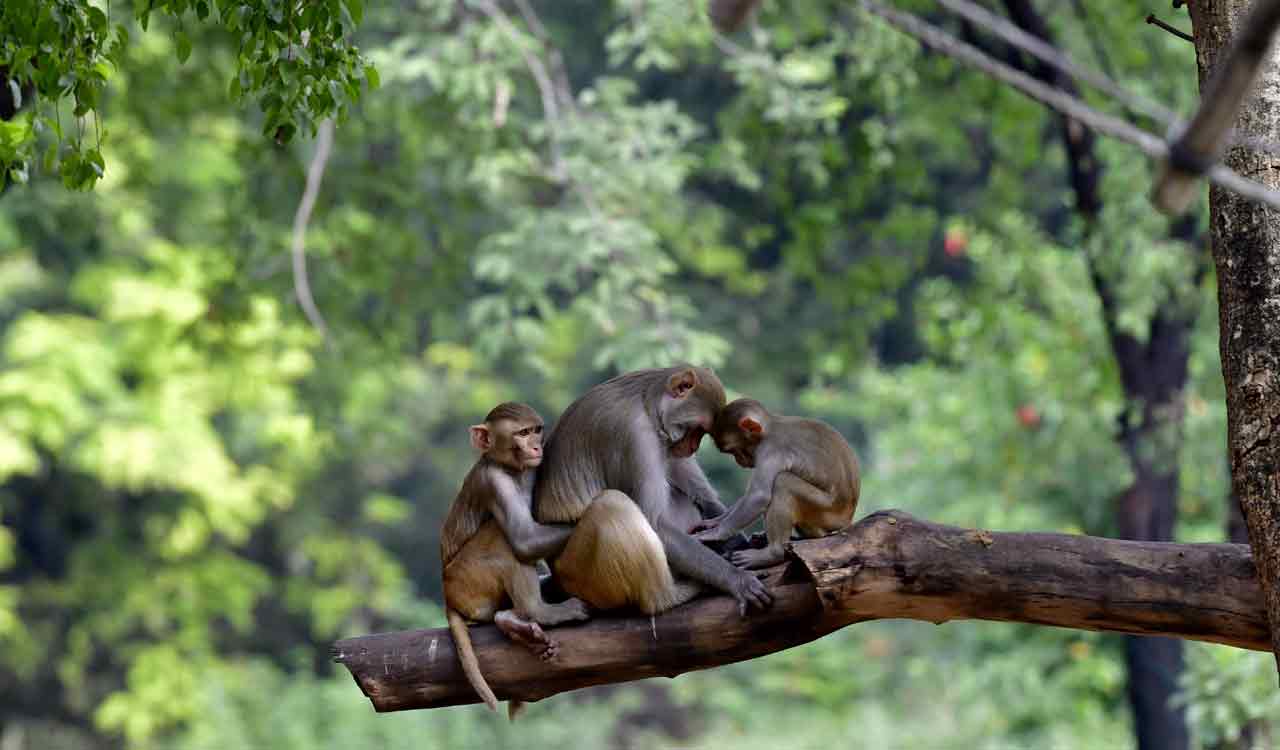


London: According to new research, monkeys increase their usage of scent markings in order to compensate for human noise pollution. Pied tamarins (Saguinus bicolor) communicate through both vocal calls and scent markings, and the current study, published in the journal Ethology Ecology & Evolution, is the first to look into how monkeys’ communication tactics shift in response to noise pollution.
The pied tamarin has an extremely narrow geographic range in central Brazil, much of which now lies within the city of Manaus. The city’s expansion has restricted individual groups to small patches of forest, surrounded by noisy urban environments, and the species is considered Critically Endangered by the IUCN.
The new study, led by academics from Universidade Federal do Amazonas and Anglia Ruskin University (ARU), investigated the behaviour of nine separate groups of wild pied tamarins.
The researchers used radio tracking to follow each group for 10 days. Within each area visited, the most common source of anthropogenic noise was road traffic, although there was also noise pollution caused by aircraft, park visitors, and even military activity.
Being able to communicate with other groups is vital for the health and ultimately the survival of a species. Pied tamarins use several types of scent marking which have different functions, including passing on reproductive and territorial information.
During the new study, the researchers found that the frequency of scent marking directly increased in line with noise decibel levels. The results suggest that scent marking is being used more frequently as the pied tamarins vocal communication becomes less effective due to the impacts of human noise.
Lead author Tainara Sobroza, of Universidade Federal do Amazonas, said, “Many species depend on acoustic signals to communicate with other members of the same species about essential information such as foraging, mate attraction, predators, and territorial defence.
“Pied tamarins produce long calls which are used for group cohesion, intergroup communication and to mark their territory. Long calls are especially important in fragmented forests which is the case in Manaus, as the urban landscape encroaches further into the pied tamarins territory. Our research indicates that communication is being impacted by urbanisation as the occurrence of scent marking is increasing directly in response to increased noise levels.”
Co-author Dr Jacob Dunn, Associate Professor in Evolutionary Biology at Anglia Ruskin University (ARU), said, “Humans have contributed many additional stimuli to the soundscapes that animals have evolved to deal with, and anthropogenic noise is increasingly drowning out natural sounds.
“The increased use of scent marking by pied tamarins is likely to be a flexible response towards this environmental change. This is an interesting result from a conservation perspective as it shows pied tamarins are adapting their behaviour in response to city noise.
“An advantage of scent marking over vocal communication is that it allows information to be passed on over a number of days. However, unlike vocal calls, scent markings are not an effective way of communicating over long distances. As the pied tamarins range is becoming more fragmented and groups are becoming more isolated, this could potentially have a detrimental impact on a species which is already critically endangered.”

Related News