Opinion: Can AI help Hyderabad grow without losing its ecological soul?
The real question is not whether AI can think like humans, but whether it can help us make wiser choices about the land, water, and ecosystems


By Dr Mahender Kotha
Hyderabad today is almost unrecognisable from what it was two decades ago. Once celebrated mainly for its history, culture, and emerging IT industry, it has evolved into one of India’s fastest-growing cities. New residential colonies spread across the outskirts, high-rise towers dominate the skyline, metro lines extend further each year, and large infrastructure projects continue to reshape the city.
Also Read
It is a remarkable story of ambition and progress. But it also raises an uncomfortable question: Can Hyderabad continue to grow without placing unbearable pressure on the very resources that sustain it?
Why AI
Rapid urbanisation has undoubtedly brought jobs, investment, and new opportunities to Telangana. Yet, it has also exposed the city to challenges that are becoming harder to ignore. Groundwater levels are falling in many areas. Lakes that once acted as natural buffers and water sources are steadily shrinking. Heavy rains increasingly lead to urban flooding. Summers feel hotter than before, while green spaces struggle to survive amid expanding concrete landscapes. At the same time, demand for water, energy, housing, transport, and waste management continues to rise in a region with limited natural resources.
This is where the growing interest in artificial intelligence, or AI, enters the conversation.
Around the world, AI is being projected as a game-changing technology capable of transforming every aspect of life. But from the perspective of those who study the Earth and its resources, its greatest strength is not its ability to replace people. Its real value lies in helping us make better decisions.
AI can detect patterns and predict risks, but it cannot replace field-based evidence, local knowledge, or transparent public decision-making
The Earth does not function in neat, predictable ways. Rivers alter their courses. Rainfall patterns shift. Groundwater declines slowly and often unnoticed. Changes in land use affect ecosystems in ways that may only become apparent years later. In a rapidly expanding city like Hyderabad, every new road, apartment complex, industrial estate, or commercial hub leaves its environmental footprint.
Understanding these connections requires more than advanced computing power. It demands scientific knowledge, local experience, and responsible governance.
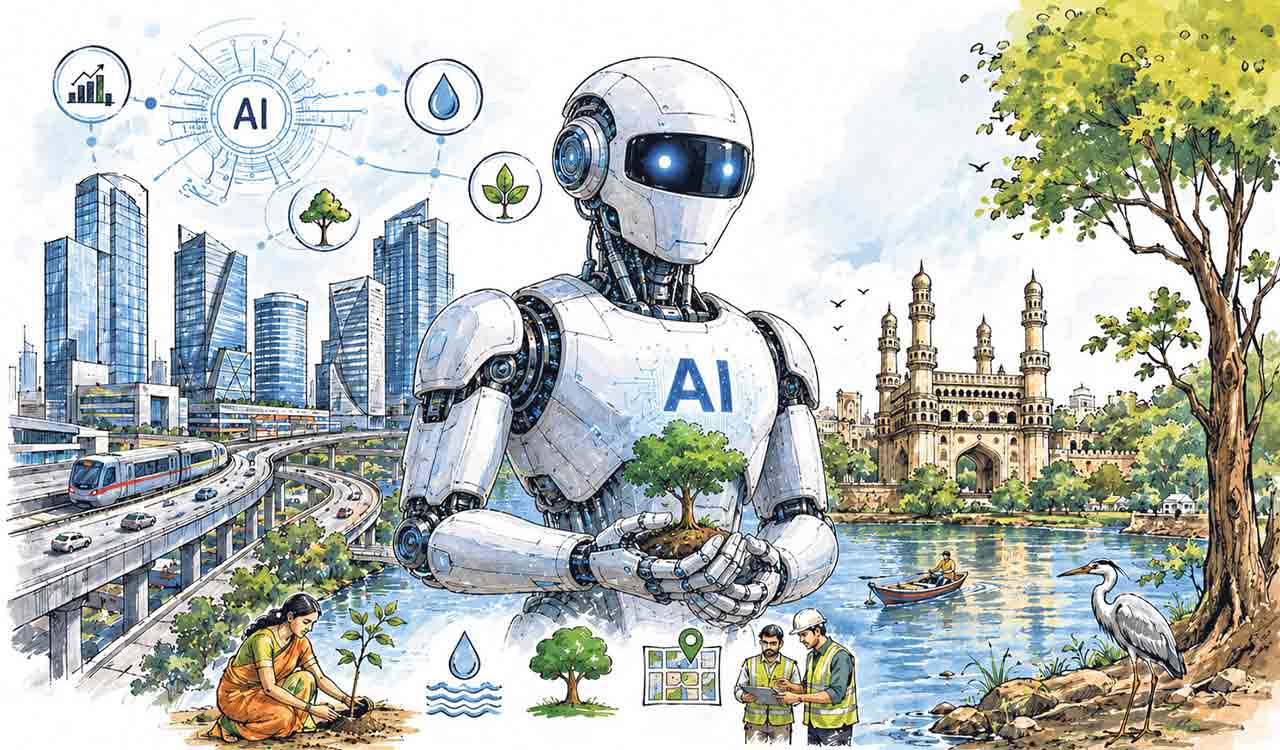
AI can certainly become an important ally. It can analyse satellite imagery and vast datasets to monitor urban expansion, identify encroachments on lakes and drainage channels, detect emerging heat islands, assess land-use changes, map flood-prone areas, and track groundwater stress. Tasks that once required months of painstaking effort can now be completed much faster.
But technology alone cannot provide all the answers. An AI system may identify unusual patterns in satellite imagery. Yet it takes experienced scientists, planners, and local experts to determine whether those patterns reflect drought conditions, seasonal changes, data errors, or genuine environmental degradation. Algorithms can spot trends, but they cannot replace field observations, community understanding, or accountability in public decision-making.
AI as Interpreter
Another obstacle is the perception that AI is too technical for anyone outside computer science. The terminology can be intimidating. In reality, the questions behind AI are familiar to every good scientist and policymaker: What does the evidence tell us? How reliable is it? What uncertainties remain? What might we be missing?
Seen this way, learning AI is not necessarily about becoming a programmer. It is about becoming a better interpreter of evidence.
For Telangana, and Hyderabad in particular, the opportunities are immense. AI-supported systems can improve urban planning, optimise water supply networks, strengthen disaster preparedness, manage traffic more efficiently, monitor environmental compliance, and support climate adaptation strategies. Used wisely, these tools can help decision-makers strike a balance between development and sustainability.
At the same time, we cannot ignore the ethical dimension. Hyderabad’s future prosperity depends on protecting its natural assets. Its lakes, groundwater reserves, open spaces, and biodiversity cannot be treated as expendable in the pursuit of growth. If AI merely helps us consume resources faster without encouraging better stewardship, it risks becoming just another technological distraction.
AI’s Promise
The true promise of AI lies elsewhere. It lies in helping societies adapt to climate change, conserve scarce resources, build resilience against disasters, and ensure that development benefits both present and future generations.
Hyderabad, often celebrated as the City of Pearls and now recognised globally as a technology hub, faces a unique opportunity. It can demonstrate that technological leadership and environmental responsibility need not be opposing goals. The city can show that growth is most meaningful when it is inclusive, resilient, and sustainable.
As Telangana looks ahead, one principle deserves to guide us: technology is at its best when it serves the public good. The aim should not simply be to build smarter cities, but better cities—places that respect ecological limits while creating opportunities for all.
Ultimately, the question is not whether AI can think like humans. The more important question is whether it can help us think more wisely about the land, water, and environment on which our shared future depends.
(The author is a retired Senior Professor of Geology from Goa University)

Related News