Opinion: Can the rich live with less?
The affluent leave a far bigger carbon footprint, while the poor bear much of climate change’s pain despite contributing far less to the crisis


By Dr Ramesh Chennamaneni
It is well established today that climate change and its negative impacts are visible, from the deadly retreat of Himalayan glaciers to devastating landslides in the Western Ghats of Keralam. It is also established that the top 20% of high-expenditure households in India and elsewhere generate nearly seven times the carbon emissions responsible for climate change compared to low-expenditure households.
Also Read
However, climate change is hurting the common man, even though their contribution to climate change is substantially lower. Are affluent households ready to change their lifestyles to reduce high emissions?
Warming Warning
Global warming is the increase of Earth’s average surface temperature due to the effect of greenhouse gases, such as carbon dioxide emitted from burning fossil fuels or from deforestation, which trap heat that would otherwise escape from the Earth. This is a type of greenhouse effect.
Scientists from around the world, including those associated with the Intergovernmental Panel on Climate Change (IPCC), tell us that during the past 100 years, the world’s surface air temperature increased by an average of 1.1° Celsius. Human activities are estimated to have caused 1.07°C of that warming, accounting for virtually all of the long-term change, and the rate of warming spiked significantly since 1970.
Some effects of climate change that we see happening now include sea level is rising; sea-surface temperatures and large lakes are warming; heavier rainfall is causing flooding; extreme drought is increasing; crops are withering; ecosystems are undergoing negative changes, such as the recent accelerated retreat of glaciers in the Himalayas; hurricanes have changed in frequency and strength; heat waves are becoming more frequent; and warmer temperatures are affecting human health.
If we look at the recent glacial retreat as part of climate change rapidly destabilising the fragile Himalayan ecosystem, one more very serious potential danger is emerging in the form of a threat to millions of livelihoods and to water security in India.
Major river systems originating in the Himalayas, such as the Indus, Ganga, and Brahmaputra, already face volatile flow patterns. This growing destabilisation endangers agriculture, drinking water supplies, and vulnerable communities in the mountains and plains, potentially displacing them. Also, in this context, human-induced linking of rivers must be examined cautiously.
India is among the top 10 most affected countries in the Global Climate Risk Index 2021. It may lose anywhere between 3 per cent and 10 per cent of its GDP annually by 2100, and its poverty rate may rise by 3.5 per cent in 2040 due to climate change, according to a report titled ‘The Costs of Climate Change in India’ released by the London-based global think tank Overseas Development Institute in June 2021. The report focused on the economic costs of climate-related risks and the possibility of increased inequality and poverty.
Lifestyle Concepts
Indeed, driven by consumption and lifestyle changes, per capita greenhouse gas emissions are constantly increasing in India. The use of traditional biomass for fuel, such as firewood, is high in peri-urban areas. At the same time, modernisation and urbanisation processes have led to a growth of commercial and indirect energy uses, such as energy embodied in products and services, indicating a shift towards a modern consumer society.
There are two main policy responses to climate change: mitigation and adaptation. Mitigation addresses the root causes by reducing greenhouse gas emissions, while adaptation seeks to lower the risks posed by the consequences of climatic change. Therefore, if mitigation and adaptation strategies are not part of a new and attractive vision of a good life, they will most probably fail, lacking both a lived everyday reality and political support from the electorate.
At the same time, the contradiction between considerable economic growth, resulting in a developing consumer society with modern technologies and services on the one hand, and poverty, malnutrition, health problems, social exclusion and resource degradation on the other, is very striking in our society.
The lifestyle concepts of different social groups are also emerging differently. This means that perceptions towards environmental and climate change issues, as well as the necessary action and measures, will invariably differ. Though the environment is scale-neutral, the measures and actions cannot be, as different strata of people and social groups are involved. Political parties and governments have to understand this reality!
India’s Position
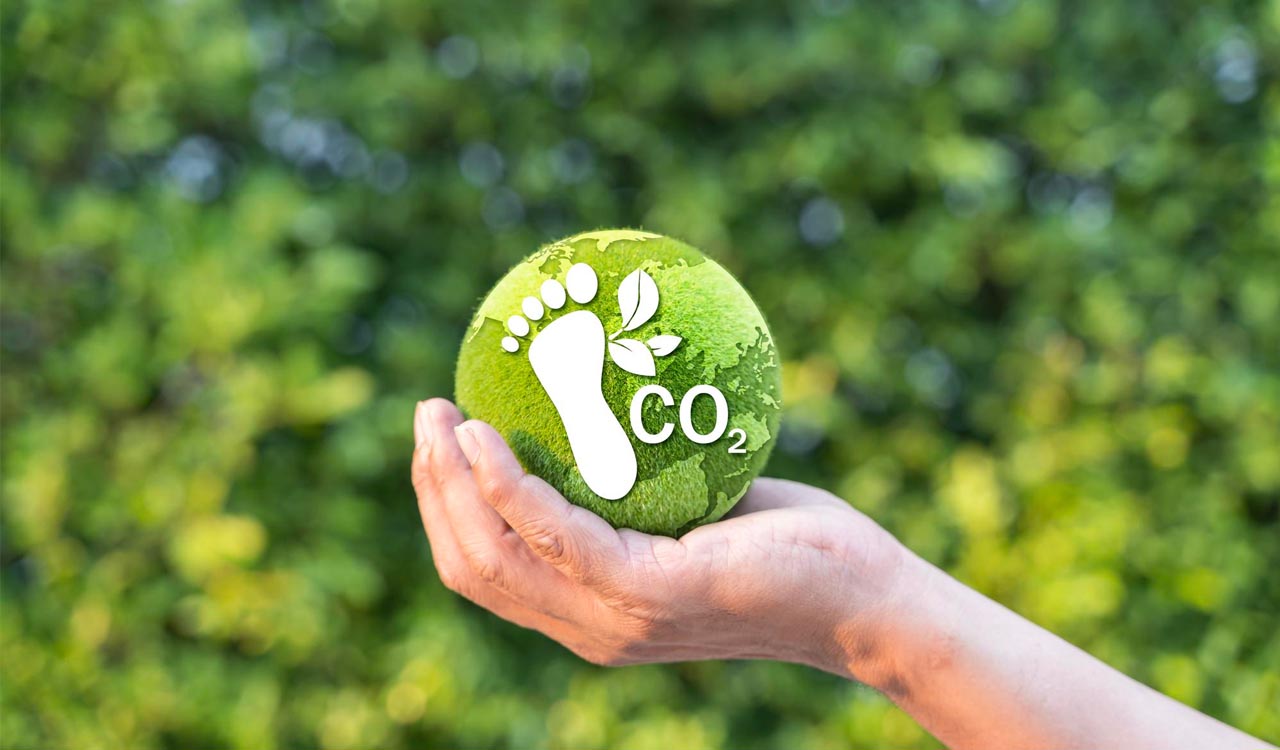
A carbon footprint approach could be one way of looking at the issue in a differentiated way. A carbon footprint is the total greenhouse gas emissions, including carbon dioxide and methane, caused by an individual, community, event, organisation, service, or product, expressed as a carbon dioxide equivalent.
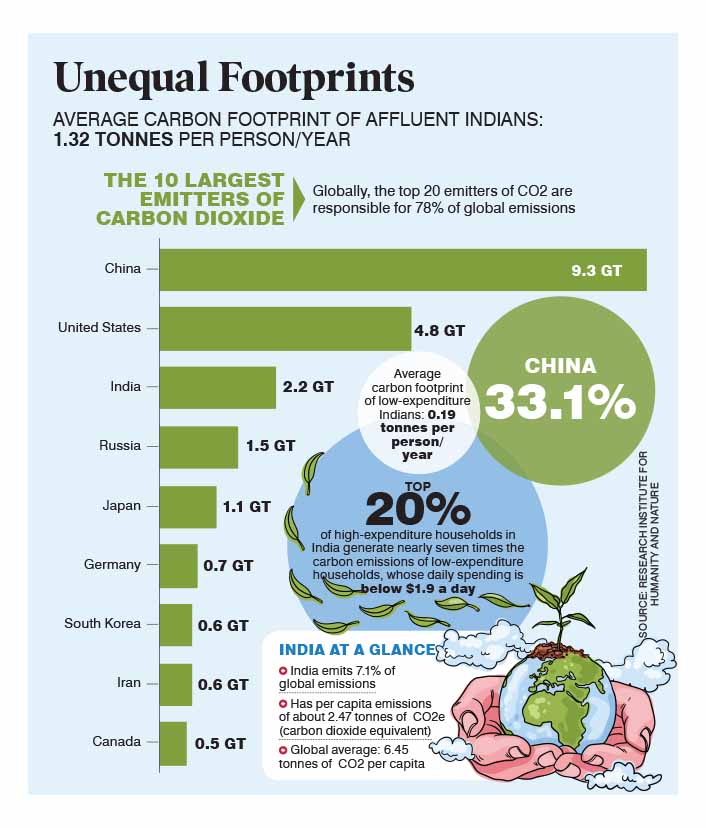
However, if we look at per capita emissions, India ranks far below the world average. India emits 7.1% of global emissions and has per capita emissions of about 2.47 tonnes of CO2e (carbon dioxide equivalent), as compared with the global average of 6.45 tonnes of CO2 per capita. Here too, there is a very high disparity between developed nations and developing nations such as India. This also implies the greater challenge and contribution that the developed world faces in combating climate change.
A recent study by the Research Institute for Humanity and Nature found that the top 20% of high-expenditure households in India generate nearly seven times the carbon emissions of low-expenditure households, defined as those who spend less than $1.9 a day. The average carbon footprint of every person in India was estimated at 0.56 tonne per year– with 0.19 tonne per capita among the poor and 1.32 tonne among the rich.
According to IndiaSpend, the study combined household expenditure data from the 2013 National Sample Survey Organisation (NSSO) and observed that food and electricity were two avenues of expenditure that accounted for the majority of emissions in the country across socio-economic groups. Among affluent households, expenditures that resulted in high emissions came substantially from private transport, durables, and non-cereal food items.
This shows that affluent households predominantly have to contribute more towards combating the effects of climate change by changing their lifestyles here and elsewhere in the world. It is indeed a fact that climate change is hurting the common man.
Therefore, sustainable solutions for global warming are crucial in the contemporary world, as climate change poses unprecedented challenges to society as a whole, taking into consideration the social disparities in our society.
(The author is former MLA and adviser, and Humboldt Expert in Agriculture, Environment and Climate Change)

Related News