Opinion: Inequitable impacts of climate change
As with any environmental disaster, the impact of heat is profoundly dictated by privilege


By Chirag Dhara
The world’s largest elections unfolded in India during April and May 2024, with nearly 970 million registered voters. Daytime temperatures have been scorching across India and there are concerns the extreme heat in these two months may have played a role in the lower-than-usual voter turnout.
On May 25, during the sixth voting phase, day-time temperatures soared above 35 degrees Celsius across most of the country, with north-western regions of Haryana, Punjab and Rajasthan blistering at 45 degrees Celsius and above.
More alarmingly, nights have offered little respite, with night-time temperatures remaining stubbornly high at 28-30 degrees Celsius across vast parts of the country, including major cities such as Mumbai, Delhi, Kolkata and Chennai.
The Global Context
This year’s extreme heat in India is neither a random occurrence nor an isolated one. Globally, the last 11 consecutive months — June 2023 to April 2024 — have broken temperature records for each corresponding month. Late 2023 and the first months of 2024 have shattered global temperature records. Among the most severe consequences of the rise in global temperatures is the surge in extreme heat events worldwide. These foreshadow severe impacts on health, lives and livelihoods, particularly in tropical developing countries like India, with high baseline temperatures and high heat exposure.
Hot Days and its Impacts
Observational records show the summer heat this year is part of a trend, illustrated by the increased number of days each year where the maximum temperature exceeds 40 degrees Celsius.
Northwest, central and southeastern parts of the country have witnessed the highest rise, with much of Rajasthan and Telangana and parts of Karnataka and Andhra experiencing an additional two weeks each year of temperatures exceeding 40 degrees Celsius. Many other parts of the country, such as Gujarat, Maharashtra, Madhya Pradesh, Tamil Nadu and the rest of Andhra, endure at least one additional week of this extreme heat.
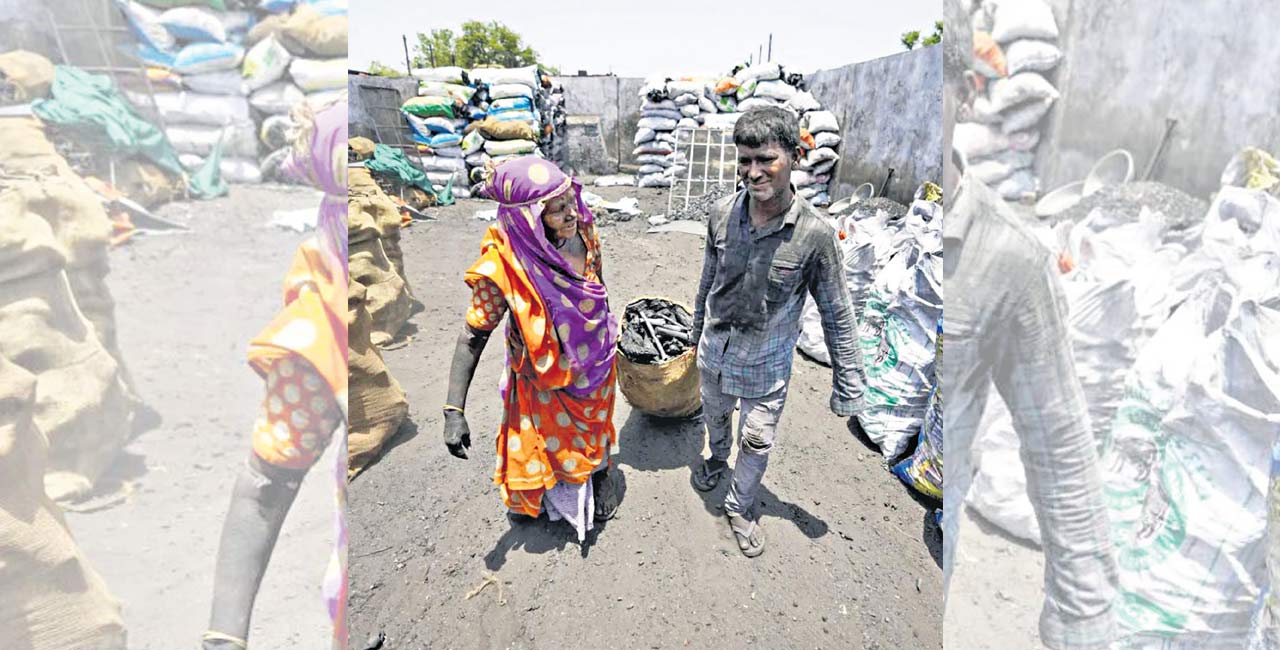
As with any environmental disaster, the impact of this additional heat is profoundly dictated by privilege. While the upper-middle classes retreat into air-conditioned refuges during extreme heat, there is little recourse for those less privileged.
Among the most exposed are essential workers such as farmers, construction labourers, sanitation workers, drivers, small business and informal economy workers (such as security guards and street vendors) and gig economy workers (such as food delivery agents).
The increasing heat places outdoor wage earners in a difficult bind, and reducing work during the hottest hours risks wage cuts and job losses
Without proactive and well-thought-out risk mitigation, the increasing heat will place outdoor wage earners in a difficult bind: they risk kidney failure, cardiovascular diseases and heat strokes by working through extreme heat.
However, reducing work during the hottest hours risks wage cuts and job losses. This has already manifested this summer with online commerce companies grappling with a sharp decline in the availability of delivery agents who are forced to stop work during the hottest hours.
Impact on Health
A more insidious trend in recent years is the persistence of high overnight temperatures. Cool night-time temperatures are crucial to enable the body to recover from oppressive day-time heat. When night-time temperatures remain high, this recovery process is hindered.
Rising mortality rates following hot nights have been documented globally. Yet, the risks posed by excessive night-time heat are often overlooked. India Meteorological Department data reveals that the extreme night-time heat of May 25 across India is consistent with a rising trend in many parts of the country.
Once again, Rajasthan, Gujarat, and coastal parts of Andhra and Tamil Nadu have seen the most conspicuous rise, with one or two additional weeks of hot nights per year.
Those at greatest risk are the least privileged: those without air-conditioning, more prominently street-dwellers. Not only do they face the most exposure, but they are also least likely to have access to adequate medical care.
The outlook is grim. Extreme temperatures are projected to rise considerably in India over the next few decades. India’s regional climate change report has assessed a rise of nearly [2020] degrees Celsius by mid-century in day- and night-time temperatures (under the moderate emissions scenario, Representative Concentration Pathway 4.5 (RCP4.5), relative to the 1976-2005 period). This increase will severely exacerbate the already extreme conditions experienced today.
The varying manifestations and impacts of global heating make it a great unequaliser. Privilege enables luxury consumption that drives greenhouse gas emissions, and it simultaneously shields those possessing it from the worst ravages of climate change.
These observations prompt deeper questions beyond the personal: if extreme heat has indeed played a role in depressing voter turnout in this election cycle, was it shaped along lines of privilege?
How might consequences such as heat-induced crop failures shape voting choices? Can these factors nudge the political trajectory of nations? In other words, the question is whether the inequitable impacts of climate change can permeate beyond tangible aspects like livelihoods and health to more abstract realms such as democratic participation.
These are complex questions without easy answers but serve to underscore how climate change can disrupt our societies in nuanced ways.
As the world’s largest democracy, India inarguably has the greater responsibility to grapple with these questions. A start would be to move the election cycle to cooler months.

(The author is Assistant Professor of Environmental Studies at Krea University. He was a lead author of India’s official climate change report [2020] and a contributing author to IPCC AR6 [2021]. 360info )

Related News