Opinion: Protecting unorganised workforce
By Dr K Srinivasa Rao With the change in the operating ecosystem driven by technology and the evolution of the gig working community, the archaic labour laws need reforms. The possibility of process reforms, automation and enhanced scope to use tools like artificial intelligence, machine learning, deep learning and robotics calls for improved capacity of […]



By Dr K Srinivasa Rao
With the change in the operating ecosystem driven by technology and the evolution of the gig working community, the archaic labour laws need reforms. The possibility of process reforms, automation and enhanced scope to use tools like artificial intelligence, machine learning, deep learning and robotics calls for improved capacity of the workforce. The industry now needs new skillsets. The present era of Industrial Revolution 4.0 in a globally connected world is talent-driven for improved competitiveness. In the milieu, the formal sector of employment is shrinking with the private sector increasingly engaging labour with specific skills through authorised agencies.
As per international definitions, informal sector enterprises are those owned by individuals or households that are not constituted as separate legal entities independently of their owners. The Indian labour market is characterised by the predominance of informal employment with the occasional seasonal engagement of labour in the farm sector.
The Mahatma Gandhi National Rural Employment Guarantee Act, 2005, (MGNREGA) was designed to provide minimum 100 days of assured guaranteed wage employment in a financial year to every household whose adult member volunteers to do unskilled manual work. It provided employment opportunities and helped in poverty reduction in the hinterland.
Labour Status
According to the Labour Ministry, 43.7 crore workforce is in the ‘unorganised sector’ as against the total workforce of 46.5 crore, ie, close to 94%. The workforce in India is the second largest in the world after China. Only 2.8 crore are in formal employment with some kind of social security. By its very definition, the unorganised sector and workers need better protection against exploitation. Another interesting feature of the labour force is the emergence of gig or platform workers engaged in the service sector.
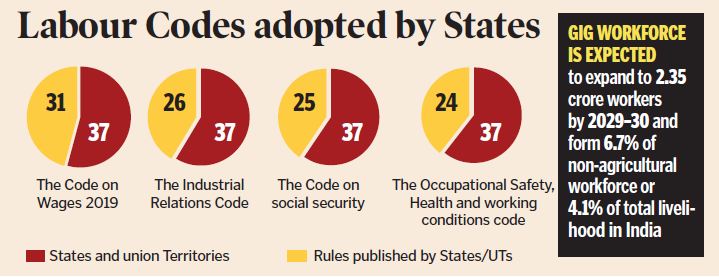
According to the recent report of Niti Aayog on ‘India”s Gig and Platform Economy’, it is estimated that in 2020–21, 77 lakh workers were engaged in the gig economy. They constituted 2.6% of the non-agricultural workforce or 1.5% of the total workforce in India. The gig workforce is expected to expand to 2.35 crore workers by 2029–30 and form 6.7% of the non-agricultural workforce or 4.1% of the total livelihood in India by 2029–30.
At present, about 47% of the gig workers are in medium-skilled jobs, about 22% in high-skilled and 31% in low-skilled jobs. The trend shows the concentration of workers in medium skills is gradually declining and that of the low-skilled and high-skilled is increasing. With such change in the pattern, their protection is important and calls for labour reforms.
Labour Reforms
To increase the rights and duties of the workforce and employers and align labour laws with the current industry needs, the government has enacted the four Labour Codes: Code on Wages-2019; Industrial Relations Code-2020; Code on Social Security, 2020, and Occupational Safety, Health and Working Conditions Code 2020. These well-articulated labour codes when seen together can strengthen the protection available to workers, including unorganised workers, in terms of statutory minimum wage, social security, working hours, healthcare, etc. The Social Security Code covers all workers, including in the unorganised sector as well as gig and platform workers.
Our Constitution plays an important part in the changes and growth in labour laws. The Fundamental Rights and Directive Principles of State Policy enshrined in Part III and Part IV mention working class-related benchmark laws. Under the Constitution, labour is a subject in the Concurrent List where both the Central and State governments are competent to enact legislation subject to certain matters being reserved for the Centre.
Accordingly, the power to make rules for ‘Labour’ has been entrusted to Central as well as State governments. As a step towards implementation of the four Labour Codes, the Central Government has pre-published the draft rules, inviting views from stakeholders. Many States have published the same for implementation (see infographics).
Existing Labour Protection
The Centre launched the e-Shram portal in August 2021. Workers registered on it will be issued an e-Shram card containing a 12-digit unique identification number, which, going ahead, will help in including them in social security schemes. Employers may change but the unique identification number remains the same for workers. So far, 270 million labour have registered on the portal. Some ongoing schemes for providing pension and health benefits on e-shram portal include Pradhan Mantri Shram Yogi Mandhan Yojana, National Pension Scheme for Traders and Self-Employed; Atal Pension Yojana and Ayushman Bharat Pradhan Mantri Jan Arogya Yojana.
The enrolment in these schemes is at the option of the labour but is open to them for social security and old-age protection against payment of nominal premium/contribution depending upon the details of the scheme. With awareness spreading fast, more and more informal workforce will get registered on the portal and methods will be evolved to protect their near- and long-term interests.
The new labour laws were expected to be enforced from July 1, 2022, but the detailed contours are still under discussion. Since the new labour codes will impact salary structure calling for investing more funds towards health, safety and terminal long-term benefits to the labour, the granular issues are being sorted out.
The new codes are an improvement substituting many existing archaic laws promising a better working environment. The proposed laws are expected to induce workers to acquire compatible skills to improve efficiency and productivity while remaining assured about their well-being.
(The author is Adjunct Professor, Institute of Insurance and Risk Management, Hyderabad. Views are personal)

Related News