Opinion: India’s Supreme Court grows, but does justice?
More judges may increase capacity, but India’s mounting judicial backlog exposes deeper problems that numbers alone cannot fix


By Shashank Shekar, Divya Sridhar
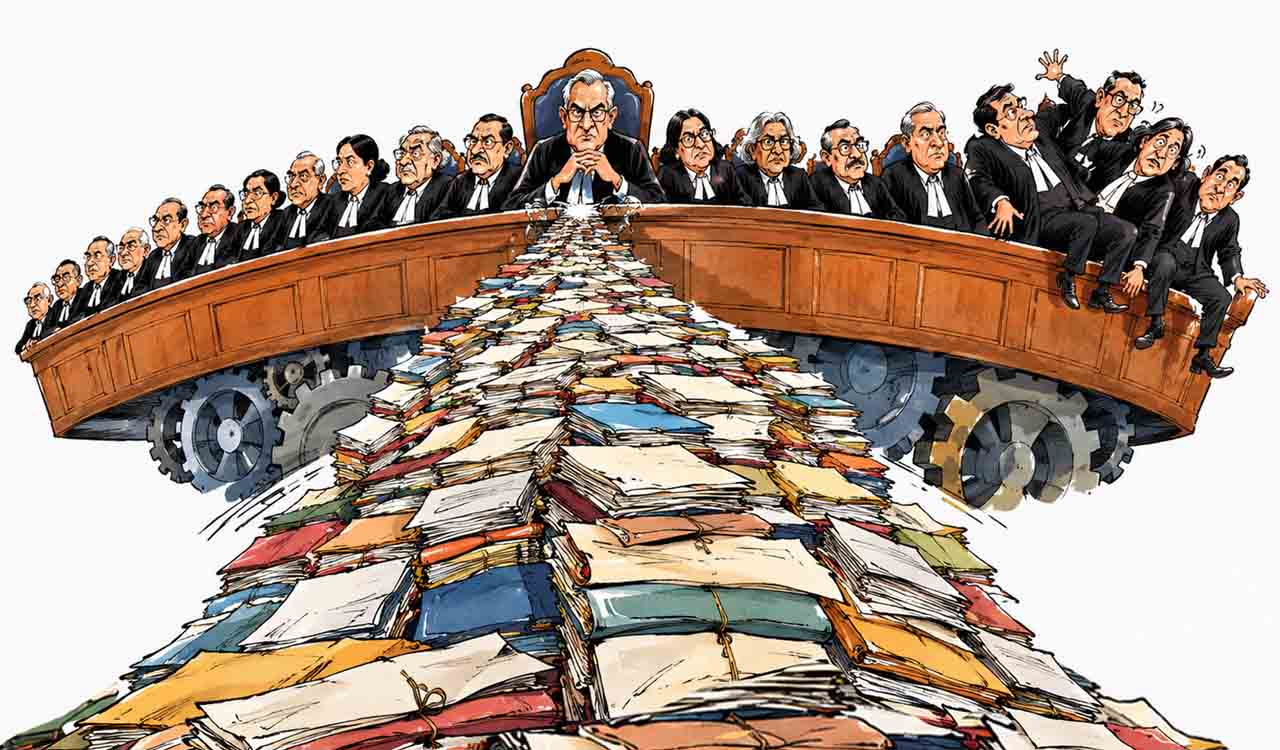
Three new judges have been appointed to the Supreme Court, taking its working strength to 37. Parliament had cleared the expansion from 33 to 37 judges, excluding the Chief Justice of India. The stated purpose is familiar: to cut pendency and speed up justice. The burden is real. Government data given to the Rajya Sabha put pending cases at about 96,000 in the Supreme Court, 63.76 lakh in the High Courts and 4.98 crore in district and subordinate courts as of late July.
Also Read
More judges appear to promise more disposals and shorter queues. Yet India has taken this road repeatedly over seven decades, and the queue has kept growing. The real question is not whether the Court needed more hands, but whether more hands alone can answer what ails it.
The government’s case deserves a fair hearing. The Bill’s Statement of Objects and Reasons records 92,101 pending cases on 1 January 2026 and notes that the Court received 75,410 new filings in 2025 against 65,615 disposals, a gap that widens the backlog every year even at near-full strength. It also argues that Constitution Benches, which need at least five judges, are hard to sustain without drawing judges away from regular benches.
Members of Parliament added a practical point, recalling a former Chief Justice’s request for 27 more courtrooms and 51 judges’ chambers. These are serious arguments, and four more judges will add hearing capacity. The difficulty is that capacity is only one variable, and the record so far suggests it is not the decisive one.
An Ever-Expanding Court
When Parliament enacted the Supreme Court (Number of Judges) Act in 1956, the sanctioned strength was ten judges apart from the Chief Justice. It rose to 13 in 1960, 17 in 1977, 25 in 1986, 30 in 2008 and 33 in 2019, and the 2026 amendment to Section 2 of the Act takes it to 37. Each step reflected a larger and more litigious republic, yet pendency has not receded in any lasting way.
The backlog reflects deeper structural problems: heavy government litigation, routine SLPs, vacancies in lower courts, and SC’s role as both constitutional and final court of appeal
The Court has sat at near-full strength since 2019, and its backlog has still grown. Part of the explanation lies in structure. Unlike constitutional courts in most democracies, India’s apex court is at once a constitutional court, a federal court and a vast court of general appeal. The United States Supreme Court decides fewer than a hundred cases a year; India’s receives about 75,000 fresh filings, and much of its time goes to deciding whether to hear an appeal at all.
Ambedkar’s Design and Its Limits
Article 124 lets Parliament set the number of judges by ordinary law, without a constitutional amendment. The design was settled in the Constituent Assembly on 24 May 1949. The draft article then provided for a Chief Justice and “not less than seven” other judges, as Parliament might prescribe. Dr BR Ambedkar moved the amendment that became Article 124(1): the Court would begin with seven judges besides the Chief Justice, and Parliament could enlarge it by law.
His stated aim was that the Court should be constituted at once rather than wait for legislation. One can read in this a philosophy that institutions must grow with democratic needs. But growth is not the same as reform. The very flexibility that lets Parliament add judges through a short Bill also makes it easy to choose arithmetic over structure.
A Court Still Short of Women
Three women, Justices Hima Kohli, Bela Trivedi and BV Nagarathna, were elevated together in August 2021, the largest cohort of women appointed at one time. After the retirements of Justices Kohli and Trivedi, Justice Nagarathna was the lone woman on the bench, and for nearly five years no woman was appointed, a gap the Supreme Court Bar Association formally protested.
That ended in June 2026, when Justice VS Mohana was elevated directly from the Bar, the 12th woman in the Court’s history. The Court now has two women judges. On 28 September, the Collegium recommended Justice Sunita Agarwal, Chief Justice of the Gujarat High Court; if the Centre notifies her, the number will be three.
This is progress, but modest. Twelve women in 26 years is roughly four per cent of all judges ever appointed. Supreme Court data for 2023 showed women at 36 per cent of the district judiciary, but only 14 per cent of High Court judges, which narrows the pool the Collegium usually draws from, and a parliamentary committee’s 133rd Report in 2023 flagged a “diversity deficit” in the higher judiciary.
The Collegium can fairly say that seniority and High Court representation constrain its choices. That is an argument for attending to gender earlier in the pipeline, not for deferring it. If seniority holds, Justice Nagarathna will become India’s first woman Chief Justice in 2027, though for only 36 days.
Why Pendency Persists
Union and State governments remain among the country’s largest litigants. Special Leave Petitions under Article 136, conceived as an exceptional remedy, have become a routine route of appeal. Admission and miscellaneous matters consume much of the working calendar, leaving Constitution Benches struggling for uninterrupted time.
Below the Supreme Court, the bulk of the backlog sits in district and subordinate courts, which worked in mid-2025 with 21,122 judicial officers against a sanctioned 25,843, according to government figures. High Court vacancies frequently linger for months. A larger Supreme Court changes none of this. There is also a doctrinal risk: more benches sitting in parallel can read similar questions differently, and a constitutional court’s authority depends not only on its disposal rate but on the consistency of what it decides.
Warning from Comparative History
Franklin Roosevelt’s 1937 proposal to enlarge the United States Supreme Court provoked fierce backlash because it was seen as an attempt to engineer outcomes, and “court-packing” entered the constitutional vocabulary. India’s context differs, since expansion here is driven by workload rather than confrontation. The lesson that carries over is that judicial reform cannot be reduced to a head-count.
India has had blueprints. The Law Commission’s 95th Report (1984) proposed splitting the Court into a Constitutional Division and a Legal Division, and its 125th Report (1988) repeated the idea. The 229th Report (2009) recommended a Constitution Bench in Delhi with four regional Cassation Benches for appeals, which the government of the day did not accept.
In 2023, the Parliamentary Standing Committee’s 133rd Report urged regional benches under Article 130, with constitutional questions staying in Delhi, and the Law Ministry later said it accepted the recommendation; no regional bench exists yet. The idea is contested. Critics fear conflicting precedents and a diminished apex court, and the Supreme Court itself has long been wary of sitting outside Delhi. Those objections deserve answers rather than silence. What the reports share is a diagnosis: one court cannot be both the country’s constitutional forum and its court of last appeal for nearly every dispute.
Beyond Arithmetic
The 2026 amendment will probably ease pressure on the Court’s docket for a time, and its supporters are right that capacity matters. But the judiciary’s challenges are structural more than numerical. They concern access to justice, the design of an apex court, who is represented on its bench, and how much deliberation precedes decisions about the Court itself.
Four additional judges cannot offset a system in which governments litigate heavily, and a single court in New Delhi must answer for the constitutional questions of 1.4 billion people. The better test of this reform is what follows it: whether Parliament and the judiciary take up the structural proposals that have waited for decades, and whether the new seats widen the bench. India needs not only a larger Supreme Court, but a clearer answer to what kind of Supreme Court it wants.

(Shashank Shekar is Assistant Professor, Lloyd Law College, Noida. Divya Sridhar is Assistant Professor, Jindal Global Law School, OP Jindal Global University)

Related News