Opinion: Policy challenges for Modi 3.0 in South Asia
Aside from relations with Bangladesh and Bhutan, various factors complicate regional politics for India


By Dhananjay Tripathi
The outcome of the general elections did not favour any single political party. Although the Congress made a comeback, the Bharatiya Janata Party (BJP) lost some ground but still emerged as the largest party. The BJP, with the support of its alliance partners, has formed a coalition government with Narendra Modi as the leader.
During the general election, opposition parties raised important socio-economic issues but did not effectively engage with Modi’s foreign policy. This lack of robust debate on foreign policy matters has been disappointing for students of world politics. However, post-election, there has been some discussion about the future direction of Modi 3.0 foreign policy.
Impact on Neighbours
Indian politics are closely followed by international experts as India is a rising power. This is particularly true in South Asia, where India’s domestic politics generates a lot of interest. India not only shares borders with South Asian countries but also has strong cultural connections with them. Therefore, any political event in India also has an impact on neighbouring countries.
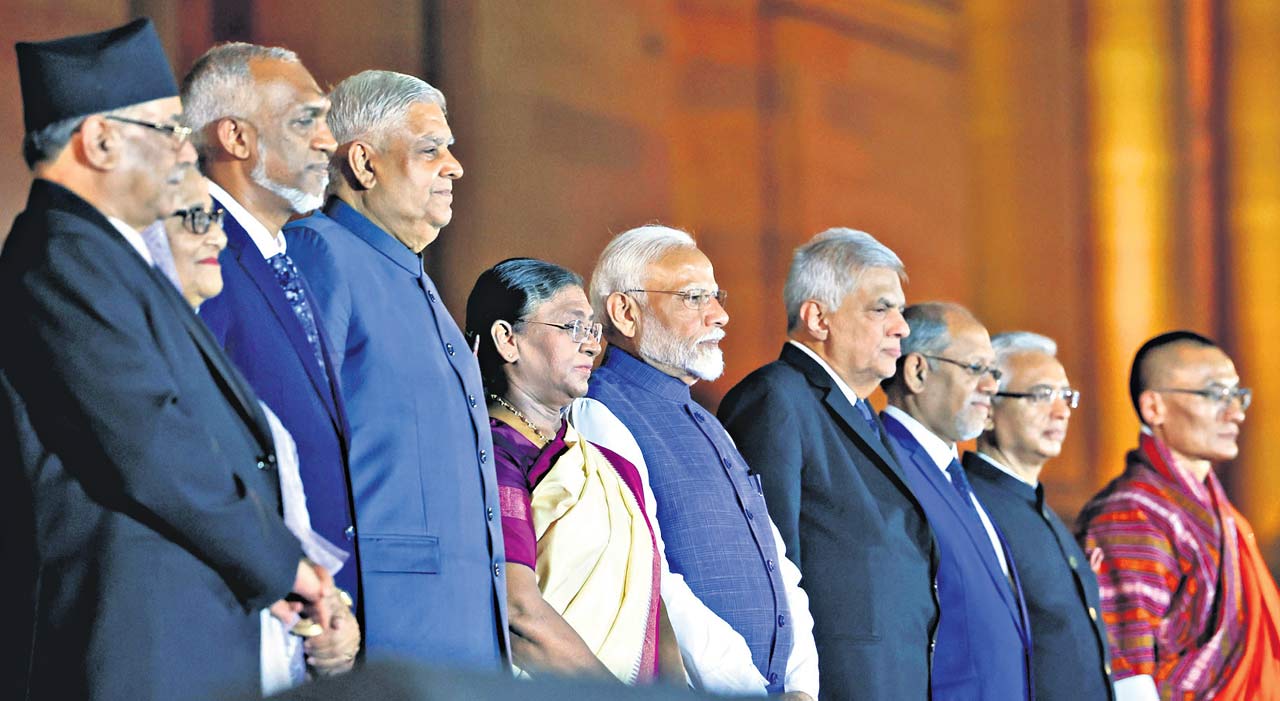
In the past decade, the BJP government has been involved in South Asia but has faced obstructions in consolidating Indian interests. Today, in South Asia, aside from relations with Bangladesh and Bhutan, various factors complicate regional politics for India. China’s growing involvement in the region and unresolved border issues will add further tests for the new government.
Ties with Pakistan
The main challenge in South Asia is the lack of regional integration. When Narendra Modi invited South Asian leaders to his first swearing-in ceremony as Prime Minister, it raised hopes for improved regional cooperation. However, tensions between India and Pakistan have stalled progress.
There has been no SAARC summit since 2014 due to strained India-Pakistan relations. Interestingly, recently there have been some positive statements from Pakistani political leaders, hinting at an effort to normalise relations with India. The question now is whether Prime Minister Modi will reciprocate this sentiment in his third term. Given the challenges of the past few years, progress in revitalising the relationship won’t be easy for either side. Therefore, it would be best to prioritise organising the SAARC summit. Many regional and international issues require careful consideration by SAARC member countries.
Afghan Dilemma
Afghanistan will be one of the most pressing issues in South Asia for the new government. There is a need for more consensus within the new government on how to deal with the Taliban. While the Taliban has appointed diplomats in China, Iran, Pakistan and the UAE, India has not shown openness to this. The strategic community in India is aware of the dynamics between the Taliban and Pakistan. Though the previous concerns about the Taliban’s control by the Pakistani Army are no longer valid, there is still a policy dilemma regarding how much India should coordinate with the Taliban.
There are Afghan nationals in India, many of whom are students, and there are several young Afghans who wish to study in India but are facing challenges obtaining visas. These young Afghans represent the future of their country, and facilitating their academic training will only strengthen the ties between India and Afghanistan. The West has failed to ensure a smooth transition in Afghanistan, yet they continue to issue visas to a few Afghans. India needs to reconsider its approach to this issue.
The Nepal Question
The current India-Nepal relations are relatively stable, but there are some complications, such as border issues and China’s growing influence in the region. In 2015, agitating Madhesi organisations blocked the India-Nepal border, and Nepal’s government at the time implicitly and explicitly blamed India. Blocked borders led to hardship for landlocked Nepal and prompted it to strengthen its ties with its northern neighbour, China. Seizing the opportunity, China increased its political and economic presence in Nepal. India has become a debated topic in Nepal’s domestic politics, and the recent dispute over the Kalapani region has raised tensions. Nepal’s parliament has approved a new map, and the country’s new 100 rupee currency note features a map India does not recognise.
Since revitalising the relationship with Pakistan won’t be easy, it would be best to prioritise organising the SAARC summit
Nepal has rejected participation in China’s security alliance, such as the Global Security Initiative (GSI), but has rapidly pursued increased cross-border connectivity through various projects. Trade between Nepal and China has grown, as has Chinese investment in Nepal, which is a cause for concern for India.
Other Worries
Other valid worries exist, such as the Maldives and Sri Lanka drifting towards China despite India’s substantial investment. There have been instances of aggressive language on social media, particularly concerning India-Maldives relations. Such political posturing on social media by certain groups also impacts foreign policy and should be avoided. By investing in the region, India will benefit and, most importantly, strengthen its international standing.
This article has focused on South Asia, but it will be challenging to handle China’s growing involvement in the Indian Ocean Region and the border dispute.

(The author is Associate Professor, Department of International Relations, South Asian University, New Delhi)

Related News
-
Rahul Gandhi seeks evidence to file cases over alleged police brutality
-
‘Forgive your enemies once, friends twice, but never traitors’: Kiren Rijiju on ‘regime change’ remark
-
BJP to launch nationwide campaign to counter Cong claims on SIR, ECI
-
Peshawar school roof collapse kills 17 children, teacher; 30 injured