Opinion: Union Budget 2026–27—A reality check for Viksit Bharat 2047
Budget 2026 rightly focuses on infrastructure investment, but physical assets must be complemented by sustained investment in human capital


By Prithwi Banik, Dr Chandan Roy, Dr Bidisha Sarkar
The vision of Viksit Bharat goes beyond headline growth rates. It imagines a society where economic progress improves everyday life, institutions function effectively, and opportunities are accessible to all. Income growth is important, but aspects such as education, healthcare, job security and regional balance are equally vital. Budgets play a key role in turning this vision into reality.
Also Read
The government has proposed a total expenditure of Rs 53.47 lakh crore, reflecting a 7.7% increase over the previous year’s revised estimates. This signals a continuation of expansionary fiscal policy. However, the effectiveness of this spending for long-term development depends not only on its size but also on its structure and sustainability.
Structural Constraints
A significant limitation arises from the way expenditure is structured. Nearly 26% of total spending is allocated to interest payments, which absorb close to 40% of revenue receipts. This significantly reduces the available fiscal space. When a large share of public resources is pre-committed, the government’s ability to respond to emerging social and economic needs is constrained.
This rigidity is not new, but its consequences become more pronounced as development goals grow more ambitious. A country aspiring to development must consistently invest in human capital, institutions and public services. Persistent fiscal inflexibility makes this task increasingly difficult.
Infra Push, Growth Strategy
The Budget continues to prioritise capital expenditure, with an increase of about 11.5% over the previous year’s revised estimates. Investments in transport, logistics, defence production and digital infrastructure are expected to support medium-term growth by easing supply-side constraints and encouraging private investment.
Infrastructure investment is necessary for India’s development. Better connectivity lowers costs, integrates markets and improves access to services. However, infrastructure alone cannot define a developed economy. Physical assets must be complemented by sustained investment in human capital.
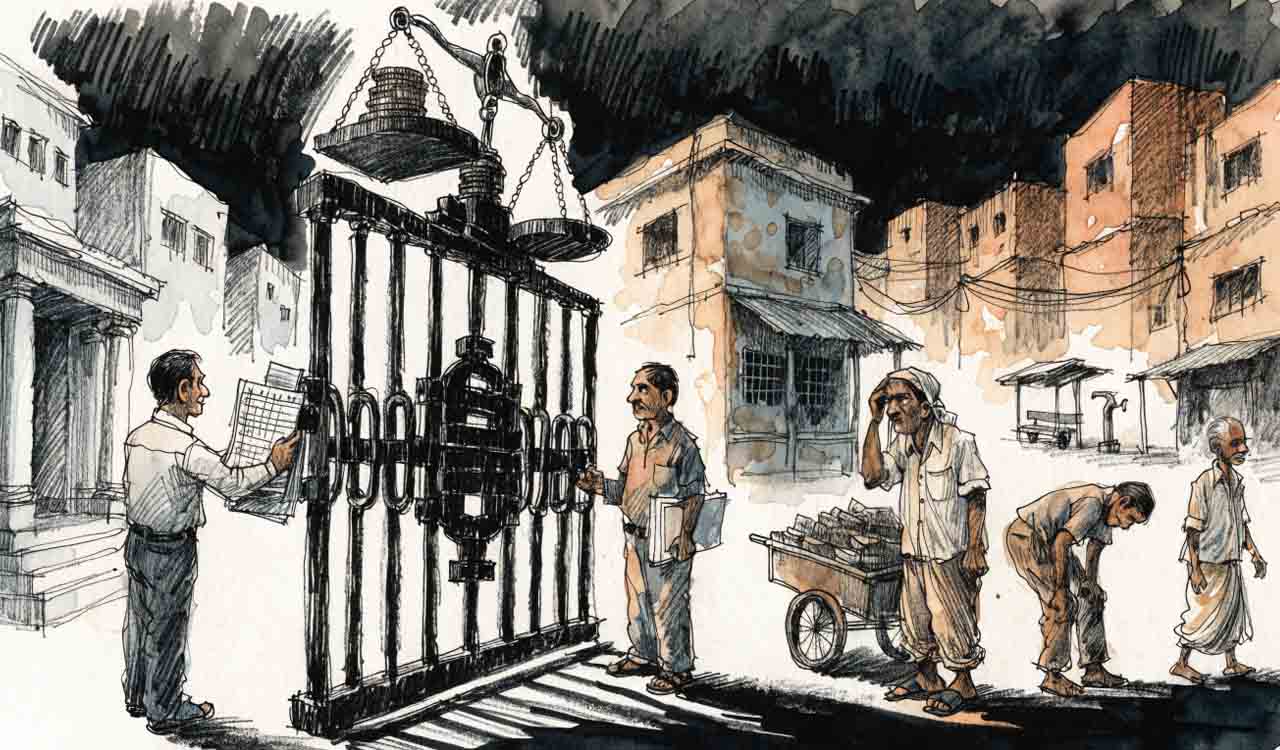
Budgets falter when numbers drift away from economic realities. If India is serious about becoming a developed nation by 2047, fiscal honesty, stronger revenue systems and people-centred spending must guide policy choices
In this context, the dominance of revenue expenditure, growing by around 6.6%, deserves attention. Much of this spending is committed, leaving limited room for policy adjustment. More importantly, recent experience shows that allocations for health, education, rural development and welfare programmes are frequently reduced at the revised estimate stage. This weakens implementation and creates uncertainty for frontline service delivery.
Human Development and Execution Gaps
At the heart of Viksit Bharat lies investment in human capital. Reliable schools, accessible healthcare, nutrition security and social protection determine whether growth translates into better living standards.
Several social sector programmes continue to receive budgetary attention. However, execution remains uneven. Flagship initiatives such as Jal Jeevan Mission and Pradhan MantriAwasYojana have faced underspending and repeated downward revisions in recent years. This is not simply an administrative issue. It reflects coordination challenges, capacity constraints and financing pressures that dilute outcomes.
Subsidies have been reduced to around Rs 4.55 lakh crore, with food and fertiliser subsidies accounting for most of the outlay. Rationalisation can be justified on efficiency grounds. However, with rural incomes under pressure and demand uneven, sharp compression risks aggravating stress rather than supporting productivity and adjustment.
Allocations for women, children and marginalised groups signal intent, but funding volatility limits impact. Development requires continuity. Short-term fiscal corrections should not undermine long-term social investment.
Revenue Numbers and Development Question
The most serious gap between ambition and capacity lies on the revenue side. Despite nominal GDP growth assumptions of around 10%, tax revenues have consistently underperformed Budget expectations. Over successive years, tax collections as a share of GDP have remained broadly flat. This points to structurally weak tax buoyancy.
To bridge revenue gaps, reliance on excise duties on petroleum products has increased. While this provides short-term relief, it is neither progressive nor stable. Such taxes place a higher burden on ordinary consumers and fluctuate with global prices. A developed economy requires a broader and more resilient tax base that grows with income and economic activity.
Weak revenue mobilisation has wider implications. Fiscal consolidation then relies largely on expenditure restraint. Social spending becomes the adjustment variable. From a public finance perspective, this approach risks weakening the social contract. Successful developmental States expanded fiscal capacity before compressing welfare expenditure.
Federal Finances and Shared Responsibility
India’s federal structure means that States deliver many essential public services, including health, education and local infrastructure. However, transfers under centrally sponsored schemes and grants have declined in recent years. Combined with volatile GST revenues and rising responsibilities, this places additional strain on State finances.
Balanced regional development is central to the vision of Viksit Bharat. Without predictable and adequate fiscal support to States, disparities widen, and national development goals become harder to achieve.
Viksit Bharat 2047
The Union Budget 2026–27 reflects continuity and caution. It supports growth through infrastructure investment and signals macroeconomic stability. At the same time, it exposes unresolved tensions between ambition and fiscal capacity.
Viksit Bharat 2047 cannot be achieved through infrastructure alone; it requires stronger revenue mobilisation, predictable social spending, cooperative federalism and sustained investment in human capital. Budgets matter not only for what they announce but for what they consistently deliver.
Budgets falter when numbers drift away from economic realities. If India is serious about becoming a developed nation by 2047, fiscal honesty, stronger revenue systems and people-centred spending must guide policy choices. Infrastructure can accelerate growth, but only a balanced fiscal strategy can sustain it.
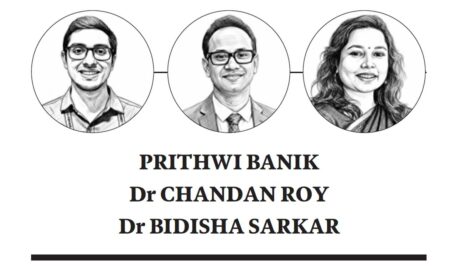
(PrithwiBanik is PhD Scholar, Dr Chandan Roy is Assistant Professor, Department of Economics, and Dr Bidisha Sarkar is Assistant Professor, Department of Business and Management, Christ University, Bengaluru)

Related News