Opinion: With apologies to Sartre and Camus, what is life for?
Beyond Camus’ ‘absurdism’ and Sartre’s ‘man is condemned to be free’, human evolution suggests a deeper purpose: coexistence


By B Maria Kumar
Most of the time, we deliberately use certain things to achieve particular purposes. Let us say we purchase a pen with the intention of writing something down. Once the writing is done, it gives us a feeling of satisfaction at having accomplished that specific goal, and that gives us the sense of meaning we intended to attain.
Such activities, however small or large, are simply a routine part of our lives. But if we ponder a little more about what world-renowned thinkers like Albert Camus have interpreted as the purpose of life, it prompts us to think a bit more seriously.
Life As They See It
Camus is famous for his brainchild idea of absurdism, a philosophy that perceives the world we live in as altogether different from our comprehension and expectations. There is invariably a tendency for conflict, according to him, between human perception and the reality of what is going on around us. He advocated that we have to face absurd situations involving things, persons, interactions or circumstances boldly and respond to them by means of philosophical revolt.
On the other hand, Jean Paul Sartre, whose mind-baffling statement was “man is condemned to be free”, revolutionised the way we view the world in usual terms. When everything in life and society is in no preset order, humans are bound to be at liberty to make their own choices and decisions, he reasoned.
That means Camus says that there is no pre-existing purpose or meaning to life, and so one should live as life unfolds, confront the absurd situations that surround us, and proceed to respond in one’s own way without regret. In contrast, Sartre says that there is no pre-defined essence to life and hence one should create purpose and meaning by making choices and decisions freely.
Unsettling Questions
If we go by the assertions of these Nobel laureates, some unsettling questions automatically pop up. Is human life really purposeless? Does it have no meaning unless created by ourselves as we continue living? Is the act of surviving the vagaries of life and the surrounding world just an inevitable habit of imitating others and following their path? Are riddles such as “Why am I here on this planet?” and “What have I come into this world for?” simply illusory questions that we thoughtfully or by default usually avoid pondering?
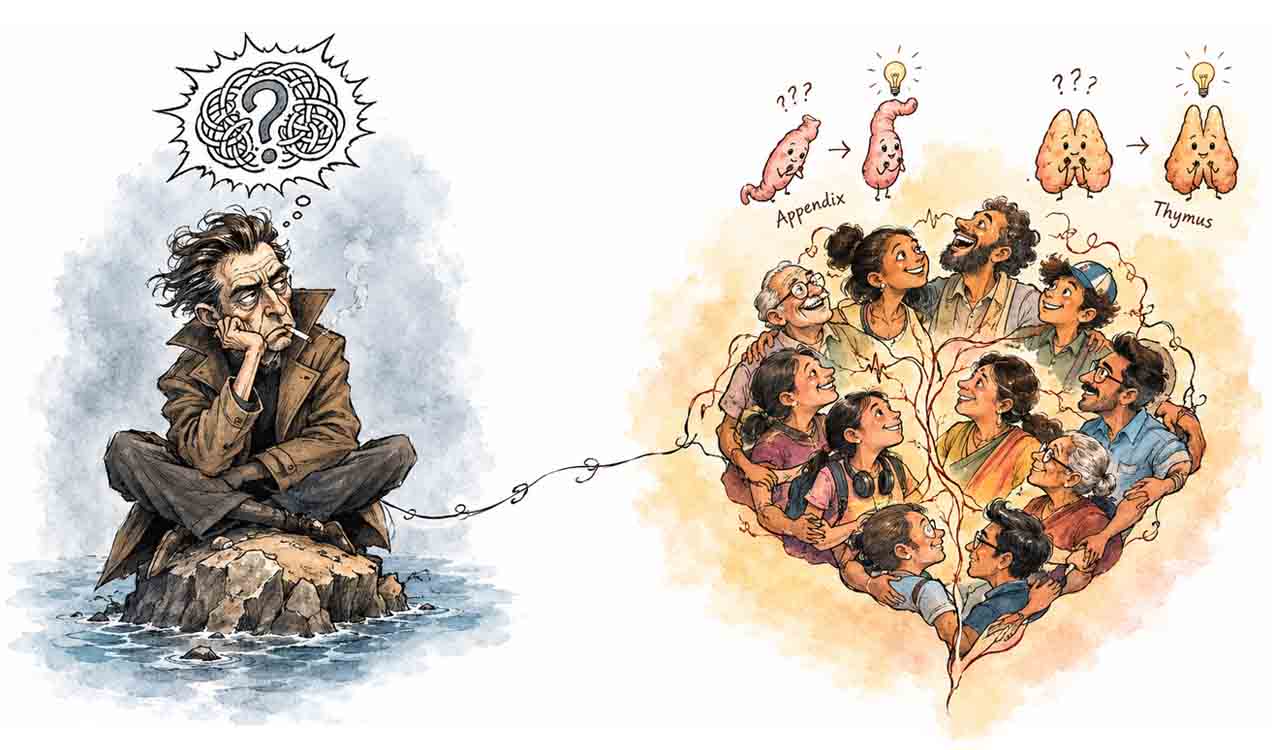
Such predicaments often force us to explore antithetical observations about the nature of reality. Examining specific research findings directs our attention to scientific facts. Consider the appendix, a small organ attached to the large intestine that was long assumed to have no significance or purpose. Later, emerging evidence indicated that it plays a vital role in gut health. Similarly, the thymus was initially dismissed as vestigial but was later found, through experimental methods, to be crucial for immune function and overall health. These instances demonstrate that purpose, though sometimes invisible, can explicitly emerge over time.
This leads us to another component that offers a compelling argument for a more revealing view of larger purpose while critiquing the conceptualisations of Sartre and Camus, namely human consciousness. To date, although various schools of thought have proposed different explanations for how and why consciousness emerged in the body, one approach that has gained traction recently points towards the evolutionary process of human development.
From consciousness and social bonds to John Donne’s No man is an island, individual existences are inextricably interconnected, revealing Synestism’s larger purpose of human coexistence
Peter W Halligan and David A Oakley, in their article, ‘Why Consciousness May Have Evolved to Benefit Society Rather Than Individuals’, which appeared on July 10, 2024, in ‘The Conversation’, referred to hundreds of research papers published by various scientific institutions and researchers on consciousness and surmised that it had evolved over the long human lineage for the sake of safe and secure existence.
Here, the crux of the matter revolves predominantly around social cohesion rather than individual survival alone. We can draw from this inference that the evolution of the human race has involved surviving collectively and together, and not merely on an individual basis. This, in turn, leads to another conclusion that human brains do not necessarily act as isolated entities but interact as a group. Louis Cozolino, a professor of psychology at Pepperdine University, explains that there are give-and-take relationships between human brains. He calls the individual brain a social organ, meaning that connectivity among people is a natural law.
Existing Together
These inferences are further supported by evidence from contemporary studies and surveys showing that the longevity and wellbeing of individuals depend considerably upon the close relationships they maintain with fellow human beings. All these clues suggest that Mother Nature itself has placed the responsibility for one’s existence and wellbeing not merely at the individual level but among people themselves, mutually and reciprocally.
That is why an individual, when born, is instinctively wary of unfamiliar faces and strange surroundings. When parents familiarise themselves with their offspring, and the offspring reciprocates similarly and comfortably, bonds of familiarity and trust begin to develop. Such familiarisation, when extended across humanity, can usher in mutual safety and peace, paving the way for the greater good of coexistence. This is the ultimate purpose for all individuals, which may be termed ‘Synestism’—from syn (together), est (to exist), and ism (a framework).
Synestism, therefore, means ‘existing together’. From this reasoning, it follows that each individual has two purposes ordained by nature—the primary purpose is synestic existence, while the secondary purpose is individual essence. Of the two, Synestism prevails over the individual purpose, because the coexistence of humanity precedes individual existence.
This very fact is implied in the celebrated line of the 17th-century English poet John Donne, “No man is an island,” suggesting that individual existences are inextricably interconnected to ensure mutual trust and, once again, revealing the larger purpose of Synestism for human coexistence.

(The author, a retired DGP of MP, is a national award-winning author)

Related News