RBI report confirms BRS-era reforms transformed Telangana’s economy
RBI data for 2024-25 shows Telangana achieved sharp economic and agricultural growth between 2014-15 and 2023-24 under BRS governance. Per capita income nearly tripled, irrigation expanded, and foodgrain output surged, highlighting a decade of sustained public investment and rural transformation


Hyderabad: A decade after Telangana began its journey as India’s youngest State, the numbers narrate a story that even early sceptics can no longer dismiss. Between 2014-15 and 2023-24, Telangana witnessed one of the sharpest economic and agricultural expansions in the country, powered by sustained investments in irrigation, infrastructure and rural productivity under the BRS government.
The latest Handbook of Statistics on Indian States 2024-25, released by the Reserve Bank of India, offers the clearest validation of Telangana’s dramatic transformation during the decade of BRS governance. In contrast, the first year of Congress rule (2024-25) shows growth continuing on sheer momentum, but with no major leap across key indicators.
Threefold surge in income, economic output
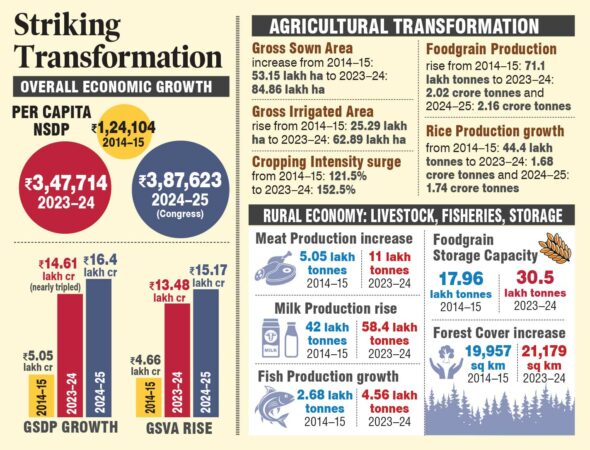
When Telangana was formed, its Per Capita NSDP stood at Rs 1,24,104 (2014-15). By the end of the BRS tenure, it had surged to Rs 3,47,714 (2023-24), a nearly threefold rise, placing Telangana among the top-performing States. The increase to Rs 3,87,623 in 2024-25 under Congress marks only a marginal rise, signalling continuation rather than acceleration.
A similar pattern emerges in the Gross State Domestic Product (GSDP). Telangana’s economy expanded from Rs 5.05 lakh crore in 2014-15 to Rs 14.61 lakh crore in 2023-24, a near-tripling driven by rapid industrialisation and a booming service sector. In contrast, the Congress-era rise to Rs 16.4 lakh crore in 2024-25 reflected a continuation of momentum rather than fresh policy impact.
Gross State Value Added (GSVA) echoed this trend with an increase from Rs 4.66 lakh crore at the State formation to Rs 13.48 lakh crore by 2023-24, before inching up to Rs 15.17 lakh crore in 2024-25.
From water scarcity to record output
The most striking turnaround has been in the agriculture sector, which was once crippled by drought, debt and migration. Telangana’s gross sown area expanded from 53.15 lakh hectares to 84.86 lakh hectares, while gross irrigated area more than doubled from 25.29 lakh hectares to 62.89 lakh hectares, driven by construction of major irrigation projects including the Kaleshwaram Lift Irrigation Project and Mission Kakatiya.
As a result, there was a structural shift in cropping patterns and higher land utilisation. Cropping intensity which languished at 121.5 per cent in 2014-15, surged to 152.5 per cent by 2023-24, indicating irrigation-led transformation.
Foodgrain output tells the same story. Total foodgrain production rose from 71.1 lakh tonnes in 2014-15 to 2.02 crore tonnes in 2023-24. The increase to 2.16 crore tonnes in 2024-25 under the Congress is again, only incremental and largely a reflection of expanded acreage achieved earlier. Rice production quadrupled, from 44.4 lakh tonnes to 1.68 crore tonnes by 2023-24, again with only modest growth of 1.74 crore tonnes.
Rural economy uplifted
Livestock and fisheries, which are crucial for rural income diversification also recorded sharp growth under BRS. Meat production rose from 5.05 lakh tonnes to 11 lakh tonnes, milk output from 42 lakh tonnes to 58.4 lakh tonnes, and fish production from 2.68 lakh tonnes to 4.56 lakh tonnes. Storage capacity for foodgrains improved from 17.96 lakh tonnes to 30.50 lakh tonnes, but remaining almost stagnant thereafter.
Even forest cover increased from 19,957 sq km to 21,179 sq km, marking steady environmental gains.
Thus, the RBI data underscores a decade of accelerated economic and agrarian restructuring in Telangana. Far from the politically motivated Congress narrative of inflated claims, the numbers pointed to a State that grew rapidly on the back of public investment, irrigation expansion and rural infrastructure. Now, the State is facing the challenge of sustaining that momentum under the Congress regime, which is yet to make its mark on key indicators.

Related News