Opinion: Why KCR can be called the ‘Father of Telangana’
Telangana was not merely the passage of a Bill in Parliament; it marked a new political beginning under K Chandrashekhar Rao and a restoration of self-respect


By Pendyala Mangala Devi
The term “Father of the Nation” has never been one that enjoys universal acceptance. In political philosophy, it is neither a government-conferred title nor a constitutional designation. It is a reasoned concept, used to recognise a person without whom the birth of a political system or collective identity would be inconceivable.
Also Read
Therefore, the fact that some people may refuse to accept such recognition does not diminish the contribution of the individual concerned.
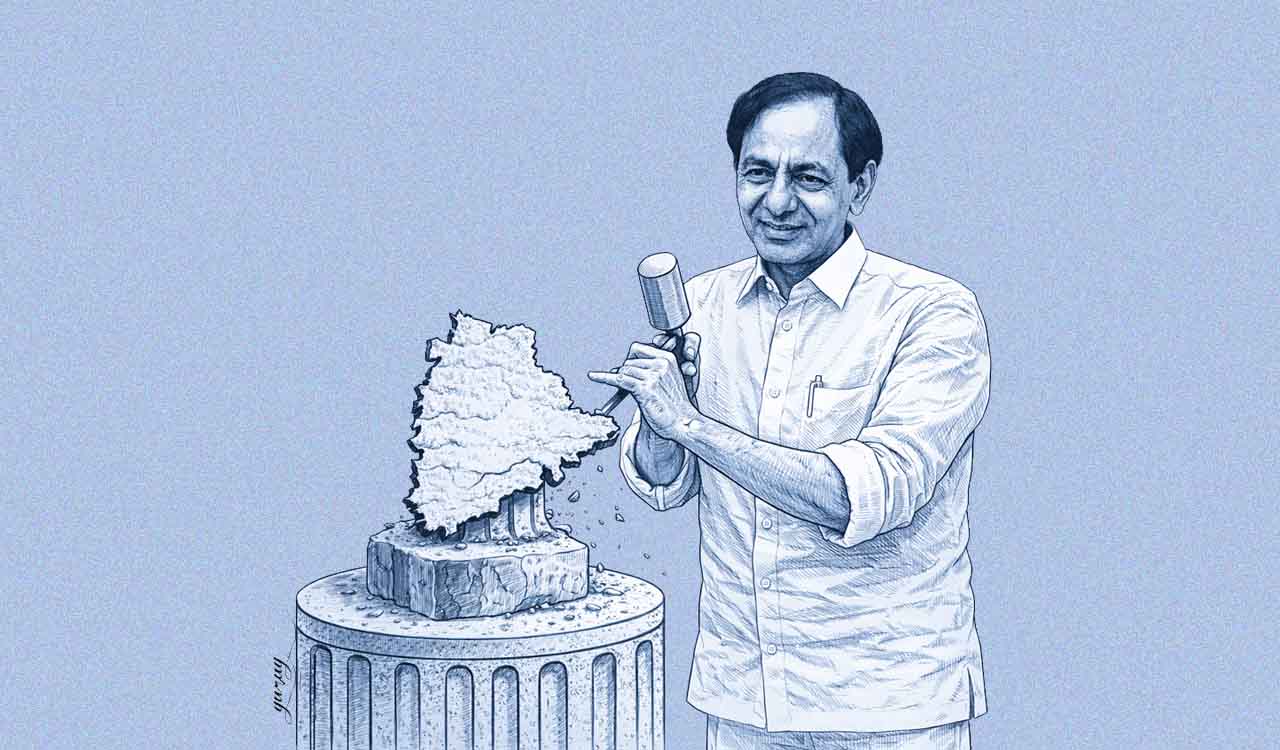
Viewed from this perspective, calling K Chandrashekhar Rao (KCR) the “Father of Telangana ” is not an emotional slogan, but a historical and analytical assessment.
A Ruler is Different from a Founder
Political philosophy draws a clear distinction between a ruler and a founder.
- Rulers administer an existing system.
- Founders make the system itself possible.
Aristotle expressed this distinction succinctly:
The lawgiver should frame his laws with a view to the permanence of the constitution. Aristotle, Politics
In other words, a founder is one who provides the direction that allows a political system to endure. When this question is applied to Telangana, the answer is difficult to dispute. Could Telangana have been formed without KCR?
Would Telangana Have Emerged Without KCR?
There was a Telangana movement in 1969. There were several attempts in the decades that followed. Yet none of them acquired continuity, political structure, or a clear and sustained objective. It was under K Chandrashekhar Rao’s leadership that the Telangana movement took the form of a political party, a continuous struggle, and a clearly articulated goal.
KCR changed the political consciousness of the people of Telangana, where issues of water, finances, and employment ceased to be demands and became rights
From the formation of the Telangana Rashtra Samithi (TRS) in 2001 to the creation of the State in 2014, Chandrashekhar Rao’s leadership served as the backbone of the statehood movement. This is not a matter of personal opinion; it is a historical fact.
Founders Are Not Always Universally Liked
Mahatma Gandhi is widely recognised as the Father of the Indian Nation. Yet certain ideological streams, most notably organisations such as the RSS, have historically refused to accept this title. That rejection, however, has not reduced Gandhi’s contribution or his place in history.
Hannah Arendt explains this phenomenon succinctly:
Every beginning contains its own violence. — Hannah Arendt, On Revolution
New political beginnings inevitably disturb old ideas and established worldviews. Opposition to founders, therefore, is natural. For this very reason, it is hardly surprising that the same ideological traditions that rejected Gandhi as the Father of the Nation today oppose the idea of K Chandrashekhar Rao being called the “Father of Telangana.”
This opposition does not arise from a reassessment of history, but from the need to protect their own ideological position.
The Telangana Movement as a Political Idea
Jean-Jacques Rousseau observed:
He who dares to found a people must be capable of changing human nature. — Jean-Jacques Rousseau, The Social Contract
Chandrashekhar Rao’s most significant contribution was precisely this transformation. He changed the political consciousness of the people of Telangana. The region was no longer seen merely as an administrative unit or a backward area, but as a self-respecting political community with legitimate rights.
The ideas of water, finances, and employment were not presented as mere demands. They became rights. This was not a checklist of grievances; it was a political doctrine.
Cultural Leadership Beyond Power
Antonio Gramsci captured the essence of enduring leadership when he wrote:
A social group becomes dominant when it exercises moral and intellectual leadership.— Antonio Gramsci, Prison Notebooks
Under Chandrashekhar Rao’s leadership, Telangana’s language, culture, history, water rights, and employment rights moved to the centre of political discourse. This was not merely governance; it was the construction of a collective identity.
Telangana as a New Political Beginning
Hannah Arendt’s words resonate strongly here: “The very essence of freedom is the capacity to begin.”
Telangana was not merely the passing of a Bill in Parliament. It represented a new political beginning, a restoration of self-respect. Chandrashekhar Rao’s role is pivotal in the formation of the Telangana State:
- Leadership of the movement,
- Democratic legitimacy,
- Political vision, and
- Cultural identity
Therefore, calling Chandrashekhar Rao the “Father of Telangana” is not personality worship. It is a reasoned conclusion grounded in history.
Those who shape history may be criticised. But history does not forget them.

Related News