T-Hub identity under cloud after Congress Govt decides to shift public offices into incubation hub
The Telangana government’s decision to shift several public offices into T-Hub has raised concerns over its impact on the startup ecosystem. Observers fear that high-footfall offices may affect the innovation-driven environment of the global incubation hub.



Hyderabad: In a move that has triggered sharp questions from different sections, the Congress government has decided to accommodate several government offices in T-Hub, the world’s second largest startup innovation hub and India’s biggest startup incubation hub.
The decision is part of the State government’s plan to shift all government offices functioning from rented buildings into government-owned premises by the end of this month. Under the initiative, 39 government offices currently operating from rented buildings are being relocated to government properties.
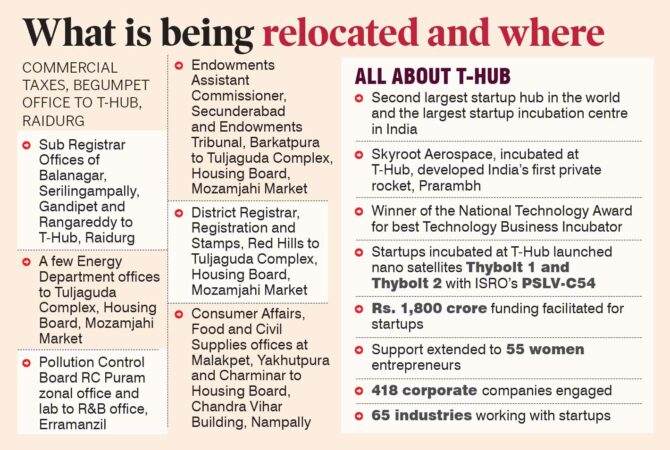
As part of the exercise, the Commercial Taxes Department, Sub Registrar Offices of Rangareddy, Balanagar, Serilingampally and Gandipet, and the office of the Director Registrar of Stamps and Registration are being accommodated at T-Hub. Together, these offices have been allotted nearly 65,000 square feet of space at the facility.
Soon after the formation of Telangana, the government set up T-Hub 1.0 at IIIT Hyderabad, Gachibowli, spread across 70,000 square feet. It was inaugurated by the then Governor ESL Narasimhan and Tata Sons chairman the late Ratan Tata in the presence of former IT and Panchayat Raj and Rural Development Minister KT Rama Rao.
Buoyed by its success, the State later established T-Hub 2.0 Knowledge Centre at a cost of Rs. 400 crore, spread over 3.70 lakh square feet. It was inaugurated by former Chief Minister K Chandrashekhar Rao on June 28, 2022.
T-Hub serves as a platform for youth-driven ideas and innovation. It is not only the largest startup incubation centre in the country but also the second largest startup hub in the world. At any given time, over 2,000 startups can operate under one roof at T-Hub 2.0, with scope for mentoring, marketing support, resource mobilisation and policy advisory.
Over the last decade, T-Hub has delivered hundreds of innovation programmes and supported more than 3,000 national and international startups with access to technology, talent, mentors, customers, corporates, investors and government agencies.
However, the move to relocate government offices into T-Hub has not gone down well with many. Concerns are being expressed that accommodating high-footfall public offices in a space designed for innovation and collaboration would defeat the very purpose of the startup ecosystem, which functions in a distinctly different atmosphere.
To ensure coordination in the past, space at T-Hub was allotted to CII, AIC T-Hub Foundation in partnership with Atal Innovation Mission, NITI Aayog, and Centres of Excellence under the Department of Science and Technology for artificial intelligence and machine learning.
Many observers view the present decision as an attempt to erase the previous government’s imprint on the startup ecosystem.
“BRS working president KT Rama Rao, one more manifesto item to add to the list for 2027/28, ‘Revival of startup ecosystem, which was killed by Congress government,’” Ram Goud Koyyada posted on X.
As part of the relocation drive, the government had initially fixed December 31 as the deadline, with instructions that no rental payments for offices housed in private buildings would be made from February 1, 2026. At present, the State government spends about Rs. 500 crore annually on rent for offices operating from private premises.

Related News