Telangana’s finances stand on firm ground, not shaky during BRS regime
The Comptroller and Auditor General’s State Finances – 2023-24: Decadal Analysis presents Telangana as one of India’s strongest revenue-generating States, with disciplined borrowing, robust tax mobilisation, and sustained growth during the BRS regime.
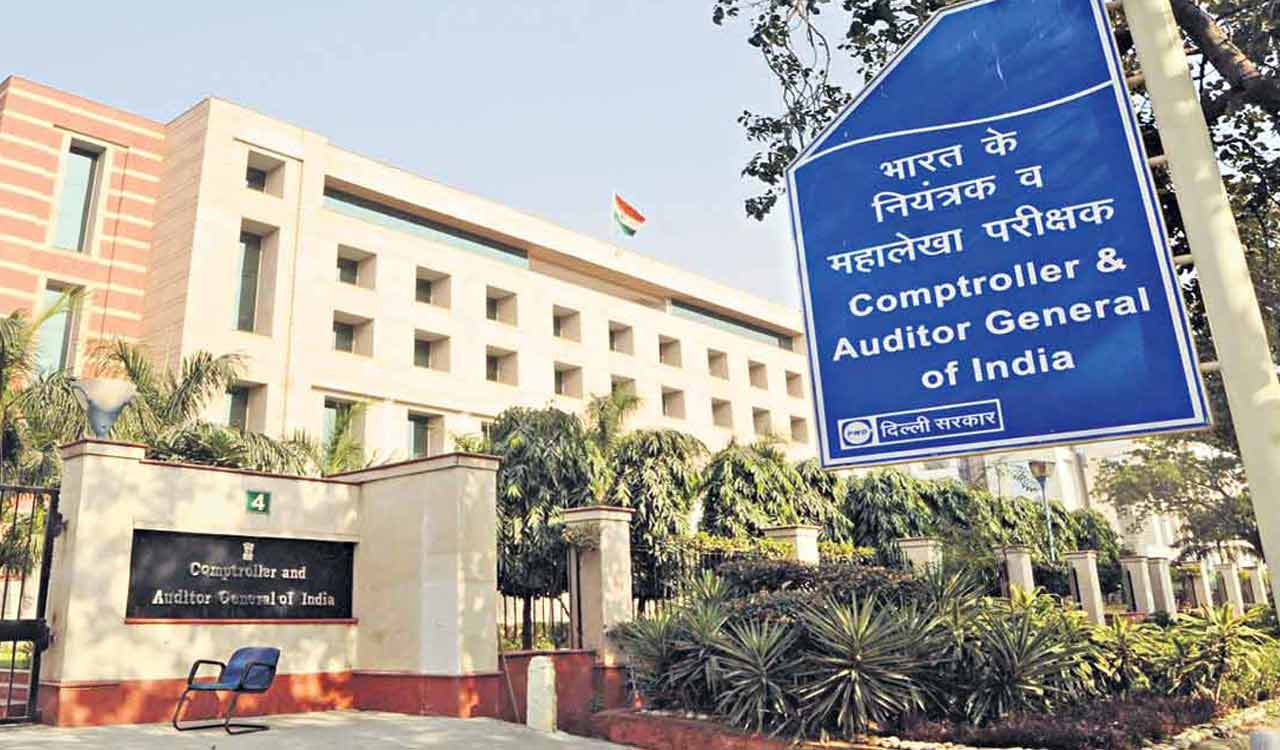
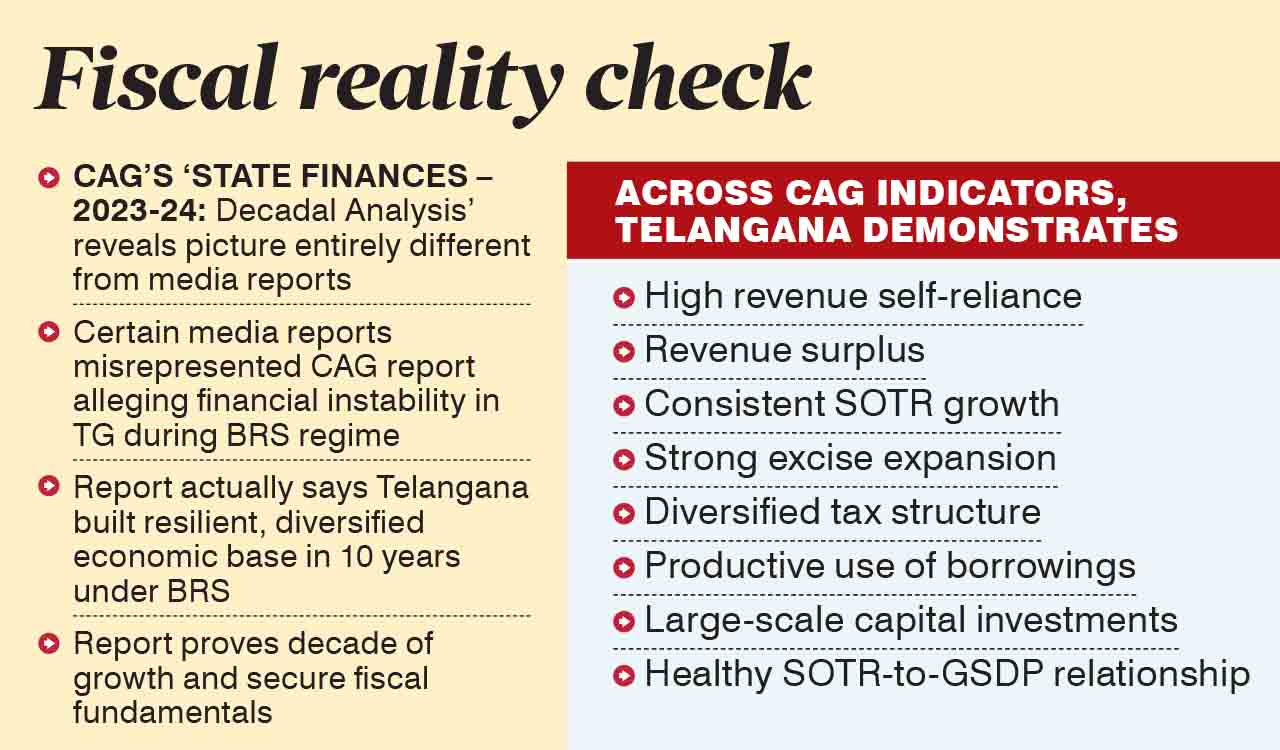


Hyderabad: A closer reading of the Comptroller and Auditor General’s latest report ‘State Finances – 2023-24: Decadal Analysis‘ reveals a picture that is entirely different from what is being written in certain sections of the English media here. The CAG’s decade-long comparative assessment placed Telangana among India’s strongest revenue-generating States, showcasing high fiscal autonomy, disciplined borrowing and expenditure, robust tax mobilisation and sustained economic expansion since 2014.
Far from the alleged ‘financial instability’, the report actually presented Telangana as a State that built a resilient and diversified economic base in just 10 years during the BRS regime. In fact, considering what is stated in the CAG report, Telangana’s finances are shaky during the current Congress rule, with poor growth in State’s Own Tax Revenue (SOTR), reckless borrowings, and poor capital expenditure.
Revenue Powerhouse
At the heart of Telangana’s financial stability during the BRS regime was its extraordinary internal revenue performance. The CAG ranked Telangana among the top six States where SOTR contributed up to 60 per cent of total revenue receipts. Telangana stood fourth, with SOTR contributing a formidable 66 per cent of its total revenue in FY 2023-24. When combined with States’ Non-Tax Revenue (SNTR), Telangana’s own revenue accounted for 80.11 per cent of total revenue receipts, which was the highest in the country.
This meant the State’s dependency on Central transfers or compensatory borrowings was among the lowest in India. Telangana had firmly positioned itself in the league of industrial and service-driven economies like Maharashtra, Karnataka, Tamil Nadu and Gujarat, known for strong internal revenue ecosystems rather than dependence on the Centre.
Nearly Rs 16,000 crore of SNTR was raised through land auctions, indicating the huge demand for real estate investments which again indicated a stable governance and robust economy.
Revenue Surplus Underscores Fiscal Prudence
Despite economic shocks triggered by the COVID-19 pandemic years, Telangana remained a revenue-surplus State in 2023-24. The CAG noted that revenue receipts exceeded revenue expenditure by 0.46 per cent, confirming that Telangana did not borrow for routine expenditure. A revenue surplus is one of the clearest indicators of sound fiscal management, showing that borrowings were deployed in asset creation including irrigation projects, power infrastructure, road networks and developmental investments, rather than recurring administrative costs.
States truly struggling with finances are those running persistent revenue deficits. The CAG data makes it clear that Telangana was not among them. As regards deficit indicators, in FY 2023-24, all States were in fiscal deficit ranging from 0.80 percent to 5.92 percent of their GSDP.
WMA Usage Not Crisis
While the said media reports attempted to portray Telangana’s 349 days of Ways and Means Advances (WMA) usage as fiscal distress, the CAG clarified otherwise, explicitly stating that Goa, Telangana and Uttarakhand, all revenue-surplus States, availed WMA purely due to temporary mismatches between inflows and outflows. WMA is an RBI-sanctioned cash-flow management tool, widely used by high-growth States with large capital expenditure cycles.
In total, 16 States used WMA in FY 2023-24, including Andhra Pradesh, Rajasthan, Kerala, Haryana, Punjab and Maharashtra. Telangana was not an outlier, nor was its usage a symptom of financial collapse. It was standard fiscal practice for States with heavy development expenditure and strong revenue inflows.
Borrowings Channelled Into Capital Growth
The CAG noted a stark contrast between Telangana and States that diverted borrowings to cover revenue deficits. Punjab, Kerala, Andhra Pradesh, Himachal Pradesh and Rajasthan used 40-95 per cent of borrowings to finance routine expenditure. Meanwhile, Telangana used borrowings primarily for productive capital creation i.e. assets that expand the economy, boost long-term revenue and enhance quality of life.
Between 2014-15 and 2023-24, internal debt of Telangana increased by 376 per cent. However, this was owing to the country’s lowest increase of 143 per cent in Loans and Advances from the Central government.
Significantly, Telangana was listed among the 15 States where capital expenditure exceeded net borrowings, indicating that borrowed funds were not being used to plug routine fiscal gaps, but to build permanent assets.
Top Performer in Excise Revenue Growth
One of the most striking metrics in the CAG’s decade-long analysis was Telangana’s exceptional performance in excise revenue. Between FY 2015-16 and FY 2023-24, the State recorded an astonishing 433 per cent growth, which was the highest in the country. Telangana’s excise collections rose from Rs 3,809 crore in FY 2015-16 to Rs 20,299 crore in FY 2023-24, placing it third among all States in excise revenue.
Diversified Tax Base even after GST Shock
The CAG highlighted that Telangana was one of only seven States where SGST growth did not exceed total SOTR growth. This suggests a broad and diversified tax base, not excessive dependence on GST receipts. While SOTR growth moderated post-GST, declining from 21.1 per cent in pre-GST regime to 12.35 per cent in the post-GST era, Telangana still outperformed most States in internal revenue mobilisation despite structural losses from GST pooling. This resilience underscored the State’s economic strength and adaptability.
Interest Burden Within Normal, Manageable Limits
Telangana ranked ninth among the States spending more than 10 per cent of total expenditure on interest payments, with 11.1 per cent allocated to interest servicing. This is far below fiscally stressed States like Punjab, where interest consumption stands at 18.43 per cent of total expenditure. Telangana’s ranking indicated a manageable and controlled interest burden relative to its revenue-generating ability.
Further, Telangana was also ranked third among the States which made investments including purchase of shares and equity, investment in securities, investment in fixed and term deposits, and other investments. In FY 2023-24, States made an investment of Rs 1,24,886 crore, of which substantial amount was spent by Uttar Pradesh (Rs 50,070 crore), Maharashtra (Rs 22,086 crore), and Telangana (Rs 18,631 crore).
Strong Financial Profile
The CAG’s State Finances – 2023-24 does not depict a State in distress. The debt to GSDP ratio is marginally higher (27.6 per cent) than FRBM limit of 25 per cent, but significantly lower than 33.1 percent total liabilities to GSDP path set out by the Fifteenth Finance Commission.
Overall, Telangana turned out to be a State with a high-growth and high-revenue economy that has generated a strong internal tax base, adhered to fiscal targets, and invested heavily in long-term infrastructure. Telangana’s fiscal fundamentals, which were built in just ten years during BRS rule, placed it firmly among the most resilient and economically dynamic States in India today, the CAG report proved.

Related News