Who owns the festival? Medaram Jatara’s identity under scrutiny
The Medaram Sammakka–Saralamma Jatara, Asia’s largest tribal festival, embodies centuries-old Koya traditions of resistance and worship, but state involvement raises concerns of cultural dilution, identity loss, and marginalisation of custodians


By Dr Trilok Chandan Goud, Dr Suman Damera
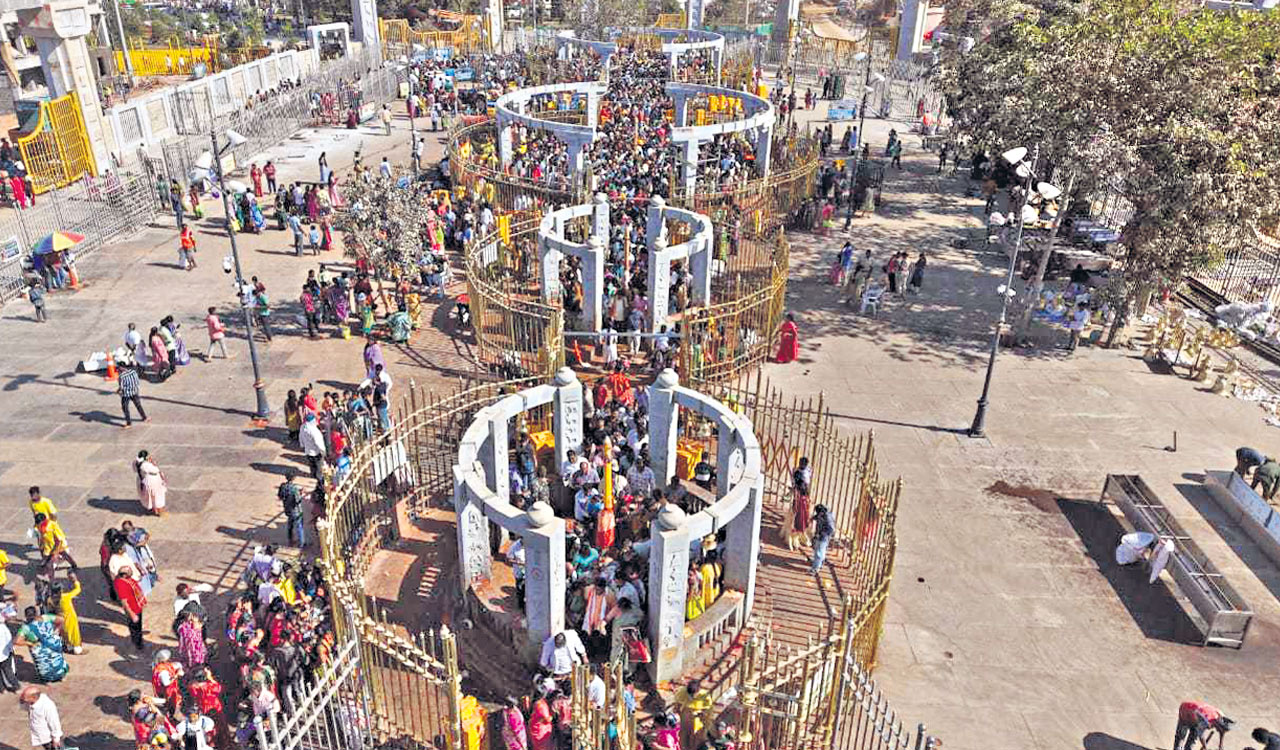
The Medaram (Sammakka-Saralamma) Jatara, renowned as the Kumbh Mela of Telangana, began on 28 January 2026. Held every two years in the forests of Mulugu district, this festival is recognised as the largest tribal festival in Asia. The story of Sammakka and Saralamma’s resistance lives on in the collective memory of the Koya tribals.
Also Read
Attended by millions of devotees from five States, this festival commemorates the fighting spirit of Sammakka and Saralamma, the brave women who stood against oppression. The festival this time starts with new grandeur. About one crore people participated in the jatara in 2022, while it was 1.5 crore in 2024. The government of Telangana estimates around 2 crore people this time.
In Telangana culture, especially among the tribal communities, the worship of goddesses holds immense significance. For generations, festivals have revolved around the worship of local deities such as Durgamma, Maisamma, Pochamma, Yellamma, and Gattamma. This worship continues not only at the village level but also in family traditions, with nature at their core.
These traditions pass down narratives of heroism, sacrifice, and resistance through oral histories across generations. The concept of subaltern deities such as Yellamma, Pochamma, Uppalamma, and Gandi Maisamma emerged from the worship of those who fought and sacrificed their lives for their people. Villagers remember and honour them through ‘gaddelu’ (memorials), songs, and stories, which are passed down through generations. People deeply believe that the powers of these deities still protect their villages.
History of Sammakka and Saralamma
During the Kakatiya rule, the Medaram forests in the Godavari river basin were under the control of the Koya tribal people. According to oral traditions, the tribal chief who ruled the region, Medaraju, had a divine experience. While hunting in the forest, he saw a girl playing fearlessly among tigers, and considered her an incarnation of Vanadurga (the forest goddess). He then brought the girl home and named her Sammakka.
Sammakka acquired proficiency in education and warfare and later married Pagidigidda Raju, the Koya prince who ruled the Medaram region along the Godavari River. Under their rule, Medaram flourished. However, a series of droughts caused severe hardship for the people. Despite this, Kakatiya emperor Prataparudra ordered them to pay tribute, which Medaram refused, declaring its independence.
This conflict escalated into a war, resulting in a battle with the Kakatiya army. Sammakka’s son, Jampanna, fought valiantly at the Sampangi stream and attained martyrdom. Subsequently, Saralamma, Nagulamma, and their husbands also sacrificed their lives in the battle. Finally, Sammakka herself entered the battlefield, striking terror in the enemy forces. However, she was severely wounded in a treacherous attack and disappeared towards Chilukalagutta.
Her followers, who went in search of her, found only a golden bowl there. In the area where she disappeared, the Koya tribals found a vessel containing turmeric and vermilion, which they considered a symbol of Sammakka’s divinity and began to worship. Over time, this worship transformed into the Sammakka-Saralamma Jatara (festival).
Following this incident, Prataparudra also expressed remorse and granted the tribals independence over that region, handing it over to the Koyas. From then on, the worship of Sammakka and Saralamma began, and over time, it expanded into the Medaram Jatara, which is held once every two years. Today, it has become the largest tribal festival in Asia, attracting millions of devotees from all corners of the country.
The Changing Culture
Even though the government is getting more involved in planning the event, tribal priests still have the power to perform the rituals. The Adivasi community makes the schedule, leads the sacred procession from the forest to the altars (Gaddelu), and then brings the gods back to the wild. Government officials help out, but their position is not the most important one.
During the festival, followers take part in close, participatory rituals where they talk to priestesses who are thought to be the goddess and share their problems. They then get answers that are thought to be led by the goddess. After that, the celebrations include communal feasting, sacrifices of goats and chicks, and traditional liquor, which show how tribal life goes on. People who believe in Jampanna Vagu bathe there, bring turmeric, vermilion, saris, bangles, and jaggery to the altars, and pray, “Mother, protect us with compassion.”
The uniqueness of the Medaram Jatara lies in the fact that the rituals, worship, and celebrations are conducted under the supervision of the Koya tribe. But with devotees coming from various regions and different castes, there has been a long-standing discussion about the shift from Koya traditions to Vedic rituals conducted by Brahmin priests. The festival, which traditionally takes place amid nature without any temples or structures, is now seeing new arrangements being made by the government this year.
A new type of temple construction has already been undertaken. The government has handed over the festival, which was previously managed by the Koya tribe, to the Endowments Department. This means that the affairs of the festival will now be conducted under government supervision.
The complete takeover of the festival by the Endowments Department essentially means distancing Sammakka and Saralamma from the tribal people and the Koya community. It would be tantamount to stripping away the identity of Sammakka and Saralamma, the brave women who fought for their existence and autonomy and whose lives are deeply intertwined with the lives of the tribal people. The government bears the responsibility of safeguarding the heroic saga and history of Sammakka and Sarakka.
(Dr Trilok Chandan Goud is a Post-Doctoral Fellow, Department of Sociology, University of Hyderabad, and Dr Suman Damera is Assistant Professor, Department of Public Administration, Mizoram Central University, Mizoram)

Related News