Health and Tech: Get rid of addiction through a skin graft
University of Chicago researchers demonstrate that genetically modified skin grafts can deliver therapeutics



Hyderabad: Addiction to alcohol and other narcotic substances is one of the most challenging disorders to treat. Quite often, individuals addicted to such substances find it very difficult to quit despite undergoing different kinds of therapies and treatments.
Due to long term usage of such substances, the brain is literally rewired in such a way that it becomes difficult to ignore the cravings and often treatments fail. However, what if there is a technology that can treat addiction by a simple skin graft?
It may sound something out of science fiction, but a group of researchers from University of Chicago have demonstrated a new approach in animal models (mice) wherein genetically altered skin grafts can be utilised successfully for treatment of addiction, a one-of-its-kind potential treatment to an ailment that has become a social evil across the globe.
Whenever individuals consume alcohol or other drugs, the levels of dopamine (pleasure chemical) in the brain go up, thus giving rise to feelings of euphoria. As a result, the brain automatically craves for such dopamine rush, forcing addicts to consume alcohol or other substances like cocaine, again and again, in search of the same rush that they had experienced the first time. As a result, it’s a difficult task for individuals to give-up substance abuse.
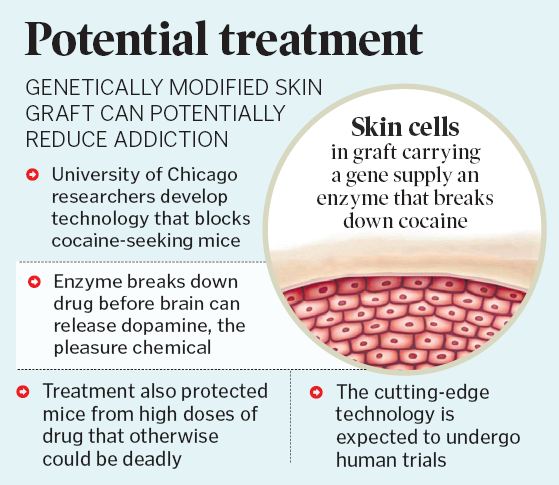
The study by University of Chicago researchers on animal models was published last year in the peer review journal Nature Biomedical Engineering. In the study, the researchers demonstrated that genetically modified skin grafts can deliver therapeutics and has the potential to provide long-lasting and effective treatment against addiction.
The researchers Xiaoyang Wu and Ming Xu demonstrated that the mice, which used to consume alcohol or cocaine in lab settings, are now ignoring them, after receiving the genetically modified skin graft.
With the technology holding a lot of promise, recently, the researchers have also approached US drug regulator FDA for approval to test the treatment for addiction using skin grafts by conducting human clinical trials.
In Nature, the researchers said “Alcohol Use Disorder (AUD) is one of the foremost public health problems. We recently demonstrated that skin grafts generated from mouse epidermal stem cells that had been engineered by CRISPR-mediated genome editing could be transplanted onto mice as a gene delivery platform. We showed that expression of GLP 1 gene delivered by stem cells reduced development of alcohol-induced drug-taking and seeking as well as voluntary oral alcohol consumption”.
In other words, stem cells from addicted patients are harvested and modified using CRISPR, by introducing genes. These genes produce molecules that reduce motivation to consume alcohol or other such addictive substances. The skin cells are then re-implanted into the patient through a skin graft.
In Polsky, the Centre for innovation at University of Chicago, the researchers said “The skin graft acts as a so-called “bio engine,” producing these molecules throughout the life of the graft. In preclinical studies, the engineered skin grafts protected against drug addiction and overdose in animal models”.
“Using this process, we can efficiently and safely deliver the therapeutic to the patient. We believe the novel approach can serve as a long-term treatment for patients and help protect them against the harmful effects of drug use,” researchers said.

Related News