Karimnagar farmers worried over restrictions on fine variety paddy
Farmers have raised concerns after the State government reduced the list of fine variety paddy seeds eligible for the Rs 500 bonus from 33 to eight. Growers fear the move may gradually end the incentive scheme despite higher cultivation risks and costs.
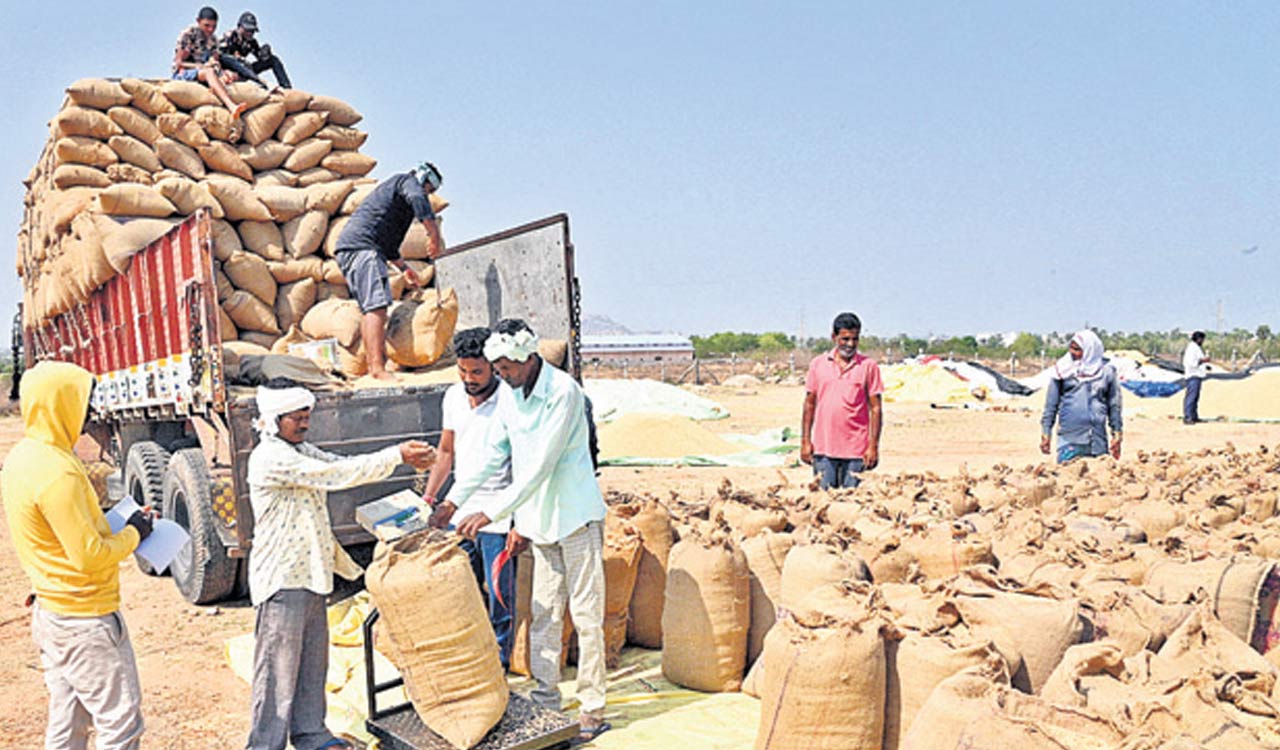


Karimnagar: It appears as if the State government is gradually going back on its promise of paying Rs 500 bonus for fine varieties of paddy as, surreptitiously, a number of fine variety paddy seeds were eliminated from the list of seeds eligible for the bonus.
To encourage farmers to cultivate fine variety paddy, the State government announced a Rs 500 bonus besides identifying 33 fine variety paddy seeds two years ago. However, the number of seed varieties has now been cut down to eight.
They are BPT-5204 (Sambamasuri), RNR-15048 (Telangana Sona), KNM-1638 (Kunaram Vari-2), JGL-1798 (Jagtial Sannalu), Jai Sriram, HMT, Sona Warangal-44 (Sidhi) and WGL-962. Agriculture department officials are advising farmers to cultivate only these varieties to get higher yield. Moreover, these seed varieties have more demand in the market.
However, the farming community is in a dilemma over the continuation of the bonus. Farmers are expressing doubts as officials are insisting only on these eight varieties, though there are a number of good quality seeds available in the market.
Farmers suspect that, just to do away with the payment of bonus, the government is imposing restrictions on the varieties of paddy to be grown. Compared to the normal variety, cultivation of fine variety involves more risk.
Though there is huge demand for fine variety rice in the market, farmers usually do not show interest in its cultivation because of high investment, low yield and because the crop is easily infected by insects. Moreover, it requires high maintenance when compared to normal varieties. To cultivate a normal variety in an acre of land, about Rs 30,000 is enough for land tilling, weed removal, spraying pesticides and labour charges. However, the cost shoots up to Rs 35,000 for the fine variety.
Farmers have to spray pesticides two to three additional times since the crop gets easily infected by insects. For this purpose, they have to spend an additional Rs 5,000 more than that of the normal variety, which requires pesticides costing between Rs 3,000 and Rs 3,500. Moreover, the yield of a normal variety would be around 30 quintals in an acre, while the fine variety gives only 18 quintals.
A farmer from Manakondur mandal, Veeresham, opined that though they were producing the fine variety by facing all these challenges, the government was imposing restrictions. Where was the need to insist only on eight varieties when a number of good quality seeds were available in the market? He expressed doubts and questioned who would take responsibility if the seeds suggested by the government failed.

Related News