Konda Laxman Bapuji: Struggle was his identity, public service his path
From the freedom struggle to Telangana statehood, Konda Laxman Bapuji’s life remained rooted in social justice and public service


By Chitikena Kiran Kumar
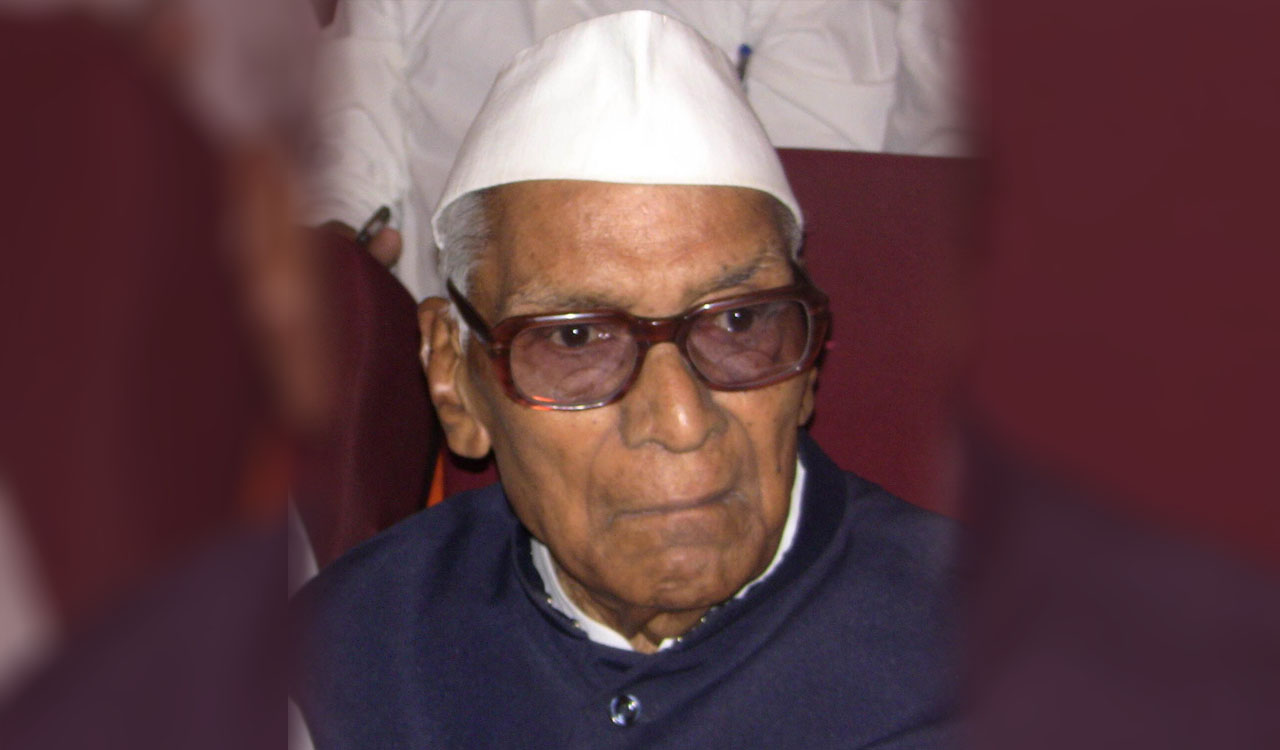
When the history of Telangana is read closely, some personalities cannot be confined to a particular period. Their lives become connected with several movements, social changes, and the aspirations of people. Konda Laxman Bapuji was one such rare public personality.
Also Read
His journey covered several important phases—from the freedom movement and public struggles in the erstwhile Hyderabad State to the welfare of handloom communities, from social awareness to the aspiration for a separate Telangana, and from political responsibilities to democratic values. Even as political circumstances changed and positions of authority came and went, his connection with public issues continued throughout his life.
Konda Laxman Bapuji was born on September 27, 1915, at Wankidi in the Adilabad region of the erstwhile Hyderabad State. Born to Konda Poshetti and Ammakka, he grew up in an ordinary family environment and witnessed many social realities from his early years. His family background was connected with the handloom profession, which brought him close to the lives and struggles of ordinary working people.
Interest in education
At a time when education, employment and social opportunities were not equally accessible to everyone, he developed a strong interest in education. The experiences of his childhood later influenced his thinking and his approach towards public life.
As he grew into a young man, his concern for society also became stronger. He believed that personal progress alone was not enough and that the lives of people around him also had to improve. He wanted young people to develop discipline, awareness, and a spirit of collective responsibility. The belief that social change could not be achieved by an individual alone, but required the participation of people, became one of the foundations of his public life.
Participation in Satyagraha
The national movement further broadened his outlook. He participated in movements seeking rights, freedom and democratic opportunities for the people of Hyderabad State. His participation in the Hyderabad State Congress Satyagraha programme in 1938, which led to his arrest, became one of the early significant moments of his public life. That experience strengthened his sense of responsibility towards public issues. Through his actions, he demonstrated that freedom was not merely a political expression but a value that had to be reflected in the everyday life of ordinary people.
Although he studied law and worked as a lawyer, his vision did not remain confined to his profession. His legal career gave him an opportunity to understand people’s problems from close quarters. The difficulties faced by rural communities, economic inequalities, and social backwardness gradually became important concerns in his thinking. He tried not merely to listen to people’s problems but also to understand the social conditions behind them.
During the freedom struggle, he played an active role. Along with the Quit India Movement, he also participated in the struggles for democratic rights in the Hyderabad State. Even after India became independent, his interest in public issues did not diminish. Following the integration of Hyderabad State with India, he continued to observe the changing political and social circumstances from the perspective of public welfare.
His association with the handloom sector occupies a special place in his public life. He had seen the hardships faced by handloom workers at close quarters. He understood the importance of education, economic opportunities, and collective strength for families dependent on traditional occupations. His efforts towards the welfare of the Padmashali community and other occupational groups reflected his broader social outlook. His contribution towards the establishment of a Padmashali hostel in 1949 is remembered as one of the important steps in this direction.
With his entry into post-Independence politics, his public responsibilities increased. In 1952, he was elected to the Legislative Assembly from the Asifabad constituency and began another important phase of his public journey. He later served as a legislator, Deputy Speaker, and Minister in different capacities. During his time in public office, he raised issues concerning handloom workers, rural communities and socially disadvantaged sections. His political journey reflected the belief that being a people’s representative meant giving a voice to the concerns of the people.
Significant phase
One of the most significant phases of Konda Laxman Bapuji’s political life came during the Telangana movement of 1969. At a time when students, employees, and people across the region were expressing their aspirations for a separate Telangana, he resigned from his ministerial position in support of the movement. Rather than continuing in office, he chose to openly associate himself with the aspirations being expressed by the people of the Telangana region. That decision became a major turning point in his public life.
The 1969 movement was not merely a political development. It reflected regional concerns, aspirations for development, and the emotions that had accumulated in Telangana society over a long period. As an experienced political leader, Bapuji closely observed the developments of the movement. He understood the aspirations of students and younger generations and connected his political experience with the larger public discussion. Therefore, his role cannot be viewed only through the narrow perspective of a leader who resigned from a ministerial position.
In the years that followed, political circumstances underwent several changes. The Telangana issue also passed through different phases. Yet Konda Laxman Bapuji continued to uphold the aspiration for a separate Telangana throughout his life. He maintained connections with a new generation of activists, political leaders and social workers. He also became a bridge between different generations by sharing his experiences of earlier movements with those who came later. The reference to his residence, Jaladrushyam, in connection with the early developments surrounding the formation of the Telangana Rashtra Samithi in 2001 is another notable aspect of his public journey.
Looking at Bapuji only through a political lens would mean overlooking another important dimension of his personality. He wanted education, dignity, and opportunities to reach socially disadvantaged sections. He tried to bring the problems of people dependent on traditional productive occupations into the public discussion. His broader understanding of social development was not limited to economic growth. For him, development also meant ensuring dignity, education, and opportunities for every section of society.
Despite spending several decades in public life, he did not treat political office as the ultimate purpose of his life. Whenever circumstances demanded, he was prepared to take and publicly declare his own political decisions. Therefore, while looking at his life, it is not merely the list of positions he held that stands out. His decisions, his response to people’s problems, and the occasions on which he stood by his convictions remain equally significant.
Reflection of Telangana’s history
The life of Konda Laxman Bapuji can be seen as a mirror reflecting several stages of Telangana’s history. The freedom movement, public struggles in the Hyderabad State, the handloom sector, social awareness, legislative politics, the 1969 Telangana movement and the later developments of the Telangana movement—all these phases had a connection with his life in one form or another. For this reason, his life provides an opportunity to understand not only the story of an individual but also the social and political journey of an important period in Telangana’s history.
His aspiration to witness the formation of Telangana as a separate State, however, remained unfulfilled. He passed away in Hyderabad on September 21, 2012. In a life spanning nearly nine decades, he witnessed several movements, carried out many public responsibilities, and responded to a wide range of social concerns. The reason his name continues to remain part of history is not merely the positions he held. It is the manner in which he connected his life with the aspirations and public concerns of his time.
Remembering Konda Laxman Bapuji is not merely about recalling a historical personality. It is also an occasion to remember values such as commitment to public life, social responsibility, sensitivity towards people’s aspirations, and the courage to give importance to a larger public cause when circumstances demanded it. Several chapters of Telangana’s history may have changed with time, but the name of Konda Laxman Bapuji remains a lasting chapter in the public memory of the region.

(The author is a poet, writer, and columnist)

Related News
-

Reorganisation of districts: A new face of Telangana
-
To SIR, with(out) love—a voter’s experience with electoral roll revision
-
Honest Money: The patient dragon—what twenty years of quiet preparation looks like, and what it means for India
-
Symbol of courage: PM Modi pays tribute to Bhagat Singh on birth anniversary