Rewind: Nuclear landscapes — One world or none
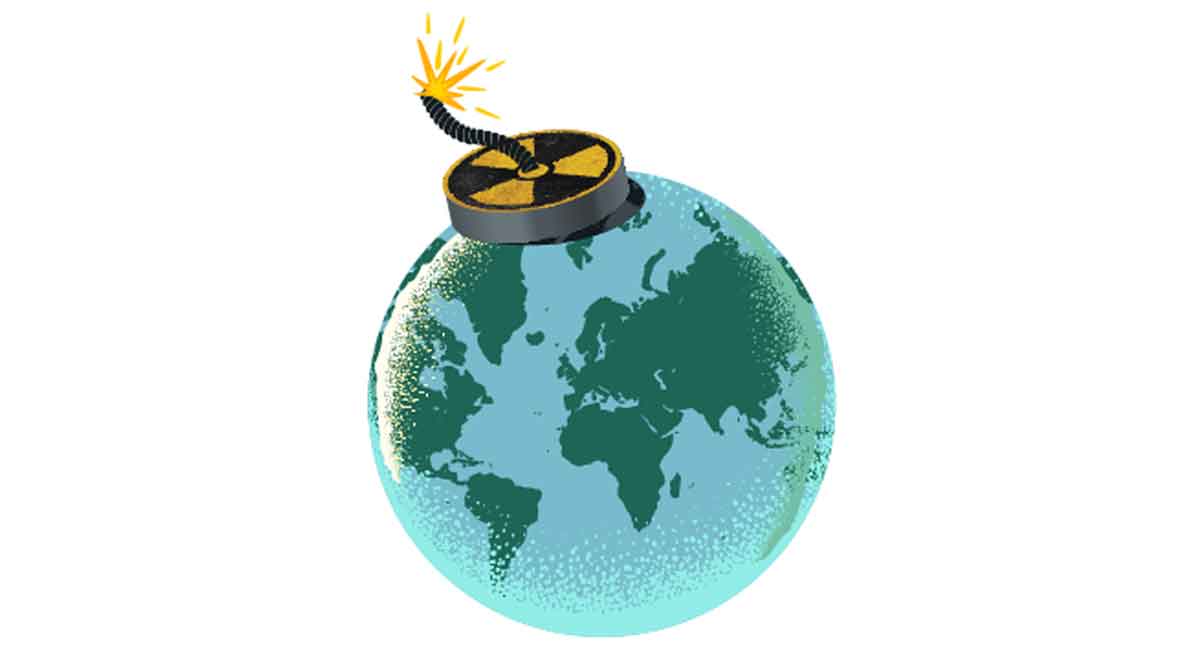
A nuclear landscape is not necessarily just Hiroshima and Nagasaki, Chernobyl and Fukushima with their burnt human forms and devastated cities. Nuclear landscapes are terra nullius, nobody’s land, because they have been rendered unfit for life


By Pramod K Nayar
What does a nuclear landscape look like? First, obviously, it looks like a city smashed to smithereens. Hiroshima-Nagasaki devastated, and buildings razed to the ground. A man’s shadow imprinted into the concrete when he was vaporised during the explosion.
Flash of Light, Wall of Fire and Rain of Ruin, the two valuable collections of photographs from the atomic bombings of Japan, capture the man-made catastrophe visited on the Asian island nation (although originally intended to be deployed against the Germans, thus suggesting a racialised bomb, as the African American thinker WEB Du Bois pointed out). As the photographs move outward from the hypocentre of the explosion, the degree of destruction changes.
Second, there are the deeply disturbing images of injured bodies and bloated corpses.
In Tomoko Konishi’s drawings and narrative of witnessing in the collection Unforgettable Fire: Pictures Drawn by Atomic Bomb Survivors (1977), he gives us this: a girl squatting on the road with what appears to be a bit of cloth hanging down from her back. The illustration is annotated in Japanese, with arrows pointing to various features in the image, and the English text follows beneath the image:
“Her back was completely burned and her skin peeled off and was hanging down from her hips.”
In other illustrations, we are shown people with ‘the flesh … scooped out and bleeding profusely’, or ‘skin of both … hands … hanging loose as if it were rubber gloves’.
Then there are people and places not directly bombed but have lived in nuclear landscapes for a very long time: the downwinders. ‘Downwinders’ was the term used to describe people living downwind from the nuclear tests in Nevada, Utah and other places. They were not adequately warned of the massive tests being held just a few hundred miles from their homes. Many of these residents would die of cancer, the long-term consequence of being in the line of radiation from the tests.
A nuclear landscape is not necessarily Hiroshima, Nagasaki or Chernobyl with their burnt cities and destroyed human form. A nuclear landscape is also one where, for all practical purposes, the land appears ‘normal’. The vast stretches of empty lands, the sites of former nuclear tests, look innocuous.
Except that it is not.
Every grain of sand, every blade of grass is toxic, and will remain so for hundreds of thousands of years, for they all are radioactive from the nuclear tests conducted upon, or below, the land. Peter Goin has spent decades photographing such landscapes, from Nevada to Bikini Atoll. Other artists, such as Anaïs Tondeur have developed more elaborate means of documenting the landscape — in terms of the plant life that arises, contaminated.
Shooting Contamination
At Gable Mountains, Montana, remnants of a tower where the nuclear device was placed for explosion stand amidst the vast landscape. The land, Goin informs us, is still contaminated although the top layer has been bulldozed. ‘Burial Ground’, from the Gable Mountain Pond waste burial site captures a landscape where ‘massive storage tanks containing hundreds of millions of gallons of liquid radioactive waste’. Goin writes: ‘some reports indicate that the tanks are already leaking’. At Hanford, site of the laboratories that were a part of the Manhattan Project, the standing water in the liquid waste disposal pond, is still radioactive. On the land, yellow posts stick out of the soil indicating radioactivity.
Many of the tanks in which nuclear waste is stored, notes Goin, are leaking. Structures (concrete, metal) are, of course, contaminated, but so is the surface in most cases. What Goin shoots is a nuclearised, highly toxic land. It is a land that would remain toxic in terms of its water and soil, and eventually in any vegetation that may spring up there.
In short, Goin captures empty lands that are filled with an invisible activity: radiation. The wind whistles across the land, but the music would be of dosimeters clicking at a furious pace (like the eerie background score, almost entirely of such clicking, in the HBO series, Chernobyl).
Invisible Agency
The lands are not empty. For there is radioactivity all around. Goin writes:
“According to a Department of Energy survey report (April 1989), if islanders were to resume living here, they would be receiving a 20-millirem dose of radiation over and above normal background radiation. The surface soils of Enjebi Island are contaminated with residual levels of plutonium (half-life of 240, 360 years) and americium, which could be re-suspended by the wind and present an inhalation hazard.”
Bikini Atoll, Nevada and Hanford in Goin’s photographs draw attention to humanity’s ruination and subsequent abandonment of places. The emphasis on leakage of radioactive materials, the strewn radioactive debris and finally, the very nature of radioactivity which is unlikely to cease for the term of humanity’s natural life — with half-lives of 240, 360 years — ensures that the area has to remain terra nullius, literally ‘nobody’s land’, unless humans wish to absorb more than the acceptable limit of radiation if they return to the Atolls.
In other words, it is a permanent terra nullius. This is terra nullius because nobody can use it, live on it, cultivate it, without serious risk to their lives and that of their future generations. The ruin humankind leaves behind is tangible in the form of material ruins and invisible in the form of radioactivity.
This new terra nullius is savagely ironic, for the inhabitants of the Pacific Islands had been asked to relocate from their traditional lands so as to allow the USA to conduct nuclear tests. And now, with the contamination from radioactivity, the Islanders have lost their land in another way, for a very long period of time, perhaps beyond the human life span.
With nuclear landscapes, the threat is invisible and present in every aspect of the land, whether this is the sand or the plant life, the residual structures of man’s work or animal bodies.
Glowing with Life
Goin turns to the Bikini and Enewetak Atolls where he photographs the massive ‘crypt’ storing ‘111,000 cubic yards of radioactively contaminated soil’. In the photograph titled ‘Nuclear Bunker Complex’, we see a patch of green adjacent to the concrete structure. Goin dispels any hope one may take from the lush green when he writes ‘this area is still radioactive’. Debris scattered across the Islands are ‘still radioactive’. ‘Radioactive vegetation’ covers the bunkers elsewhere on the Atoll.
He photographs a landscape of coconuts on Eneu Island, Bikini Atoll. Goin says: ‘the residual levels of cesium 137 (half-life of 30 years) absorbed into the coconuts…are still too high for human consumption to be safe’. He titles the image, ‘Coconut Graveyard’. The last photograph, ‘Tide Pool’ shows electric cables intertwined with coral in the Bikini and Enewetak Atolls. Goin tells us:
“even the best cleanup efforts could not remove all the electrical wire, pipe, and assorted smaller objects. Some were welded naturally into the coral in tidal areas throughout Bikini and Enewetak atolls, creating an unnatural beauty.”
Apocalyptic machinery has merged with the corals, embedded itself into seeds, flowers and fruit, and has become a part of the landscape. There is life, of course, but life that glows with its own internal radiance. A brilliant example, literally, would be the collection of ‘photograms’ of the artist Anaïs Tondeur in The Chernobyl Herbarium. The plants are full of radiation. Michael Marder, the philosopher who writes on plant/vegetal life, says:
“Chernobyl’s human survivors are the scraps of radiation’s after-life, which severely limits life expectancy as a consequence of external and, in many cases, ongoing internal exposures. Plants grown in contaminated soil are, likewise, a finite after life of radiation. Strontium-90 accumulates in vascular vegetal tissues, whereas cesium-137 is distributed throughout a plant, due to its similarity to potassium…”
The rabbits found in the Hanford and other test areas were radioactive. This means, the life forms in places of nuclear testing are carrying the toxins inside them, and transmitting it from generation to generation, even though the testing concluded in the 1950s. This is the case with the animal life from Chernobyl’s ‘Exclusion Zone’ as well, now verdant with life, including animals, as documented in Rebecca Johnson’s Chernobyl’s Wild Kingdom.
Cornelia Hesse-Honegger, an illustrator for the University of Zurich, collected specimens of insects in areas with nuclear power plants and in regions in direct line of the toxic cloud from Chernobyl: Sweden and Switzerland, and from the Chernobyl region. Over the years, Hesse-Honegger collected and drew over 16,000 true bugs from 25 nuclear sites around the world.
Later, she took live-samples from areas impacted by the Chernobyl cloud in Switzerland, breeding Drosophila in her home to observe abnormalities in the offspring. She published a 40-page study in the journal Chemistry & Biodiversity in 2008. Her other work appeared on Atomic Photographers Guild website. The artistic renderings attracted both scientific and public annoyance and fascination, as a Smithsonian essay noted.
Hesse-Honegger focuses on the loss of bodily similitude to the normative form of the insect. The deformity implies the presence of something not-quite-life: the toxin. In the process, she captured the transformation of Nature: insects breeding after ingestion of toxins, their genetic material modified and, more seriously, passed on too. Hesse-Honegger is speaking of a disruption in the order of Nature, as evidenced in the mutated bugs.
There are no places to hide in the event of a nuclear war, as all the anti-nuclear documentaries, including the Academy Award-winning, If You Love This Planet (1982), emphasise. If there are no safe places in the world, then, as the first major collection of essays — including those by Albert Einstein, Hans Bethe, Harold Urey, Robert Oppenheimer – published in 1946 told us in its very title, it amounts to: ‘one world, or none’.
Evidently, once nuclearised, a landscape stays nuclearised. With the impossible timelines of the half-lives of radioactive materials, what Goin, Hesse-Honeggar and Tondeur are signalling is essentially a nuclear eternity.
And eternity, said Tom Stoppard, the British playwright, is a terrible thought: where is it all going to end?
(The author is Professor, Department of English, University of Hyderabad)
Now you can get handpicked stories from Telangana Today on Telegram everyday. Click the link to subscribe.
Click to follow Telangana Today Facebook page and Twitter .

Related News