Opinion: Child absenteeism and learning gaps in Telangana’s rural schools
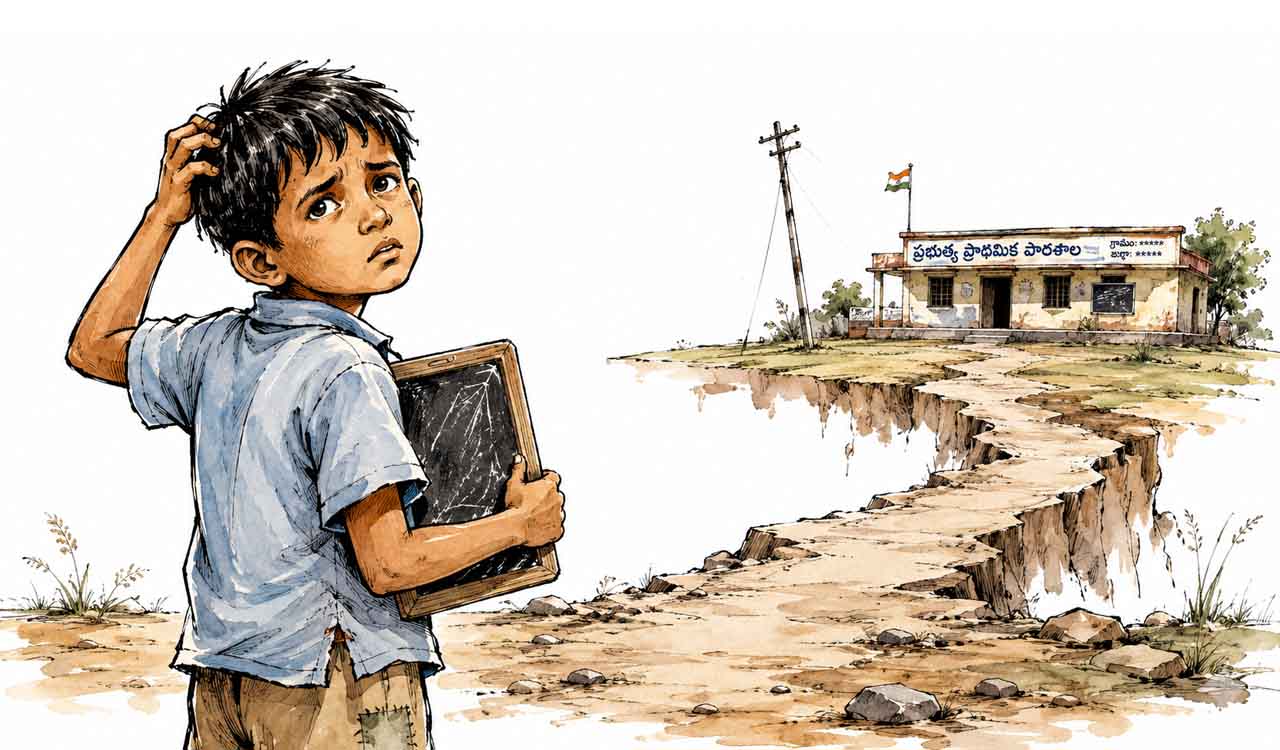
Despite Telangana’s progress in school enrolment and educational access, child absenteeism in rural schools persists, widening learning gaps and increasing dropout rates


By Venkatanarayana Motkuri
Telangana’s achievements in educational development, spanning both school and higher education, are noteworthy. Despite a historical legacy of relative backwardness during the Nizam period and even in the post-Independence era under Andhra Pradesh, the region witnessed a significant turnaround beginning in the late 1990s.
Also Read
Since the turn of the 21st century, the State has made steady progress, expanding access to schooling, improving educational infrastructure, and strengthening higher education institutions, thereby forging ahead on a path of sustained educational advancement.
Missing Link
Our estimates based on the Periodic Labour Force Survey 2025 indicate that in Telangana, about 99.5% of children in the elementary school-age group (6–14 years), and 93.3% in the secondary school-age group (15–17 years) are attending school. Among the college-age population, around 48% are enrolled in educational institutions, while attendance among pre-primary-age children is roughly 75%. Overall, Telangana performs above the national average and ranks among the top five States in terms of Current Attendance Rates (CAR) across school and college-age cohorts.
This suggests that the constitutional mandate of universal schooling — particularly for the 6–14 age group — has largely been achieved in the State. However, when assessed against the broader global norm that all children aged 6–17 should be in school, a gap of around seven percentage points still persists, indicating the need for targeted efforts to ensure full participation at the secondary level.
The rapid quantitative expansion in schooling over the last three decades in Telangana has also raised significant concerns, particularly regarding quality. There is growing concern about the adequacy of school infrastructure, as well as the availability and effective utilisation of human and financial resources. Issues related to curriculum relevance and pedagogical practices have also come under scrutiny. In addition, persistent challenges such as teacher absenteeism and children’s irregular attendance continue to affect the overall effectiveness of the education system.
ASER Estimates
The ASER 2024 estimates for rural Telangana are concerning, indicating that more than a quarter of surveyed children who were reported as enrolled and usually attending school were, in fact, absent on the day of the survey (in both primary and upper primary levels). This highlights an important gap between official enrolment and regular attendance reporting, and actual day-to-day participation in schooling.
Strengthening incentives such as mid-day meals and cash transfers can improve attendance, while better infrastructure, teacher accountability, and inclusive teaching can boost student engagement
A child may be formally enrolled and even classified as a regular attendee, yet still exhibit frequent or episodic absenteeism, pointing to weak engagement with the schooling process. This issue is not isolated, as earlier studies have also documented significant teacher absenteeism. While the ASER findings and our CAR estimates are broadly consistent, ASER’s follow-up verification of physical presence in schools reveals a substantially high incidence of child absenteeism.
This has important implications for educational quality, since such disengagement undermines learning outcomes and calls for targeted policy interventions to improve both attendance monitoring and classroom participation.
Multifaceted Problem
Children’s absenteeism in rural schools is a multifaceted problem shaped by economic, social, and institutional factors. In many rural households, children are expected to contribute to family income or assist in domestic and agricultural work, especially during peak farming seasons such as sowing and harvesting, to offset high labour costs and other related pressures. This creates a high opportunity cost of schooling, leading to irregular attendance rather than complete withdrawal. Poverty further intensifies the problem, as families prioritise immediate survival needs over long-term educational benefits.
Household characteristics and social norms also play a crucial role. Parental education, particularly that of mothers, strongly influences children’s school attendance; less educated parents may not fully appreciate the importance of regular schooling. Gender disparities are evident, with girls more likely to be absent due to responsibilities such as household chores, sibling care, or social expectations like early marriage.
Health-related issues, including malnutrition and lack of access to basic sanitation facilities, particularly affect attendance, with adolescent girls being disproportionately impacted in the absence of adequate toilet facilities.
School-related factors significantly contribute to absenteeism as well.
Poor quality of education, including teacher absenteeism, multi-grade classrooms, and unengaging teaching methods, reduces students’ motivation to attend. Inadequate infrastructure — such as the lack of proper classrooms, drinking water, and electricity — further discourages regular participation. For children from tribal or marginalised communities, language barriers between home and school environments can create additional challenges, making schooling less accessible and relevant.
Accessibility remains another major constraint. In many rural areas, schools are located far from children’s homes, requiring long and sometimes unsafe travel. This disproportionately affects younger children and girls, leading to frequent absences and increased risk of dropout. Seasonal migration also disrupts education, as families move in search of employment, forcing children to miss school for extended periods or drop out altogether.
Institutional weaknesses exacerbate these issues. Monitoring mechanisms are often weak, and programmes designed to incentivise attendance, such as mid-day meals or scholarships, may suffer from inconsistent implementation. As a result, absenteeism persists, leading to serious consequences such as learning gaps, poor foundational skills, higher dropout rates, and the perpetuation of intergenerational poverty.
Tackling Absenteeism
Addressing absenteeism requires a comprehensive approach that tackles both demand-side and supply-side factors. Strengthening incentives like mid-day meals and conditional cash transfers can encourage attendance, while improving school quality through better infrastructure, teacher accountability, and inclusive pedagogy can enhance student engagement.
Community awareness, particularly regarding the importance of girls’ education, along with flexible schooling arrangements for migrant children, can further reduce absenteeism. Ultimately, sustained policy attention and integrated interventions are essential to ensure regular school participation and improved educational outcomes in rural areas.

(The author is with the Centre for Economic and Social Studies [CESS], Hyderabad)

Related News