Opinion: Make Panchayats more effective
Panchayats should be empowered to make decisions about the allocation and use of funds



By Seela Subba Rao
In the history of the Panchayat Raj System in India, 24 April 1993 is important as on this date the Constitution (73rd Amendment) Act came into force to provide constitutional status to the Panchayat Raj Institutions. The Panchayat Raj System exists in all the States and union Territories except Nagaland, Meghalaya, Mizoram and Delhi. The three-tier system is Gram Panchayat (GP) at the village level, Panchayat Samiti at the block/mandal level and Zilla Parishad at the district level.
Also Read
There are 2,55,623 GPs followed by the intermediate panchayats (6,697) and Zilla Parishads (665) across the country, according to the annual report 2022-23 of the Ministry of Panchayat Raj. They are responsible for a variety of tasks including agriculture, rural housing, water management, rural electrification, healthcare and sanitation. In some cases, Zilla Parishads are also responsible for maintaining schools, hospitals, dispensaries and minor irrigation projects. As they have to depend on the Centre and the State for funds, most panchayats suffer from interference from the top two tiers. Last August, several panchayat heads protested in Chennai asking for greater autonomy for the Panchayat Raj Institutions.
Revenue Receipts
According to the RBI report on Finances of Panchayat Raj Institutions released in January, panchayats recorded a total revenue of Rs 35,354 crore in 2022-23 (Rs 37,971 crore in 2021-22). Of this, just Rs 737 crore (2.1% of total revenue) was earned through own tax revenue which is mainly through taxes on profession, land revenue, stamps & registration fees, property and service tax. Panchayats also earned Rs 1,494 crore (4.2% of the total revenue) through non-tax revenue which is mostly earnings from interest payments and Panchayat Raj programmes. In contrast, they earned Rs 33,123 crore (93.7% of total revenue) as grants in aid from the central (Rs 24,699 crore) and State governments (Rs 8,424 crore) together.
Since the lion’s share of their revenues comes in the form of grants, this restricts their spending ability which is already hampered by delays in the establishment of State Finance Commissions in respective States. The RBI report also revealed that the average revenue per panchayat from all sources stood at Rs 23.20 lakh in 2021-22 and the same got reduced to Rs 21.23 lakh in 2022-23.
Devolution Index
The devolution index measures the functions, finance and functionaries of the Panchayat Raj Institutions as well as accountability in the institutions and accordingly ranks States. The index rates a State on three parameters. First, the transfer of subjects that is, how many functions including drinking water, rural housing, family welfare and women & child development are under the control of panchayats. Second, transfer of functionaries, that is, how many positions were filled by panchayats on their own. Third, transfer of finances, that is, what share of funds is raised by panchayats on their own and what share can they spend based on their decisions.
By using the panchayat devolution index (PDI) prepared by the Ministry of Panchayat Raj, the States have been classified into four grades. Those with scores of up to 40% fall in grade D, 40-60% in grade C, 60-75% in grade B, 75-90% in grade A, while those scoring above 90% are categorised as A . The States with higher devolution index scores are Kerala, Karnataka, Maharashtra, and Tamil Nadu while Assam, Punjab, Odisha, Chhattisgarh, Madhya Pradesh and Uttarakhand rank lower.
The Fifteenth Finance Commission has earmarked Rs 2,36,805 crore for the five-year period under its purview, ie 2021-26. The commission specified the online availability of audited accounts as a prerequisite to avail the grant amount – 60% of this grant was tied exclusively to water and sanitation-related areas. The commission mandated the release of local body grants by State governments within ten working days of the receipt of such grants from the central government, with a specific interest rate to be paid for any delay beyond the said period.
Improving Efficiency
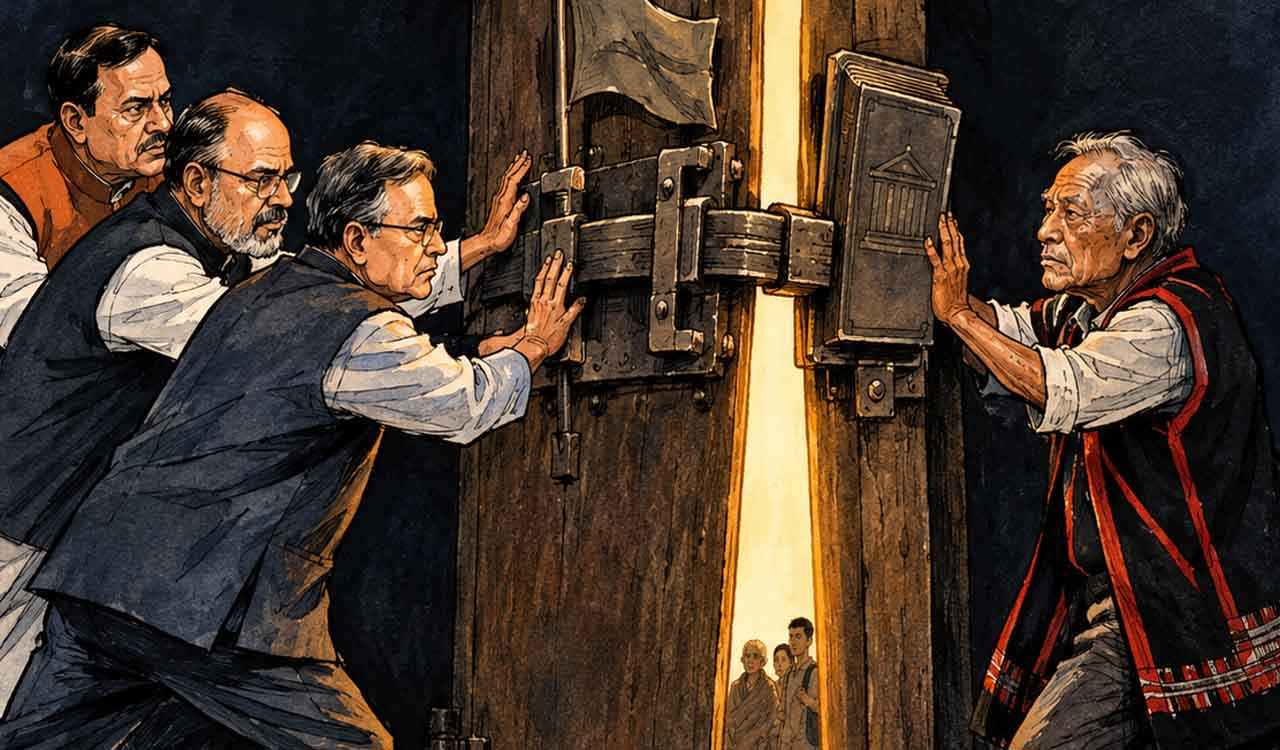
Many panchayats face financial constraints, limiting their ability to execute development projects effectively. Increasing further allocations of central and State governments can help the revenues of panchayats to some extent. Transfer of funds directly to panchayats can be done rather than routing through intermediaries. Despite constitutional provisions, political interference from higher levels of government remains a challenge. Panchayats should be empowered to make decisions about the allocation and use of funds rather than having decisions made for them by higher levels of government.
Training and refresher courses for panchayat members and staff will enable them to effectively manage financial resources and implement development projects. Transparency and accountability issues can be addressed by conducting regular meetings, publishing information, implementing an e-governance system and through conduct of social audits. In this regard, the ministry has launched e-Gram Swaraj, a user-friendly web-based portal which aims to bring better transparency in decentralised planning, financial management, work-based accounting etc. The ministry also recently rolled out an online application — Audit Online which facilitates not only the auditing of panchayat accounts but also provides for maintaining audit-related records.
The Rashtriya Gram Swaraj Abhiyan (RGSA) was a unique scheme launched by the government in April 2018 to develop and strengthen the Panchayat Raj Institutions by way of capacity building and training of elected representatives and functionaries, providing infrastructural support like Gram Panchayat building and computerisation. The scheme was implemented during 2018-19 to 2021-22 and was restructured and has been extended till March 31, 2026, (co-terminus with the 15th Finance Commission). The outlay earmarked for revamped RGSA is Rs 5,911 crore (Centre’s share — Rs 3,700 crore, State’s — Rs 2,211 crore).
Similarly, State governments should make adequate efforts to devolve funds, functions and functionaries to panchayats for them to efficiently plan economic development and social justice schemes. The prompt establishment of the State Finance Commissions (SFCs) assumes importance. The SFC with roles identical to those of the Central Finance Commission and with the obligation of tabling their action-taken reports in State legislatures can fortify the financial position of Panchayat Raj Institutions and help them in better delivery of their responsibilities for the uplift of the rural economy. They can also look to improve local revenue generation and use their limited resources through more effective measures such as transparent budgeting and fiscal discipline and active involvement of the local community.
Seela Subba Rao is former Assistant General Manager, Nabard

Related News