Opinion: Modi in Jerusalem signals India’s strategic autonomy in a shifting West Asia
Prime Minister Modi’s visit to Jerusalem sends a clear message: India seeks partnership, not alignment; cooperation, not confrontation; and stability, not sides


By Brig Advitya Madan (retd)
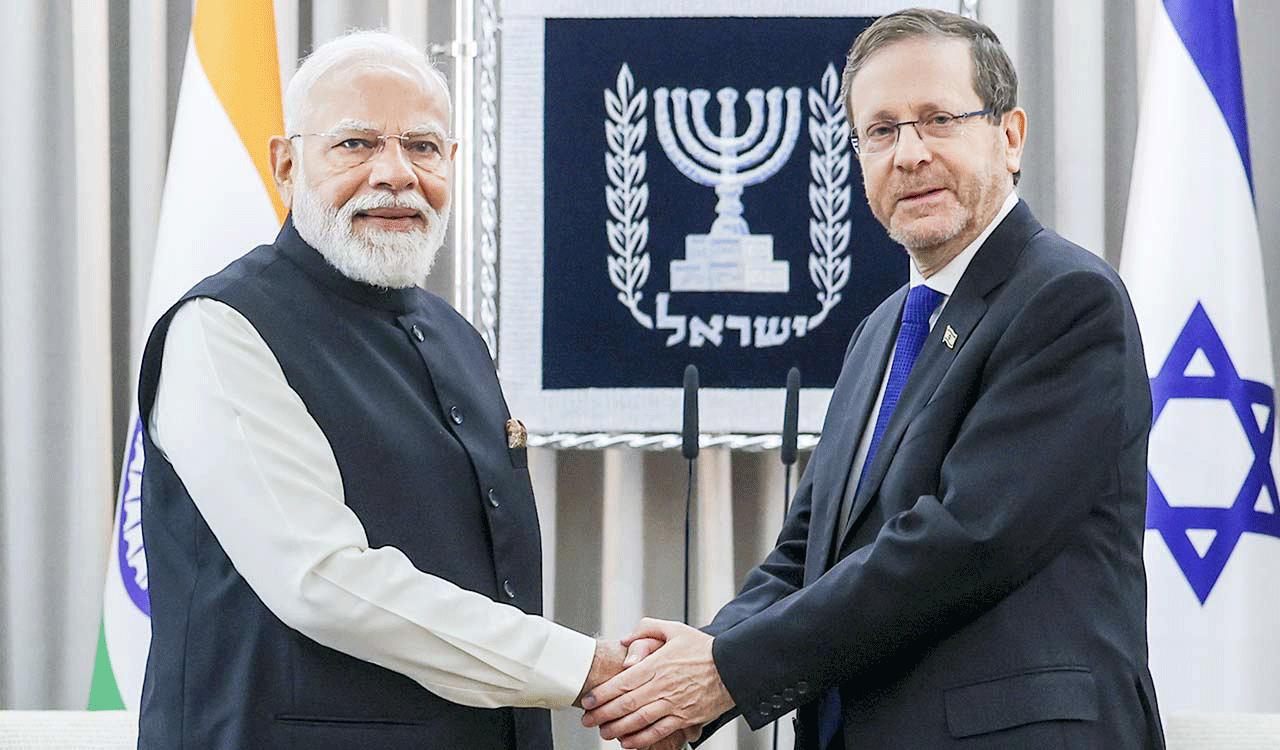
Prime Minister Narendra Modi’s visit to Israel marked his third engagement with the Jewish state — and each visit tells the story of a changing India, a changing Israel, and a dramatically changing West Asia.
His first visit, on May 21, 2006, was as the Chief Minister of Gujarat. It was a quiet, focused trip to study agriculture and water management. The lessons drawn from Israeli innovation — drip irrigation, arid-zone farming, and efficient water recycling — found practical application in Gujarat’s agricultural transformation. His second visit, in July 2017, was historic: the first ever by an Indian Prime Minister. That visit elevated bilateral ties to a strategic dimension and, importantly, de-hyphenated India’s relations with Israel from those with Palestine.
Now, the third visit, which came amid geopolitical turbulence, carried far higher stakes.
Rooted in Shared Realities
India and Israel are societies shaped by difficult neighbourhoods and persistent security challenges. Beyond strategic calculus, there is genuine warmth at the people-to-people level.
During my tenure commanding 15 Punjab in Lebanon, I recall entering Jerusalem to visit the Western Wall. Strangers rushed forward saying, “You are from India — welcome, come to our home.” That spontaneous goodwill captures the street-level affinity between Indians and Israelis.
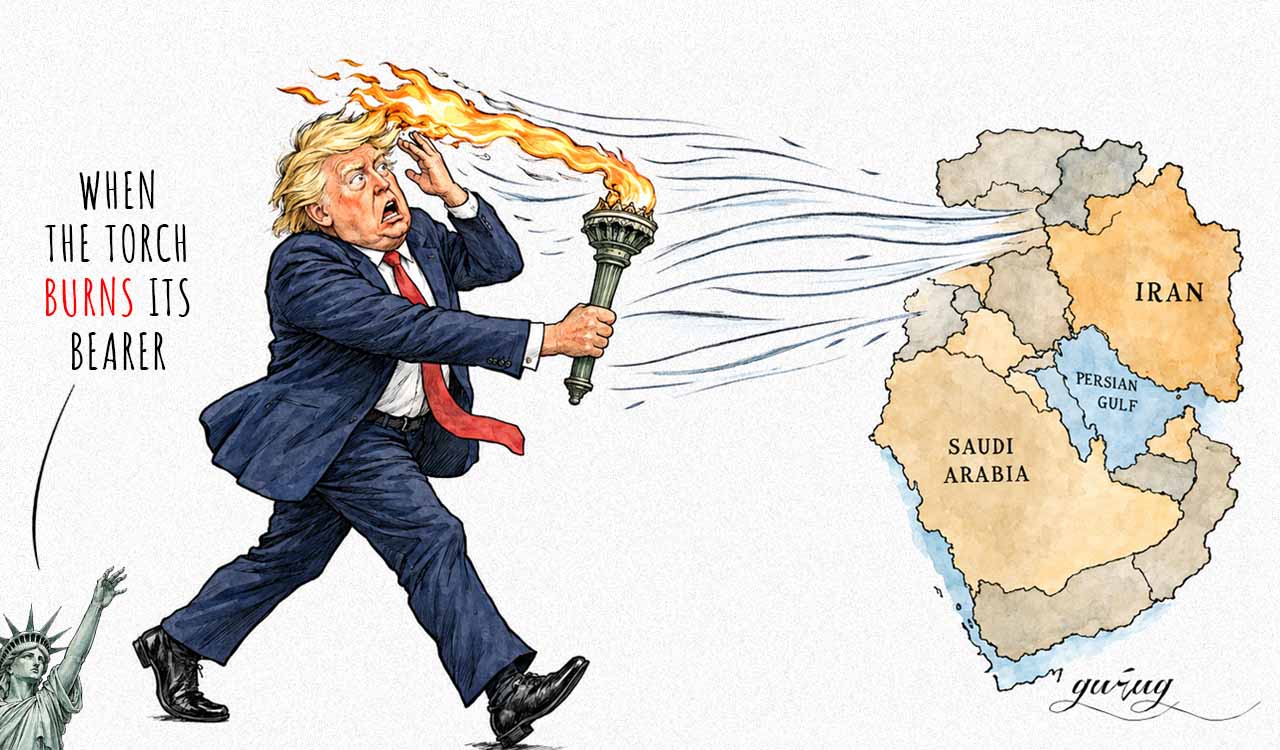
The context of this visit differs profoundly from 2017. Since the June 25 strikes on Iran’s nuclear infrastructure and the degradation of Iran’s “axis of resistance” — including Hamas, Hezbollah and the Houthis — the regional balance has shifted. Iran stands on the brink of confrontation with the United States, even as negotiations continue. We must remember that the June 25 attack took place while talks were ongoing; diplomacy and conflict in this region often move on parallel tracks.
Gaza remains under a fragile ceasefire. Regional fault lines are sharp. West Asia is not in equilibrium; it is in a state of flux.
Road to Open Diplomacy
India recognised Israel in 1948 but hesitated to establish full diplomatic relations. An Israeli diplomat once quipped that India treated Israel “like a mistress — private engagement, public distance.” In the 1950s, Israel opened a consulate in Bombay. Full diplomatic relations were established on January 29, 1992 — ten days after Yasser Arafat’s visit to India. Then Prime Minister PV Narasimha Rao persuaded Arafat that an Indian ambassador in Israel would strengthen, not weaken, the Palestinian cause. Arafat publicly endorsed the move.
Yet even before formal ties, strategic cooperation existed. During the 1962 war with China, India used Israeli weapons. In 1977, Israeli Foreign Minister Moshe Dayan visited India quietly. During the Kargil conflict in 1999, Israel supplied precision munitions from emergency stocks to target bunkers on the heights.
The relationship gathered momentum under Prime Minister Atal Bihari Vajpayee, culminating in Israeli Prime Minister Ariel Sharon’s landmark visit to India in 2003. However, between 2004 and 2014, political caution limited overt defence engagement.
Since 2014, ties have become more visible and institutionalised. Modi’s 2017 standalone visit — without a stop in Ramallah — marked a decisive policy shift. Israeli Prime Minister Benjamin Netanyahu reciprocated with a visit to India in January 2018. Cooperation has since expanded into defence, artificial intelligence, cyber warfare, agriculture and innovation.
Defence at the Core
Defence cooperation remains the anchor. Between 2020 and 2024, roughly 34% of Israel’s total arms exports came to India. Platforms include unmanned aerial vehicles such as Heron and Searcher drones; loitering munitions like Harop; air and missile defence systems including the jointly developed Barak-8; anti-tank guided missiles such as Spike; SPICE precision bombs; Rampage air-launched missiles; and Phalcon AWACS radar systems.
Joint research now extends to anti-drone systems, ballistic missile defence, and potential co-production of Iron Beam — a 100-kilowatt laser interception system. The metaphor of “Sudarshan Chakra” for layered missile defence captures India’s ambition for a protective shield.
Recent conflicts, including Operation Sindoor, underline how warfare has transformed.
Engagements occur from distances of 300 kilometres or more. Precision-guided munitions, loitering ammunition and ballistic missile defence dominate the battlefield. Borders are not crossed; wars are fought remotely. This makes technological partnerships indispensable.
Beyond Security
Bilateral trade stands at approximately $4 billion. India exports about $2 billion worth of goods — primarily cut and polished diamonds, engineering products, petroleum derivatives, pharmaceuticals, chemicals, electronics and agricultural products. Imports of a similar value include precious stones, fertilizers, electrical machinery, defence equipment and high-tech components.
India must avoid rigid alliances that risk regional entanglements, keeping strategic autonomy at the core of its West Asia policy
Cooperation spans water management, solar energy, irrigation, clean drinking water, agri-technology, quantum computing and advanced electronics. Israel is also a key partner in the India-Middle East-Europe Economic Corridor (IMEC), announced during the 2023 G-20 Summit in New Delhi. IMEC envisions rail, port, shipping, energy and digital connectivity linking India to Europe through the Gulf — involving Saudi Arabia, the UAE, Israel, the European Union and the United States.
Emerging Alignments
The regional canvas has shifted further with the Abraham Accords, under which Israel normalised relations with several Arab states. India recently attended a related peace meeting as an observer. Meanwhile, Israel is exploring a “hexagon” of partnerships linking itself with Greece, Cyprus, Arab and African states — and potentially India — partly to counter emerging Sunni and Shia axes.
Parallel alignments are visible. Saudi Arabia, Turkey and Qatar are deepening coordination, reportedly seeking to draw Pakistan into a collective security framework. The geopolitical chessboard is crowded. There is also the I2U2 grouping — India, Israel, UAE and the US — focused on economic and strategic collaboration. Trilateral cooperation among India, Israel and the UAE may gain traction, especially amid shifting Gulf dynamics.
Herein lies the strategic challenge. India’s core interests in the Arab world — energy security, oil supplies and the welfare of a vast Indian diaspora — cannot be compromised. Saudi Arabia and the UAE are vital partners. India recently signed a statement at the United Nations criticising Israeli settlement expansion in the West Bank. On January 30, New Delhi hosted the second India-Arab Foreign Ministers’ meeting. This is calibrated diplomacy.
India must avoid any formal alliance architecture that entangles it in regional rivalries. Strategic autonomy remains our compass. Both Russia and China maintain productive ties with Israel and Arab states alike; India can do no less.
Realism, Not Rhetoric
Prime Minister Modi was received personally by Prime Minister Netanyahu at Tel Aviv airport and driven to Jerusalem — symbolism that resonates deeply in Israeli political culture. His address to the Knesset — a privilege rarely extended — will carry weight. Yet Israel’s domestic politics are fluid, with elections due in October 2026. The visit may be projected internally as a diplomatic achievement.
What is most significant is that India’s relations with Israel no longer adversely affect its ties with Arab states. New Delhi’s engagement with Riyadh and Abu Dhabi is deepening; differences persist mainly with Turkey. India’s foreign policy has become more interest-driven and less constrained by domestic political considerations.
This visit signals maturity. India is engaging West Asia as it is — fractured, competitive, opportunity-laden — not as it once was. The art lies in balancing principle with pragmatism, security with diplomacy, and ambition with restraint. In Jerusalem today, the message is clear: India seeks partnership, not alignment; cooperation, not confrontation; and stability, not sides.
(The author is a retired Army officer)

Related News