Opinion: Securing future of Gulf migrants
One estimate says that meeting the Paris Agreement targets could reduce the price of oil to $10 a barrel by 2050


By Ablaz Mohammed Schemnad
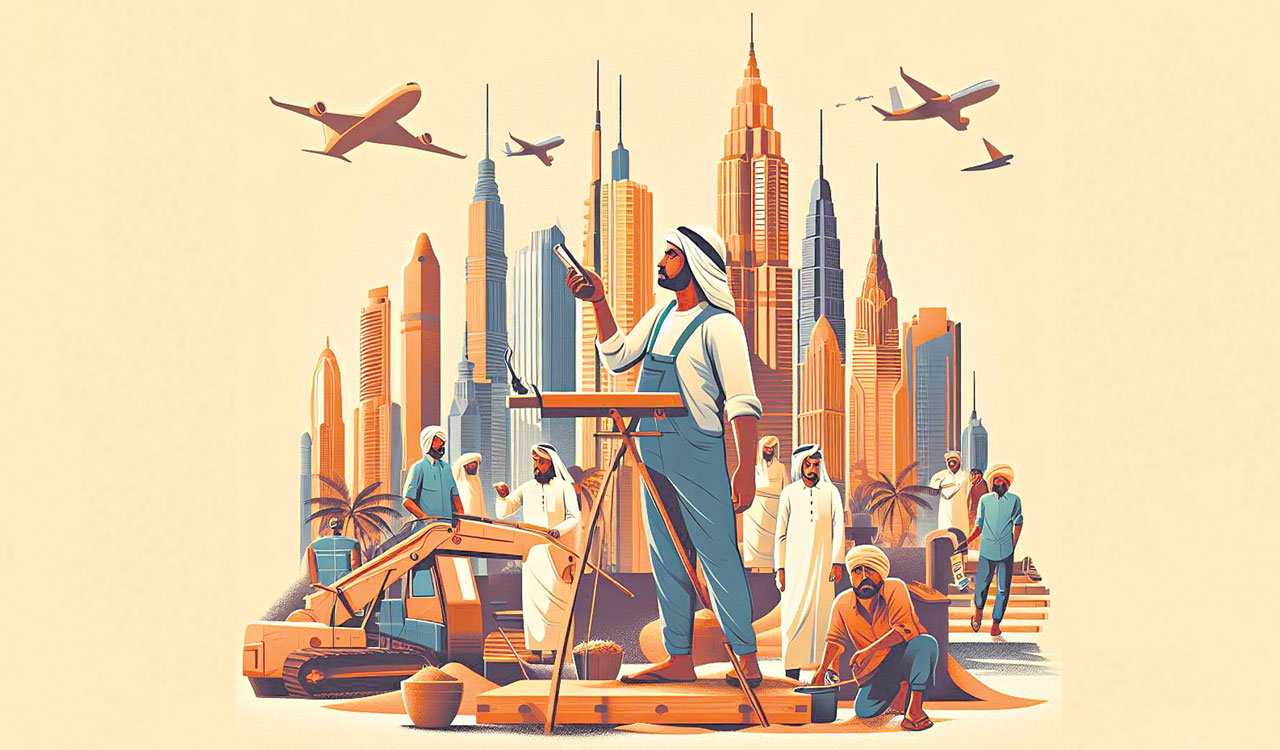
Gulf states or the Middle East region has the largest migrant-to-population ratio in the world. They form the backbone of the Gulf economies. According to estimates by the Gulf Labor Markets and Migration programme, dependence on migrants — especially in the private sector — is extremely high: in 2020, Qatar was estimated to rely on non-nationals for 95% of all employment, Kuwait for 85% and Bahrain for 78% (the GCC average is 70.4%).
The last four decades have seen a massive increase in the number of migrants in search of labour flowing to oil-rich countries, both from Arab and non-Arab countries. Between 2005 and 2015, the number of such immigrants coming in search of labour to the Gulf from non-Arab countries increased by 50%. There are 35 million foreign workers in the Gulf region. There have been many discussions regarding the torture and exploitation of foreign employees in the Gulf labour market, especially of those in low-skilled or unskilled areas like construction and domestic jobs.
Oil Boom
The oil revenue boom in the 70s is the major reason behind the gradual increase in the number of foreign workers. The unanimous decision of the oil-rich Gulf countries to raise the price of oil opened up much investment in the economies. Eventually, there was a demand for labour force participation, which could not be supplied by the inhabitants of the Gulf countries. Due to this, a huge inflow of migrant workers from South Asia and North Africa hit the Gulf labour market, mainly for low-skilled or unskilled jobs. “The stock of migrants went from 8,00,000 to 1.8 million between 1970 and 1975”. By the 1980s, the Middle East became the largest market for migrant labour the world had ever known with more than seven million migrants, of which five million were workers (Thiollet, 2011).
Human Rights Issues
However due to the disproportionate involvement of the institutions of the state, norms and rules, problems started arising in the living and working conditions, social security and rights of foreign workers. The migrant workers, quite often, are victims of human rights violations and torture from their employers.
The row over massive forced labour for the construction of stadiums for the 2022 FIFA World Cup in Qatar is a recent example of it. The UN General Assembly in 1990 approved the International Convention on the Protection of the Rights of All Migrant Workers and Members of their Families (ICMW), an important human rights convention. The harsh reality is that none of the Gulf countries have signed the ICMW document and neither did many of the rich countries, including EU nations, which host a decent number of migrant workers (Aslan, 2022).
Kafala System
To this injustice and recipe of intolerance towards migrant labourers adds the Kafala system, which is a sponsorship system of legal framework defining the relationship between employers and their migrant employees in all Arab Gulf countries. This sponsorship system grants little rights to workers from abroad. Under this system, it is an obligation for a foreign worker to have a sponsor first, who can either be the company or the businessman who hired him/her.
The sponsor further decides if the worker can shift between jobs, and firms and when to leave the country. The employer confiscates the travel document of the employee and puts him/her under their control. Violation of the regulations would end up in a two-year ban for the foreign worker. Through this, institutional denial of freedom for foreign labourers, unionisation and participation in strikes are also kept under control (Zahra, 2014). Furthermore, it restricts and prevents the free mobility of foreign workers in the job market (Akzahrani, 2014).
Anti-Refugees policy
Even if the rich Gulf countries have acted as a haven for foreign jobseekers, they don’t really appreciate letting in refugees, even from the neighbouring tension-filled and war-torn nations. According to the United Nations High Commissioner for Refugees (UNHCR), there were less than 2,000 registered refugees in the GCC in 2015. None of the GCC countries have signed the 1951 Refugee Convention. The irony is that a major chunk of the migrant labourers in the Gulf are from these war-torn countries (Valenta & Jakobsen, 2017).
There have been deliberations to solve the issue through conventions and agreements. The Kuwait Declaration as a part of the 3rd Ministerial meeting of the Abu Dhabi Dialogue by the International Labour Organization and the bilateral agreements with certain countries are some hope-giving moves at the diplomatic channels (ILO, 2016).
The GCC countries have initiated to adopt policies to promote the share of the indigenous population in the labour market, thus, reducing the dependency on foreign labour. This is besides the restrictive measures in immigration which are already in place. These include a more severe regulation on entry visas, increasing the cost of hiring foreign workers and the imposition of quotas for foreign and local workers employed in firms (Nitaqat Policy or Saudization in Saudi Arabia) and taxing remittances etc. (Shah, 2008). However, these policies faced the challenge of the local labour force leaning towards public sector jobs and their complete aversion towards domestic and manual jobs in the private sector (Abbas, 1996). The outputs weren’t satisfying. The private sector struggled to employ the local population due to their higher salary demand and relatively low marginal productivity, as well as a form of ‘work apartheid’ towards certain jobs by the local population (Essomba, 2017).
Oils not Well
With the decline in oil revenues, it has been difficult for the Gulf states to maintain their over-dependency on natural resources and hence, the need to diversify. In the coming years, with countries shifting to renewable energy sources, oil prices could fall drastically. One estimate says that meeting the Paris Agreement targets could reduce the price of oil to $10 a barrel by 2050. Oil wells in Bahrain and Oman could go empty in the next 25 years (Huckstep & Dempster, 2022). Gulf countries have started to invest in renewable energy sources and further diversify the economy into different sectors, thereby promoting tourism as well. For instance, Qatar has been focusing on sports for the past few years and has been hosting prominent competitions including the FIFA World Cup.
From my research, there can be three ways forward for sustainable economic progress in the coming years. First, diversify the economy across varying sectors to avoid a stagnant economy in the future. Second, countries can provide training for migrant workers to ensure a smooth transition to newer sectors and invest further in those sectors. Third, the Kafala system should be regulated to put an end to the violation and abuse of human rights. We can hope for a more forward-thinking society in the coming years.

Related News