Opinion: Teach students the Right to Disagree
This Teachers’ Day, law schools should celebrate not only the teachers who taught students the Constitution, but also the students courageous enough to ask whether their institutions are living by it


By Shashank Shekhar
Every September 5, India celebrates its teachers. In law schools, however, Teachers’ Day should mean something more than ceremonies, photographs and words of gratitude. A law teacher does not merely teach statutes, precedents and constitutional provisions. At their best, teachers teach students to question authority: whether power has been exercised lawfully, whether a decision is arbitrary, whether a right has been violated, and whether the exercise of public power is accountable.
Also Read
But this Teachers’ Day comes at a moment when Indian law schools must confront an uncomfortable question: what happens when law students actually do what their teachers taught them?
The controversies involving NALSAR, the Bar Council of India, the Chief Justice of India and subsequently the National Law School of India University have turned this question into a matter of significance for the entire law-student community.
These controversies were not merely about a convocation, an invitation or the presence of a constitutional authority. They raised a much larger question: whether a law school can genuinely teach constitutionalism if students are expected to remain silent when they disagree with institutional decisions or powerful authorities.
When Students Said: We Disagree
At NALSAR, a controversy emerged around the proposed presence of Chief Justice of India Surya Kant at the university’s convocation. Students expressed their opposition. What followed transformed a campus disagreement into a much larger institutional and constitutional controversy. The Bar Council of India initially directed State Bar Councils not to enrol the 2026 graduating batch of NALSAR as advocates. The direction was subsequently withdrawn amid criticism, and the Supreme Court intervened. The CJI-led Bench also recognised the right of students to protest peacefully.
The episode produced an extraordinary irony. The students were law students. The institution was a law university. The dispute involved the Chief Justice of India. And the response ultimately required the Supreme Court to confront a basic question about the freedom of students to dissent. The important question was whether disagreement with authority could itself become a basis for professional or institutional consequences.
For law students across India, that question matters enormously. A student may spend years studying Article 19, judicial review, natural justice, constitutional morality and limits on State power. But if the practical lesson is that those principles become dangerous when applied to one’s own institution or to a powerful authority, legal education risks becoming an exercise in memorising constitutional ideals rather than experiencing them.
The BCI Question
The Bar Council of India has an important statutory responsibility to regulate the legal profession and maintain professional standards. But regulatory authority, like every other public power, must operate within the limits of law. The suggestion that disagreement by law students could affect their professional entry into the Bar raises concerns that extend beyond NALSAR.
A law student’s criticism of a constitutional authority, without more, should not automatically become a question of professional fitness. Otherwise, an unsettling message reaches every law student: you are free to study the Constitution, free to debate it in the classroom, and free to write about it in examinations, but be careful when you actually exercise the freedoms it protects. That cannot be the lesson that a democratic legal education should impart.
If India’s law schools are serious about producing lawyers who will defend dissent tomorrow, they must be willing to tolerate dissent from their students today
The story did not end at NALSAR. Students and alumni of NLSIU subsequently expressed opposition to the proposed presence of the CJI and BCI chairman at their convocation and expressed solidarity with the students of NALSAR. The development was significant because it demonstrated that the controversy was no longer confined to a single campus. A question that began at one law school had begun to resonate across the law school community.
NLSIU subsequently cancelled its 2026 convocation, with degrees and medals to be distributed separately. But the cancellation should not end the conversation. It should begin one.
Real Meaning
This is where Teachers’ Day becomes more than an occasion for ceremonial gratitude. A constitutional law teacher teaches Article 19. A jurisprudence teacher teaches students to question authority. Administrative law teaches them to recognise arbitrariness and understand the limits of administrative power. Criminal law teaches them to examine the relationship between liberty and state coercion. Professional ethics teaches professional responsibility.
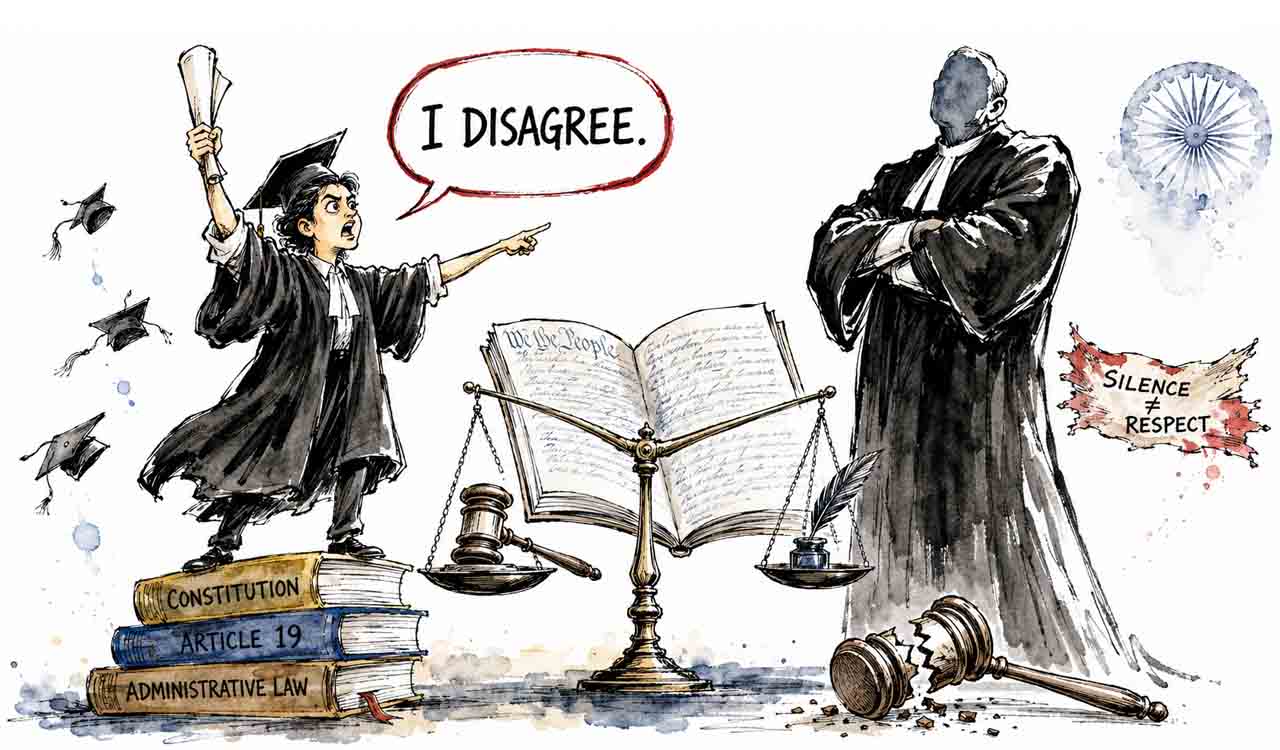
But these lessons cannot remain confined to classrooms and examinations. Their real test comes when a student says, “I disagree.”
A student who questions a government decision is not necessarily anti-national. A student who challenges a university decision is not necessarily undisciplined. A student who participates in a peaceful protest is not necessarily creating disorder. And a student who disagrees with a judge is not necessarily disrespecting the judiciary.
The purpose of legal education cannot be to produce students who are comfortable only when authority is unquestioned. It must produce graduates capable of engaging with authority through reason, law and constitutional principle.
CJI’s Difficult Position
The controversy also placed the CJI in an unusual institutional position. Students were protesting against a decision concerning his proposed participation, while the Supreme Court was subsequently called upon to consider consequences faced by those students. That made the episode particularly delicate.
Yet the larger constitutional principle remains important: the authority of constitutional institutions is not weakened simply because citizens question them. The judiciary does not become less respected because students disagree with a judge. In a constitutional democracy, legitimacy should not depend upon silence.
The CJI does not need students to agree with him. The judiciary does not need universities to be silent. And law schools should not need students to be obedient.
What Should Teachers Teach?
This Teachers’ Day, perhaps the question should be reversed. Instead of asking only what teachers give students, we should ask what teachers hope their students will eventually become.
Do we want lawyers who merely follow authority, or lawyers who can respectfully ask whether authority is acting within the law? Do we want advocates who hesitate to challenge a powerful institution, or advocates who can stand in court and say, “With respect, I disagree”? Do we want constitutional citizens who memorise fundamental rights, or citizens who understand that those rights are meant to be exercised? The answer should be obvious.
A law school that teaches dissent as a constitutional value cannot be surprised when its students dissent. The NALSAR and NLSIU episodes should therefore not be reduced to a contest between students and institutions, or between students and the CJI. They should become a moment of introspection for the entire Indian legal education system. Tomorrow’s judges, advocates, legislators, academics and constitutional lawyers are today’s students. If we want them to question arbitrary power tomorrow, we must allow them to question authority today.
Teachers’ Day lesson
Perhaps the greatest tribute a student can give a teacher is not obedience. It is the courage to think independently. A teacher’s success cannot be measured only by how many students agree with them. In a law school, it must also be measured by whether students acquire the confidence to disagree—with their professors, administrators, regulators, governments and, where necessary, institutions of constitutional authority.
This Teachers’ Day, therefore, law schools should celebrate not only the teachers who taught students the Constitution, but also the students courageous enough to ask whether their institutions are living by it. And if India’s law schools are serious about producing lawyers who will defend dissent tomorrow, they must be willing to tolerate dissent from their students today.

(The author is Assistant Professor of Law, Lloyd Law College, Greater Noida, and an alumnus of NLU Delhi and Jamia Millia Islamia, New Delhi)

Related News