Singareni Controversy Explainer: How Naini tender row unfolded
The cancellation of tenders for the Naini coal block in Odisha has thrown Singareni Collieries Company Limited (SCCL) into turmoil. Conceived as a crucial project to secure coal for Telangana’s power sector, Naini faced years of delays due to forest clearances before limited mining began in 2025.


Hyderabad: The cancellation of high-value tenders at the Naini coal block, amid allegations of procedural rigging, has plunged Singareni Collieries Company Limited (SCCL) into one of the most serious controversies in its history.
What began as an effort to secure coal for Singareni’s power ambitions outside Telangana has snowballed into a fierce political battle, marked by charges of favouritism, interference and corruption by the Congress government, and growing demands for a CBI probe.
Here is how the Naini project evolved, why outsourcing became unavoidable, how the tender process derailed, and where matters stand now.
Why Naini Mattered
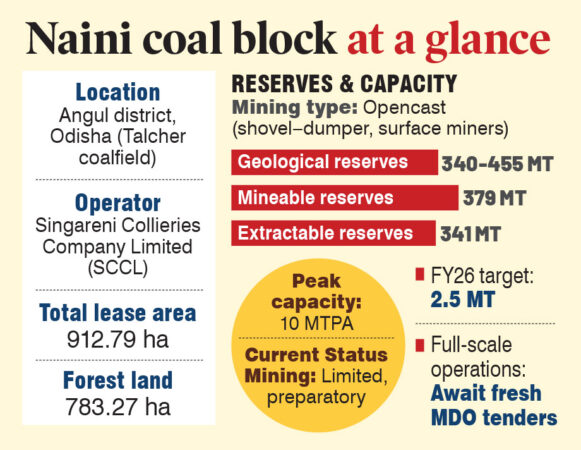
The Naini coal block, located in Angul district of Odisha’s Talcher coalfield, was conceived as a transformational project for SCCL. It is the miner’s first captive coal block outside Telangana, meant to ensure long-term fuel security for the 2×600 MW Singareni Thermal Power Plant (STPP) at Pegadapalli.
Geologically, Naini is a rich opencast deposit of high-grade thermal coal. With a peak rated capacity of 10 million tonnes per annum (MTPA), it was expected to reduce SCCL’s dependence on bridge linkages and market purchases while anchoring its expansion beyond Telangana.
The block covers 912.79 hectares, of which about 783 hectares is forest land. Geological reserves are estimated at 440-455 million tonnes, with mineable reserves of 379 million tonnes and extractable reserves of about 341 million tonnes.
Allocation and Early Stages
The Union Ministry of Coal allocated the Naini block to SCCL on August 13, 2015, following sustained efforts by the then BRS government to secure captive coal resources for Telangana’s power sector.
By early 2016, SCCL had recognised that the project’s scale would stretch its internal capacity. An Expression of Interest (EOI) issued in January 2016 signalled that large parts of the operation would eventually have to be outsourced.
Delayed Clearances
Despite allocation in 2015, Naini remained stalled for years, largely because over 85% of the lease area is forest land.
Clearances came slowly, with Stage-I forest clearance and environmental clearance in 2021, followed by Stage-II (conditional) forest clearance in March 2023.
The decisive breakthrough came only in July 2024, when the handover of 643 hectares of forest land was approved, followed by consent from the Odisha government. With mining plans, groundwater clearance and pollution control approvals also in place, the project finally became operationally viable.
Mining with Limited Production
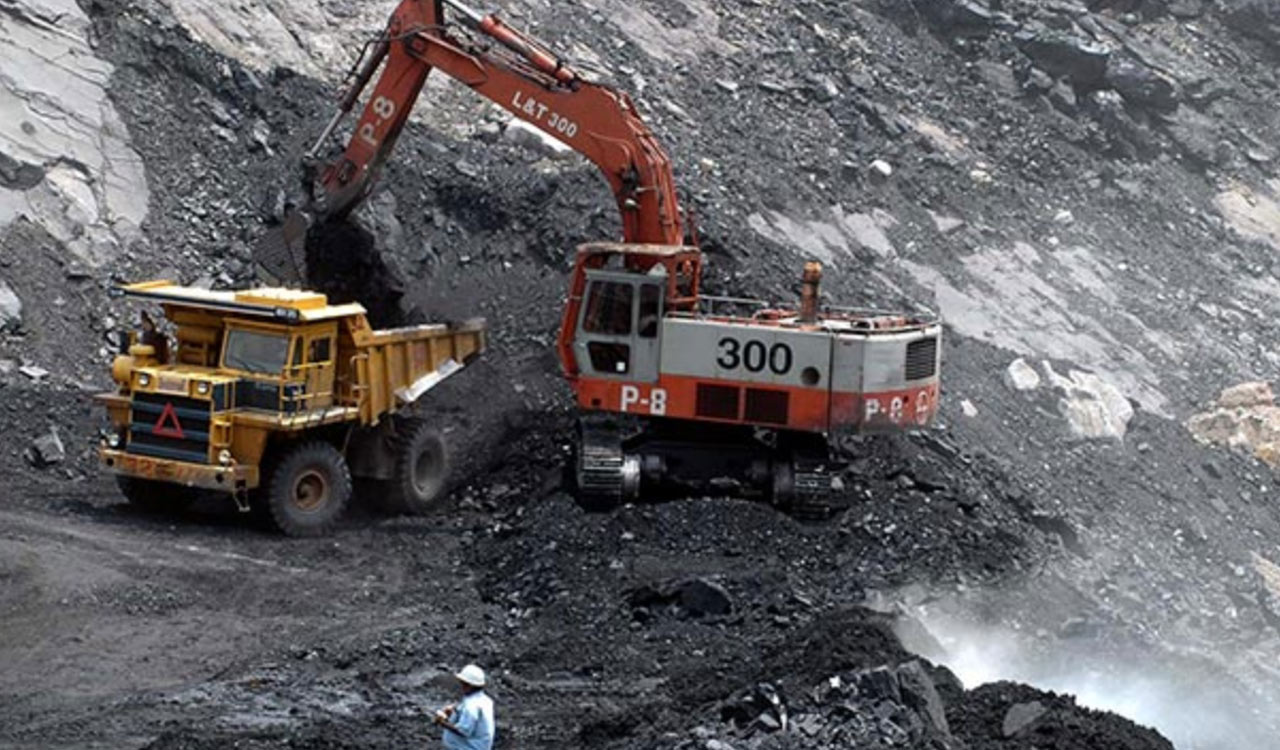
SCCL formally commenced mining at Naini on April 16, 2025, but operations were limited and preparatory, not full-scale. Initial activity focused on overburden removal and basic excavation using SCCL’s own machinery. For FY 2025-26, production was projected at 2.5 MTPA, far below the mine’s peak capacity. Coal dispatch was expected to begin from July 2025, with the STPP continuing to rely on bridge linkages from Telangana mines during the ramp-up phase.
Outsourcing Inevitable
From the outset, SCCL acknowledged that Naini could not be developed at scale through in-house resources alone. The reasons were structural: a vast lease area, deep excavation zones and a high stripping ratio.
This led SCCL to opt for the Mine Developer and Operator (MDO) model, under which a private operator would handle excavation, drilling, blasting, coal handling and reclamation. The long-term contract was estimated at Rs.1,604 crore over 25 years, and outsourcing was central to scaling production from 2.5 MTPA to the planned 10 MTPA, according to officials.
Tenders trigger storm
In late 2025, SCCL floated tenders to appoint MDOs for the Naini block. That is where the controversy took root. Several prospective bidders objected to a mandatory pre-bid site visit and certification clause. Companies argued that certification by authorities was unusual and discouraged wider participation. Complaints also emerged about poor response to the tenders and claims that projected rates were higher than industry norms, where coal contracts typically attract bids below estimated cost.
Political interference
By December 2025, the tender issue had escalated into a political storm. Allegations surfaced that relatives of senior Congress leaders were angling for advantage, with reports of a business war between factions within the State Cabinet, each allegedly backing different companies.
The controversy took a darker turn when vernacular news channels aired reports targeting senior ministers. Competing accusations followed, with rival media houses and political factions accusing each other of running smear campaigns to settle scores over the contracts. The arrest of journalists further inflamed tensions.
Cancellation and damage control
Facing mounting pressure, Deputy Chief Minister Mallu Bhatti Vikramarka directed SCCL to cancel the Naini tenders, even though no bids had been finalised. He denied corruption charges, defended the site visit clause as a technical and safety requirement, and ordered fresh tenders strictly in line with central PSU norms, calling the cancellation a “benefit of doubt” measure to protect institutional credibility.
Opposition push and Central scrutiny
The opposition BRS, led on this issue by former Minister T Harish Rao, said the Congress government was manipulating tender conditions. Rao alleged that multiple tenders carried the controversial clause and claimed that Chief Minister A Revanth Reddy’s brother-in-law was among the beneficiaries. He demanded a CBI probe or a judicial inquiry and wrote to Union Coal Minister G Kishan Reddy.
The Centre soon stepped in. Between January 19 and 21, 2026, the Union Coal Ministry sought details from SCCL, citing procedural lapses. Kishan Reddy expressed concern over the setbacks at Naini, but stated that the Centre was open to a CBI probe if the State consented. The review is ongoing.
Where Things Stand
Operationally, Naini remains in limbo. Mining continues only at a preparatory level, while full-scale development awaits fresh MDO tenders, and SCCL’s expansion plans hinge on restoring confidence in the procurement process.
For now, Naini stands as a project caught between promise and paralysis with its coal underground, and its future tied to how convincingly transparency is restored.

Related News
-

Godavari-Cauvery link a death warrant for Telangana’s water rights: Harish Rao
-
KTR accuses Congress of creating drought despite Telangana’s irrigation infrastructure
-
Harish Rao demands Rythu Bheema benefits for families of deceased farmers
-
Harish Rao blames Congress for drought, questions GO 17 over farm power