Opinion: Coastal States and cost of cyclones
By Prakash Kumar Sahoo & Yashobanta Parida India’s geo-climatic and socioeconomic factors are contributing to an increase in the frequency and damage from cyclones. Among the natural disasters, cyclones constituted the second most frequent phenomena accounting for 15% of India’s total natural disasters over 1999-2020. Around 12,388 persons were killed and the total damage stood […]


By Prakash Kumar Sahoo & Yashobanta Parida
India’s geo-climatic and socioeconomic factors are contributing to an increase in the frequency and damage from cyclones. Among the natural disasters, cyclones constituted the second most frequent phenomena accounting for 15% of India’s total natural disasters over 1999-2020. Around 12,388 persons were killed and the total damage stood at $32,615 million in the same period. In addition, it is the third most lethal disaster after earthquakes and floods. According to the Global Climate Risk Index Report 2021, India was the 7th worst disaster-affected nation in the world in 2019 due to extreme weather-related events.
According to the National Disaster Management Authority, around 5,700 km of India’s 7,517 km coastline is prone to cyclones and tsunamis. Nearly 66 coastal districts and 14.2% of the population in 13 coastal States/Union Territories are regularly exposed to the fury of cyclones. Only 7% of the world’s cyclones originate in the Bay of Bengal and the Arabian Sea. However, they have a major impact on coastal districts and several mega-cities in India.
Increasing Damage
Typically, the tropical cyclones that have damaged the east and west coast are post-monsoon (October-December). Nevertheless, in recent years, coastal States have been facing pre-monsoon cyclones (April-June). Odisha witnessed a pre-monsoon cyclone for the third year in a row, after Amphan and Fani. This is only due to the warmer waters of the Bay of Bengal, which is typically more prone to cyclones than the cooler Arabian Sea.
Climate change, increase in oceanic surface temperature and unique geo-climatic conditions are the main causes of creating tropical cyclones in the Bay of Bengal, making itself the world’s worst tropical cyclones hotbed. Severe cyclonic storms like Phailin in 2013, Hudhud in 2014, Titli in 2018, Fani in 2019, Amphan in 2020 and Yaas in 2021 have led to devastation of public property and human casualty. However, the super cyclone which Odisha faced on 29th October 1999 broke all the records of hundred years, resulting in the death of over 10,000 people.
The extremely severe cyclonic storm Tauktae, which battered the coast of Gujarat, along with the west coast in 2021, is the fifth strongest cyclone ever in recorded history in the Arabian Sea. It left a trail of devastation in Gujarat and Maharashtra and took at least 91 lives, damaging thousands of houses, boats, and state infrastructure in Kerala, Karnataka, and Goa. Cyclone Nisarga, which was classified as severe, made landfall slightly away from Mumbai in 2020.
Frequent cyclones account for many deaths, loss of livelihood, public and private property. Cyclones also lead to an abnormal rise in sea level, especially near the coastal areas. Heavy torrential rain, along with cyclonic storms, leads to physical destruction, saline inundation of low-lying areas, destruction of vegetation, erodes beaches and embankments, and causes flash flood-like situations.
In the absence of long-term mitigation measures, cyclones inflicted substantial damage to public and private properties, increasing from $2,990 million in 1999 to $14,920 million in 2020. As a result, the direct government expenditure on natural calamity increased 13 times. India lost around 2% of GDP and 15% of total revenue over 1999-2020.
Act on Protection
To deal with these issues, the government of India came up with the Coastal Regulation Zone (CRZ) in 1991 under the Environment (Protection) Act, 1986, with the mandate to take measures to protect and conserve our coastal environment. Several amendments were made to the CRZ-1991 in 2011 to conserve and protect coastal stretches, ensure livelihood security to the fishing and local communities living in the coastal areas, and sustainably promote development considering the natural hazards and risks. In 2019, the CRZ was updated to develop and manage the coastal regions on scientific principles, taking into account the current global challenge of climate change and the rise in sea level.
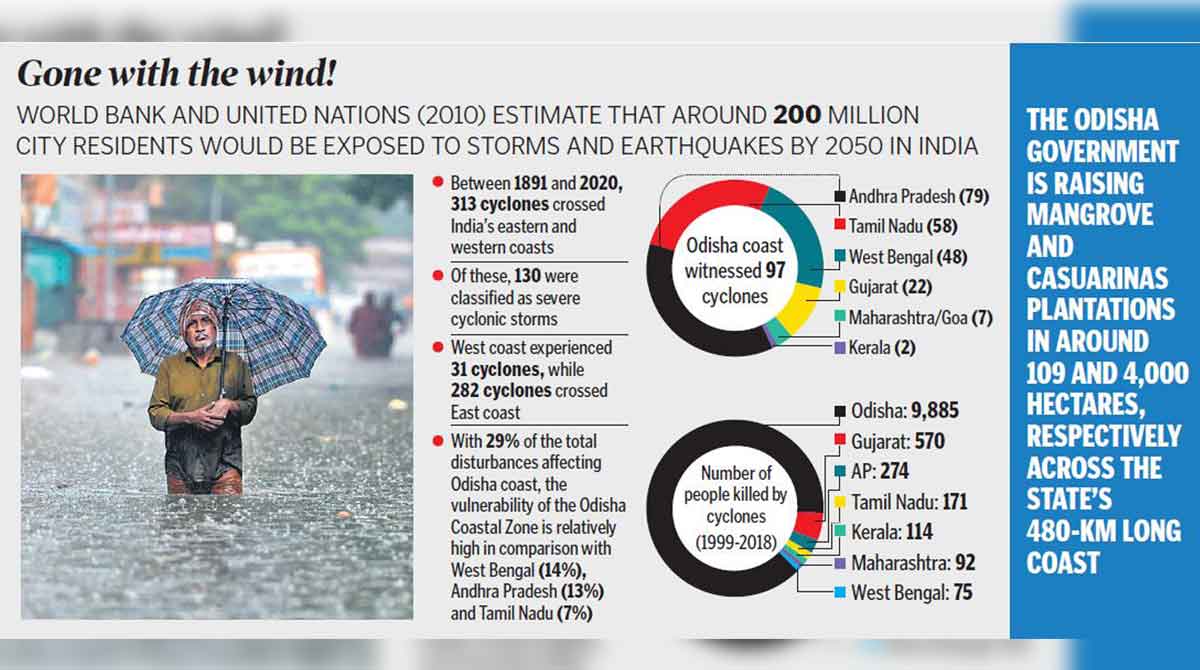
In the aftermath of the 1999 super cyclone, the Odisha government has undertaken various measures to mitigate the impact. For example, installing a disaster warning system in coastal districts, construction of multipurpose cyclone shelters, setting up the Odisha State Disaster Management Authority and Odisha Disaster Rapid Action Force. The Odisha government has proposed raising mangrove and casuarinas plantation in around 109 and 4,000 hectares of land, respectively, in the State’s 480-km long coastal belt under the Integrated Coastal Zone Management Project Phase-II. The coastal belt plantation aims to erect a strong, natural barrier against the strong winds during cyclones.
Other coastal State governments should devise long-term measures and build cyclone-resilient infrastructure such as constructing and monitoring the storm surge resilient embankments, constructing canals and improving river connectivity to prevent waterlogging in low-lying areas.
Moreover, a more scientific management approach by installing disaster-resilient power infrastructure in coastal districts, providing pucca houses to beneficiary households, increasing mangroves plantation and creating a massive community awareness campaign would minimise the cyclone impact. In the face of frequent cyclones in coastal States, governments must pursue a coordinated approach, and it is essential to put in place a comprehensive disaster management plan and build cyclone-resilient infrastructure.
Now you can get handpicked stories from Telangana Today on Telegram everyday. Click the link to subscribe.
Click to follow Telangana Today Facebook page and Twitter .

Related News